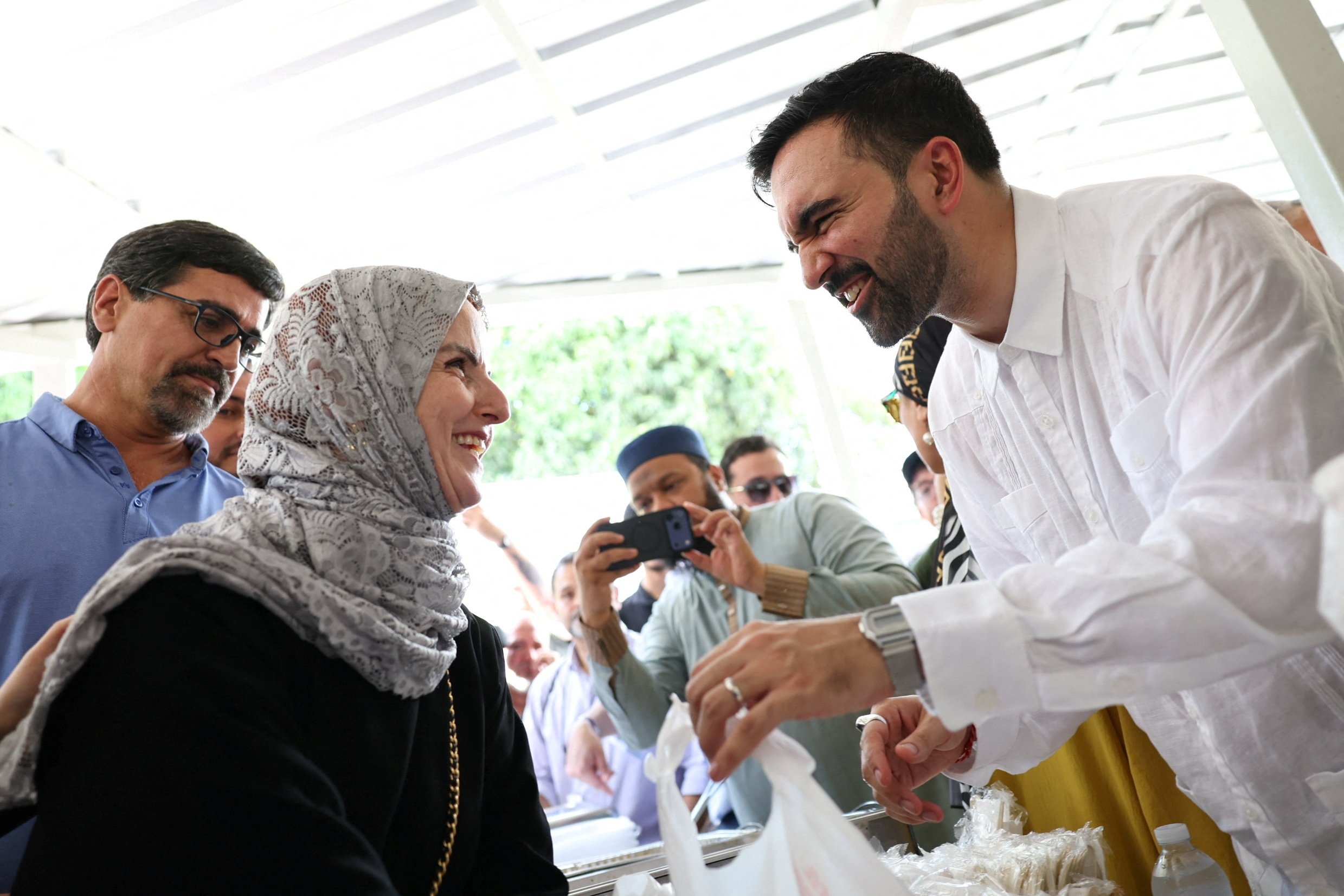
New York City, in unprecedented times, elected Zohran Mamdani, a 34-year-old state lawmaker from Queens, as the 111th mayor of New York. He will be the first Muslim to lead the city, as well as its first South Asian mayor and the youngest mayor in more than a century.
Voters elected Democratic Socialist Mamdani in a mayoral race that has drawn worldwide attention, due not only to New York City’s global significance but also to its role in inspiring ordinary people to witness the real passion of politics, which disappointed many voters in the U.S before.
These elections reflect an awakening among Americans after a period of political inertia over the last nine months. Mamdani mobilized thousands in the city of 8 million, prompting many to wonder why. His story is featured in every major national newspaper and on global news networks. Main Street sees him as the leader they have long dreamed of having.
The global political excitement surrounding Mamdani is partly due to the compelling message he brings, focused on affordability and equality across race and religion. He has energized many New Yorkers, representing a new wave of young politicians challenging the political establishment and the socioeconomic divide between Main Street and Wall Street. At least 26 billionaires spent millions trying to prevent Mamdani from becoming New York’s next mayor.
Mamdani’s message signals a rejection of the xenophobia and political paranoia that had dominated the past nine months. Last Tuesday, voters in New York rejected the narrative of fear and hatred toward “the other,” a tactic commonly used by far-right ideologies in both the U.S. and Europe.
Mamdani is a Muslim immigrant whose father, Indian Shiite Muslim Mahmood Mamdani, and Hindu mother, filmmaker Mira Nair, immigrated from Uganda to the U.S. Both are highly educated, economically well-off, and hold liberal values. Mamdani was given the middle name Kwame by his father, in honor of Kwame Nkrumah, the first president of Ghana and a Pan-African revolutionary leader.
A young Muslim becomes mayor of the U.S. financial capital. Could this happen in France? In light of rising far-right ideology and anti-Muslim rhetoric, such a scenario is highly unlikely in large French cities like Paris. Decades ago, political fringe groups questioned the loyalty of French athletes of immigrant descent. Today, this sentiment persists, fueled by media and political actors.
In the upcoming municipal elections, one notable center-right candidate, Rachida Dati, who was born to Muslim parents of Algerian and Moroccan descent and serves as the mayor of Paris’s 7th arrondissement, will be pursuing her party’s nomination. However, she rarely discusses her faith publicly due to France’s strict secularism (laïcité).
France is taking a sharp right turn politically. In this climate, in large cities, any candidate with a Muslim background, especially those with left-leaning or pro-immigrant platforms, faces almost zero chance of election. Far-right politicians and media outlets frequently associate left-wing parties like France Unbowed (LFI) with pro-Muslim agendas. These most influential anti-Muslim and pro-Israel groups accuse the pro-Muslim movements and pro-immigrant platforms in Paris, Lyon and Marseille of exploiting religious and ethnic divisions, inflaming tensions between Jewish and Muslim communities over issues like Gaza, the West Bank and Al-Quds.
This divisive rhetoric undermines social cohesion in France. By contrast, in New York City, Mamdani received strong support from the Jewish community, despite being openly critical of Israel’s atrocities in Gaza and publicly condemning the genocide. He even stated he would act against Israel’s prime minister under an International Criminal Court (ICC) arrest warrant if possible.
Mamdani openly practices Islam and campaigns in Arabic, exemplifying the multicultural heritage of America, to which Arabic-speaking communities have contributed greatly. Such a scenario is unexpected in France, where Arab contributions are largely recognized only in sports and are often downplayed when politically inconvenient.
However, this historic win will inspire more American Muslims to engage in politics and seek leadership roles, as seen in Virginia, where Ghazala Hashmi became the first Muslim woman elected to statewide office.
Voters in New York City elected a socialist to lead the world’s financial capital. They are tired of being lectured by pundits on affordability during a time of hyperinflation, tired of analyses by biased commentators, and tired of debates about immigrant assimilation. The masses are voting for affordability and accountability – ending political dynasties like the Cuomos – not based on race, religion or ethnicity. Hopefully, this wave of change will reach France one day.