I was put in touch with Parveen through a mutual connection while trying to understand how ordinary Malaysians are experiencing the ripple effects of a war unfolding thousands of miles away. What I expected was a brief conversation about rising costs. What I found instead was something far more revealing.
“I’m definitely more intentional now,” she told me. “Even with small things like when I buy tea or dessert or how often I drive out,” she said.
Parveen works in the education sector, engaging closely with communities and young people. Her perspective is shaped not only by her professional environment, but also by a broader awareness of how global events filter into everyday life.
For her, the impact of the war is not something experienced through headlines. It appears in the quiet recalibration of daily routines, planning movements more carefully, questioning small purchases and cutting back on habits that once felt automatic.
As we spoke, I was struck by how ordinary these adjustments sounded and how quickly they had become routine. Having lived in Kuala Lumpur for the past decade, I have seen how effortlessly the city once moved, how daily life felt spontaneous and fluid. That rhythm now feels subtly altered. Even the smallest decisions seem to carry more weight.
“Before, it was quite normal to just grab a drink fruit tea or boba,” she said. “Now I pause and ask myself if I really want it or if I can do without it.”
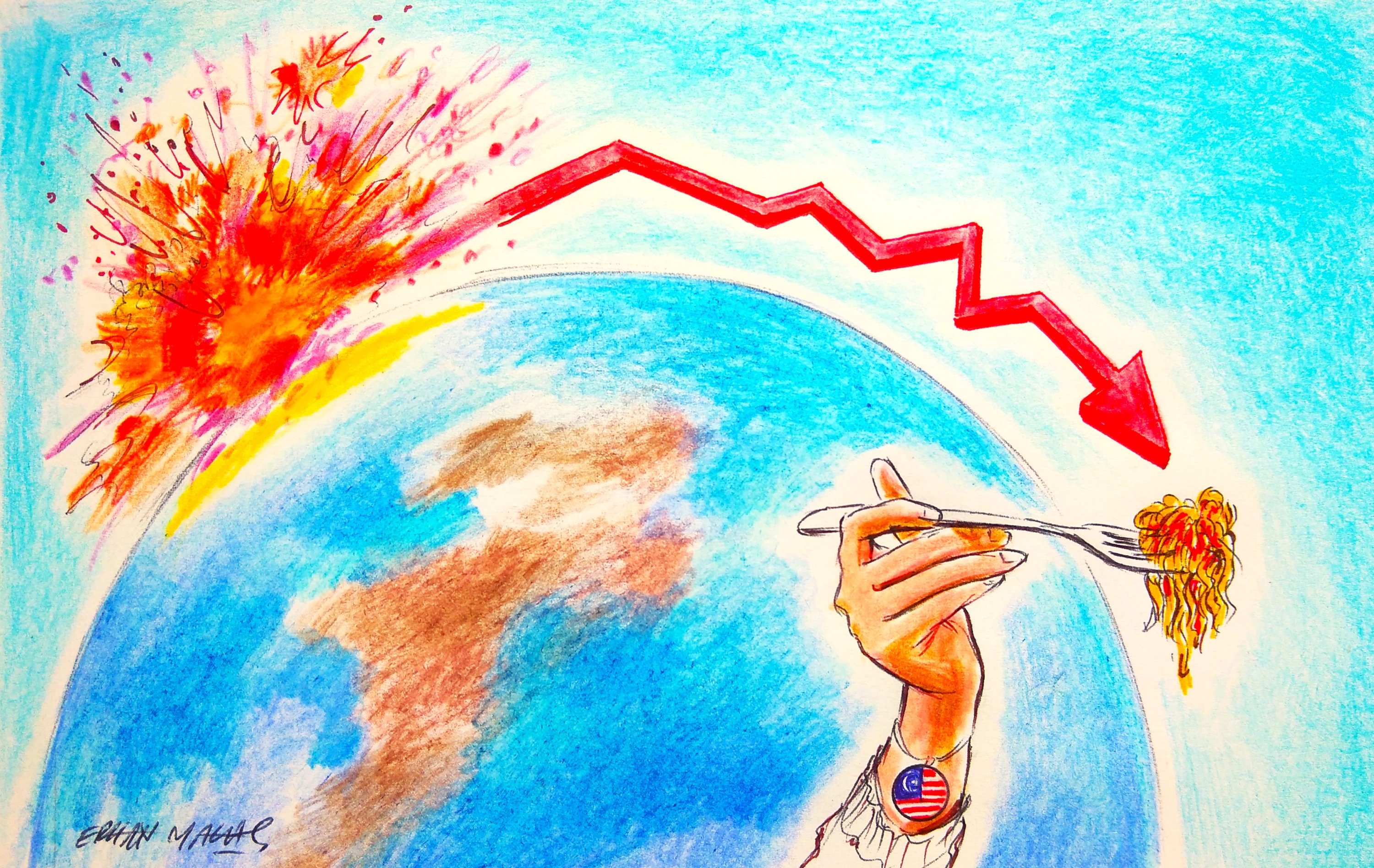
More than a month into the U.S.-Israel war on Iran, this kind of change is no longer isolated. Across Southeast Asia, the effects of a distant conflict are steadily embedding themselves into everyday routines, reshaping how people spend, move and think about stability.
The economic transmission is direct. Disruptions around the Strait of Hormuz, a route that carries roughly a fifth of global oil supply, have tightened energy markets and pushed prices upward. Even partial restrictions on shipping have been enough to unsettle supply chains and fuel inflation across regions far removed from the conflict.
In Malaysia, those pressures are becoming increasingly visible. Rising oil prices have placed a strain on fuel subsidies, prompting policy adjustments such as reduced subsidised petrol quotas. What may appear as a technical decision reflects the deeper reality: the cost of global conflict is being absorbed domestically.
For Parveen, this translates into subtle but meaningful changes.
“Even simple meals, even at mamak restaurants, feel pricey now,” she said. “It’s less of a casual, everyday thing and more something I plan or look forward to.”
Mamak restaurants, long associated with affordable, everyday dining, are now warning of price increases of up to 30% as higher fuel and supply costs ripple through the system. What was once instinctive has become intentional.
As she described this, I could not help but think of how familiar that felt. There was a time when stopping at a mamak was almost automatic, part of the unspoken rhythm of life in Kuala Lumpur. Today, there is often a pause, a moment of calculation that did not exist before.
The effects extend well beyond food. Rising diesel costs are feeding into logistics, manufacturing and agriculture, gradually pushing up the price of everyday goods. What emerges is not a sudden crisis, but a steady accumulation of pressure that households must continuously adjust to.
“I try to plan my day, so I’m not making unnecessary trips or impulse purchases,” she said. “You start thinking ahead more, even for small things.”
What became clear through our conversation is that this adjustment is not only individual. It is collective.
“I notice more people talking about side income, savings or investing,” she added. “People are thinking more about stability and long-term security now.”
From where I stand, this is where the real story lies. Not only in policy responses or market fluctuations, but also in how quietly and deeply these pressures are reshaping everyday life. The change is subtle, but once seen, it is difficult to ignore.
Work patterns, too, are adapting. While not universal, flexible arrangements have become a practical response to rising costs.
“I still need to go into the office sometimes,” she explained, “but working from home helps. Some people I know drive more than 20 kilometers daily, so saving on petrol does make a difference.”
Beyond financial strain, there is a more intangible impact, a growing sense of uncertainty.
“In a way, it does affect my sense of stability,” she said. “Not directly, but it creates this underlying feeling that things can change very quickly.”
In an era of constant connectivity, distance no longer provides the same buffer.
“It feels closer than before,” she reflected. “We see everything in real time. It’s harder to disconnect.”
This is perhaps the most significant change of all. Conflict is no longer experienced as something distant or abstract. It is immediate, visible and increasingly personal.
Across Southeast Asia, governments have largely taken a cautious and neutral stance, calling for restraint while managing economic exposure. Yet neutrality offers little insulation. The region’s dependence on global trade and energy flows means that disruptions are felt not through direct involvement but through rising costs and tightening conditions.
The geopolitical stakes remain high. Escalation in the Middle East carries consequences far beyond the region. A destabilized Iran would not only alter regional dynamics but also risk amplifying global economic and security instability, with ripple effects reaching economies like those in Southeast Asia.
But for many, the reality of war is no longer defined by strategy or alliances. It is defined by its everyday consequences, subtle, persistent and deeply personal.
“Life feels more expensive and uncertain,” Parveen said, “but I’m also grateful that I still have the ability to make choices about how I want to live.”
In many ways, her experience is no longer unique. It reflects a quiet shift unfolding across the region, where ordinary people are adjusting to pressures they did not create, but can no longer ignore.
As our conversation ended, I found myself reflecting on how familiar her experience felt. After 10 years in Kuala Lumpur, the change is not dramatic, but it is undeniably felt in pauses, in hesitation, in the recalibration of everyday life. And even that sense of control is becoming more fragile. Because the truth is, this is no longer a distant war. It is already embedded in daily life, influencing how people spend, move and plan for the future.