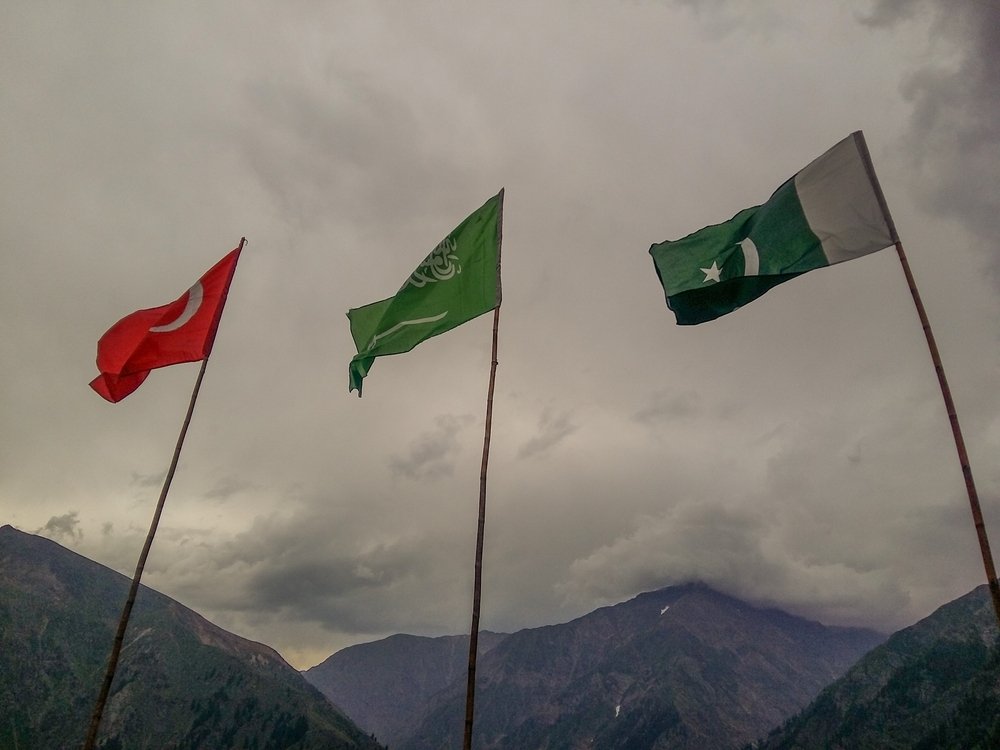
When Türkiye’s foreign minister publicly confirmed that Ankara is in talks with Pakistan and Saudi Arabia over a possible defense pact, he was doing more than clarifying a diplomatic rumor. He was signaling how power is being recalibrated in the Middle East. The area today is defined less by fixed blocs and more by strategic hedging. Security guarantees of the United States feel conditional, regional conflicts remain unresolved and old assumptions about deterrence no longer hold. Against this backdrop, Ankara’s exploratory talks are not about creating a NATO-style pact. They are about options.
The starting point is the Saudi-Pakistan defense agreement signed in September 2025, which formalized decades of close military cooperation. That pact framed aggression against one as a shared concern, but crucially avoided automatic military triggers or integrated command structures. It was mutual defense in principle, not in mechanism.
Türkiye’s potential involvement would expand that framework from a bilateral understanding into a loose triangular arrangement. The significance lies less in legal clauses and more in strategic signaling: three influential Muslim-majority states, each with distinct strengths, exploring ways to coordinate security interests without surrendering autonomy.
For Ankara, the attraction is not binding commitments but flexibility. Türkiye has the second-largest army in NATO, a battle-tested force, and a rapidly expanding defense industry. It is already deeply engaged with Pakistan through naval programs, aircraft upgrades, joint exercises and co-production initiatives. Pakistan is a familiar and low-risk defence partner.
Saudi Arabia, on the other hand, plays a different role. Over the past five years, Türkiye has carefully rebuilt ties with Riyadh after a period of sharp rupture. The reset reflects a hard lesson from the post-Arab Spring decade: Isolation and diplomacy carry real economic and strategic costs.
President Recep Tayyip Erdoğan now promotes a foreign policy that privileges stabilization, trade and regional platforms over ideological alignment. In that context, associating with a Saudi-Pakistan security framework allows Türkiye to widen its regional footprint, enhance deterrence signaling and hedge against uncertainty without jeopardizing its NATO position or committing to automatic defense obligations.
Pakistan’s role in this emerging equation is understated but critical. As a nuclear-armed state with mature armed forces and a growing defense-export sector, Islamabad brings deterrence credibility and operational depth. Its expanding defense sales across the Middle East and Africa are not only commercial but strategic, reinforcing long-term security relationships.
For Saudi Arabia, the logic is equally pragmatic. Riyadh is no longer content with a purely reactive security posture. Under the "Vision 2030," the kingdom seeks strategic autonomy, diversified partnerships and the ability to shape regional outcomes rather than depend on external guarantees. Elevating defense ties with Pakistan and potentially drawing Türkiye into the orbit serves that objective.
This is not about forming an exclusive bloc. It is about creating a flexible security platform that can be activated politically, if not militarily, in times of crisis.
Critics have been quick to frame the prospective alignment as an anti-Israel or anti-UAE axis. That reading misses the nuance. Ankara, Riyadh and Islamabad all maintain incentives to preserve working relationships with a wide range of regional actors, including Abu Dhabi. Economic interdependence, investment flows, and diplomatic balancing make outright confrontation unlikely.
What is taking shape is better understood as a hedge against instability and strategic vacuum. The language of mutual defense matters less than the message it sends: Regional powers are increasingly willing to coordinate among themselves rather than rely exclusively on outside guarantors.
The broader regional picture reinforces this interpretation. As Ankara, Riyadh and Islamabad explore one configuration, other powers are quietly assembling their own.
Just this week, India and the United Arab Emirates signed a letter of intent to deepen defense and security cooperation, including industrial collaboration and maritime security, during UAE President Sheikh Mohammed bin Zayed Al Nahyan’s short but significant working visit to India. The timing is telling.
Rather than one dominant alliance, the region is witnessing the emergence of parallel security frameworks that are overlapping, flexible and shaped by national interests rather than ideology. Time will tell whether these arrangements neutralize each other or instead coexist, compete or even intersect in an increasingly fragmented regional security landscape.
Türkiye’s talks with Pakistan and Saudi Arabia are therefore less about a single pact and more about a structural change. The Middle East is moving toward a multipolar security environment where influence is measured by connectivity, defence-industrial capacity and diplomatic agility.
In this new landscape, formal treaties matter less than the ability to signal unity, deter adversaries and keep options open. Ankara’s message is clear: Türkiye wants a seat at every relevant table, without being locked into any one arrangement.
As India and the UAE sketch their own defense framework, the region’s future security order is beginning to resemble a mosaic rather than a map, that is, fragmented, adaptive and constantly renegotiated. For now, the talks themselves may be more important than any agreement they eventually produce.