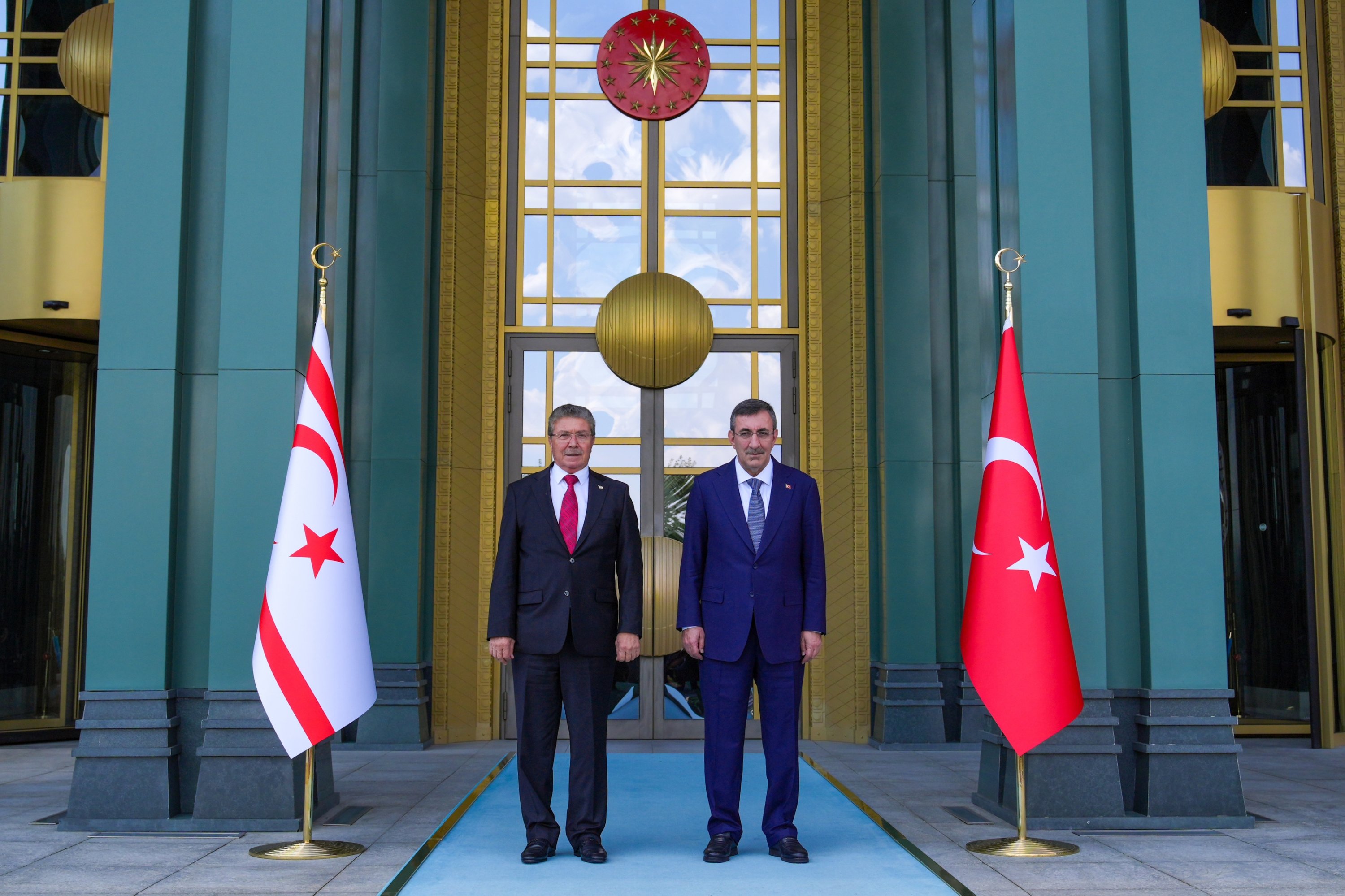
Turkish Vice President Cevdet Yılmaz reaffirmed Ankara’s support for Turkish Cypriots and their political cause as Türkiye and the Turkish Republic of Northern Cyprus (TRNC) signed an additional protocol Thursday on a fiber-optic infrastructure project aimed at accelerating the island’s digital transformation.
Yılmaz met TRNC Prime Minister Ünal Üstel and representatives of the coalition government at the Presidential Complex in Ankara, where the two sides discussed bilateral relations, ongoing development projects and cooperation in energy and digital infrastructure.
Speaking at a joint news conference after the meeting, Yılmaz reiterated Türkiye’s long-standing position on Cyprus, saying Ankara would continue to stand by Turkish Cypriots.
“Türkiye, as the motherland and guarantor, will always stand with the Turkish Cypriot people in line with its historic responsibility on the Cyprus issue, which is our national cause,” Yılmaz said. “It will continue to defend the just cause of the Turkish Cypriots on every platform and mobilize all its resources to ensure their prosperity and peace.”
Yılmaz also emphasized Türkiye would continue supporting projects designed to improve living standards in the TRNC under the 2026 Economic and Financial Cooperation Agreement.
“These projects serve to increase the welfare of the Turkish Cypriot people, enable young people to look to the future with greater confidence and help the TRNC reach better days,” Yılmaz noted.
He pointed to a memorandum of understanding signed on July 10 on supplying natural gas to the TRNC as part of a broader effort to deepen cooperation in areas including energy, connectivity, digitalization, education, transportation and health.
Yılmaz said Türkiye and the TRNC would continue working together despite what Ankara describes as the international isolation of Turkish Cypriots.
“As long as we act in unity of mind and heart, there is no difficulty we cannot overcome and no obstacle we cannot surmount,” he said. “Although our Turkish Cypriot brothers and sisters are being subjected to unjust isolation, we will continue working together for the development of the TRNC.”
A major focus of Thursday’s talks was the fiber-optic project, which Yılmaz described as strategically important for the TRNC’s digital future.
He said concerns had previously been raised over some provisions of the project’s implementation protocol and that the two sides had worked on revisions addressing the concerns of Turkish Cypriot institutions. Yılmaz and Üstel signed an additional protocol clarifying those provisions and strengthening the framework for implementation.
“The fiber project is a strategic development initiative that will reinforce the TRNC’s digital sovereignty, increase its economic strength and strengthen its connections with the world,” Yılmaz stressed.
The infrastructure is expected to improve service quality and lower costs for residents and businesses while expanding access to digital technologies. The project would also help Turkish Cypriot entrepreneurs reach global markets and allow public services to be delivered more efficiently and securely, he remarked.
Yılmaz underlined that Ankara viewed digital connectivity as another way to counter the isolation faced by Turkish Cypriots.
“We are strengthening the TRNC’s ties with the world through the opportunities offered by the most advanced technologies,” he stated.
Üstel, for his part, said relations between Türkiye and the TRNC were rooted in historical ties, a common struggle and a shared vision for the future.
He noted energy and digital infrastructure would be among the main pillars of a new phase in bilateral relations.
“The fiber-optic infrastructure investment whose additional protocol we signed today is not merely a high-speed internet project for us,” Üstel said. “It is a strategic investment that will form the basic infrastructure of our country’s digital transformation.”
The prime minister said the project would affect sectors ranging from public administration and education to health care, tourism, trade and finance.
The infrastructure would strengthen the government’s capacity to produce, collect and analyze data while improving digital security and facilitating faster decision-making based on reliable information, he noted.
Üstel added that the project would provide the foundation for a stronger e-government system and greater digital integration among public institutions.
“This transformation will also be one of the fundamental steps in our vision of becoming an information technology island,” he said. “With the additional protocol signed today, we are effectively launching this important transformation.”
The fiber project was launched between Türkiye and the TRNC on July 11, 2025. Yılmaz and Üstel said the additional protocol would move implementation forward as the two sides seek to expand economic integration and digital connectivity.
Üstel also thanked President Recep Tayyip Erdoğan for Ankara’s continued support, saying political stability and close cooperation between the two governments had helped turn major infrastructure projects into concrete initiatives.