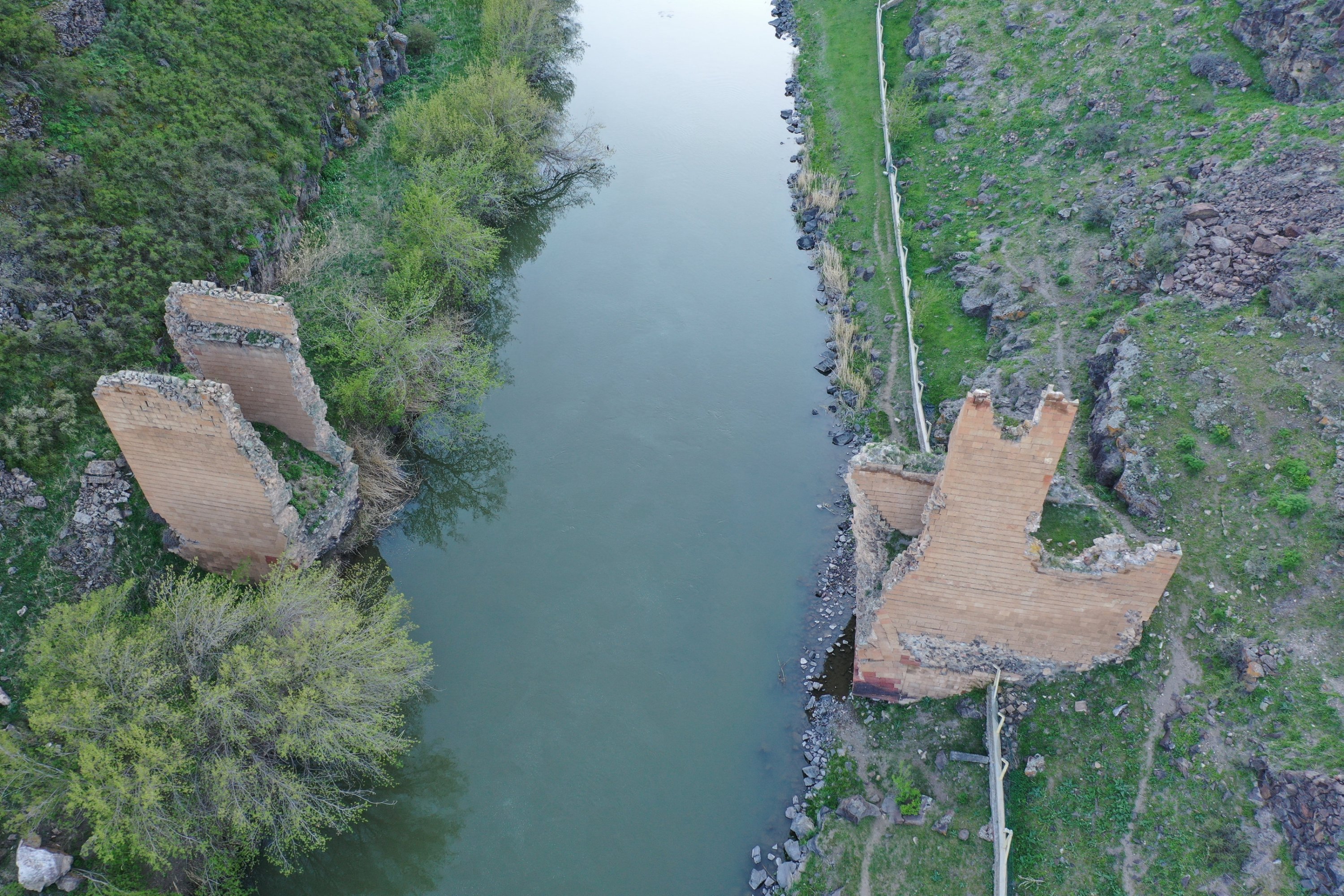
Remnants of two abutments of a bridge on the border perhaps symbolize best the state of relations between Türkiye and Armenia, or rather, how they could have been after the fall of the Soviet Union. So, it is fitting that the two neighbors decided to turn a new page in their efforts to normalize ties in this very location. Ani Bridge spanning across Arpaçay or as it is known in Armenia, Akhuryan River, will be jointly restored by Türkiye and Armenia under a deal signed by representatives of the two countries last Monday in Yerevan. Experts say that the new steps include profound opportunities for both countries and the region, though they also underline the need for cautious optimism, instead of expecting a swift normalization.
A visit by Vice President Cevdet Yılmaz to the Armenian capital to attend the European Political Community summit brought the memorandum of understanding for joint restoration to fruition. Yılmaz, the first high-ranking leader from Türkiye to visit Yerevan since then-President Abdullah Gül in 2008, had kind words for his hosts and, in remarks to journalists after a meeting with Armenian Prime Minister Nikol Pashinyan, said peace and normalization in the South Caucasus would benefit every country, including Azerbaijan, which advanced its own peace process with Armenia after years of hostilities.
For the better part of the last decade, Türkiye has sought to re-establish ties with countries with which it had sour relations, in line with changing circumstances and as part of its “peace diplomacy.” For instance, it rebuilt ties with Egypt and reached out to Greece after decades of tensions. Now, Armenia may join this growing list of countries with which Türkiye hopes to reconnect for the sake of mutual interests.
Professor Yıldız Deveci Bozkuş of Ankara University says Yılmaz’s participation in the European Political Community summit is a significant and symbolic development for the normalization process between the two countries. Speaking to Daily Sabah, Bozkuş noted that a new diplomatic process was underway in the aftermath of the 2020 Karabakh war. The said war led to Azerbaijan’s victory against the Armenian occupiers of Karabakh and paved the way for a budding peace between Baku and Yerevan. Türkiye, a close ally of Azerbaijan, runs a parallel process. Over the past six years, Ankara and Yerevan have assigned special representatives to further normalize their relations and have taken steps to establish a lasting diplomatic relationship, reopen land borders and establish transportation and commercial links. Bozkuş highlighted noticeable progress in the process. She pointed out that a recent meeting between Turkish and Armenian delegations on the two countries’ border was followed in days by Yılmaz’s visit, adding that those were important indicators of the sides’ will to keep channels of dialogue open and their commitment to normalization.
“(The deal on Ani Bridge) is not purely a restoration project; it is also a symbolic reflection of years-long problems between Türkiye and Armenia, closed borders and disrupted contact. The bridge is a metaphor of a new concept of relationship, a ‘bridge’ between the past and future, between the memory and normalization,” Bozkuş added.
As a matter of fact, Türkiye was one of the first countries to recognize the independence of Armenia within months of its declaration in 1991. In the following years, it sought to help Armenia integrate with the international community. One such step was the invitation of Armenia to the Organization of Black Sea Economic Cooperation, which was founded in Istanbul in 1992. Yet, one year later, Türkiye started cutting off ties with Armenia and shut down the border when Armenia attacked Azerbaijan.
It took 15 years for the first steps to be taken for normalizing relations. In 2009, they signed protocols to that extent, but the political climate of the time in Armenia stalled the normalization efforts. Another sticking point that prevented restoration of ties has been a different interpretation of a shared history, or rather, the history of Armenians during the Ottoman rule in Anatolia. The infamous 1915 incidents, which are recognized by Armenia as an “Armenian genocide,” have been another obstacle in relations. The former governments of Armenia and the Armenian diaspora in Europe and the United States pushed the “genocide” agenda and its recognition by Türkiye for years before mending ties.
Under Nikol Pashinyan, Armenia has largely changed this rhetoric and introduced the “Real Armenia” doctrine, which touts peace with neighbors. Though not openly declared, this was a step toward abandoning Armenian claims to Karabakh, something also symbolized by a lapel pin worn by Pashinyan that shows Armenia without Karabakh, as was the case in the former maps of the country. Last year, Pashinyan was also quoted by Turkish journalists visiting Yerevan as saying that “genocide recognition” was not a foreign policy priority for them.
Nigar Göksel, the International Crisis Group’s Türkiye/Cyprus director, says normalization will be a win-win situation for both countries for a wide variety of reasons. She pointed out that especially the opening of the Türkiye-Armenia border would reduce Armenia’s isolation, vulnerability and dependence on Russia. “(It would) strengthen Türkiye’s role and soft power across the Caucasus, and solidify Azerbaijan’s connection to Nakhchivan. It would also create new opportunities in trade, logistics, tourism, energy and digital infrastructure. Provinces in eastern Anatolia are expected to benefit economically, which can also positively spill over into security,” Göksel told Daily Sabah.
The issue of Nakhchivan also figured prominently in Yılmaz’s remarks to the Turkish media in Yerevan. This exclave of Azerbaijan inside landlocked Armenia will be linked to mainland Azerbaijan as part of the Zangezur Corridor, a project that aims to bring economic prosperity to the two countries and Türkiye while strengthening regional trade and transport networks. It is part of the Middle Corridor, a logistics network spanning thousands of kilometers and connecting China to Europe via Central Asia, the Caspian Sea, Azerbaijan, Georgia and Türkiye. Yılmaz noted the strategic importance of the Middle Corridor and how it would present a strong connection between Türkiye and the Caucasus and Turkic states. “This is not only about roads, but it is also about strengthening connectivity in fields ranging from telecommunications and digitalization and energy,” he said. He said making Zangezur functional would lay the groundwork for wider regional cooperation.
Bozkuş says Yılmaz’s visit had multiple messages on the regional and global levels as well. “In recent years, the South Caucasus has been a geopolitical field of attraction in international politics, in terms of energy lines, transportation corridors, connectivity projects and competition of major powers. At a time when conflicts on a global scale, energy crises and geopolitical fractures escalate, the South Caucasus’ strategic position has become more apparent. This is clearly observed in competition around transportation and connectivity projects oriented in the region,” she said.
Armenia will hold elections on June 7, a vote Pashinyan branded as a choice “for peace or non-peace” last year as he pushes to achieve the said peace with Azerbaijan and Türkiye.
Göksel says that after the elections and in parallel with momentum in Azerbaijan-Armenia normalization, technical and infrastructure preparations for opening the border may accelerate. “While Baku has been expecting Armenia to first remove the reference to its 1991 Declaration of Independence from the Constitution’s preamble, as it includes a claim over Karabakh, we are already seeing de facto openings pick up pace. This is important for giving Armenian society confidence that Pashinyan’s constructive path is delivering results,” she said.
For Türkiye, the restoration of ties is part of wider regional ambitions, that is, increasing the connectivity for peace, as former Ambassador Serdar Kılıç, Türkiye’s special representative for the process, implied during an event in Yerevan earlier this week. Kılıç told the Yerevan Dialogue Forum on May 5 that Türkiye was “building confidence” with Armenia, and this cannot be separated from general initiatives for connectivity in the region. “The connectivity, too, cannot be confined to fields such as transportation. A more comprehensive approach is needed, just as we need a comprehensive approach for ensuring peace and stability in the region,” he said, adding that the ideas to improve relations and maintaining lasting peace and stability should “come from the region itself,” something in line with Türkiye’s advocacy for ‘regional ownership’ in matters regarding the relations in the region instead of relying non-regional actors to resolve the issues.
“In the new era, South Caucasus’ strategic importance is not merely security-oriented. It is also being redefined in the framework of connectivity, sustainable transportation networks, energy security and geoeconomic integration,” Bozkuş said. “In this context, Türkiye’s effort to contribute to the solutions to regional problems, continuing normalization process with Armenia and playing an active role in several transportation and commerce projects, particularly the Middle Corridor, can be counted among elements boosting Türkiye’s clout in the South Caucasus,” she added.
She noted that diplomatic and geoeconomic initiatives were crucial for reinforcing Türkiye’s position as an actor strengthening connectivity between Europe and Asia. “This in turn contributes to Türkiye’s regional influence and makes its strategic importance amid changing global geopolitical balance more visible.”
This “regional ownership” and bolstering the peace prospects may have its detractors as well, as Göksel points out.
“As with any such change, there will also be actors who lose; those that benefit from the current closed borders might not be able to retain their advantage. From a security perspective, completion of these normalizations, both between Türkiye and Armenia, and between Armenia and Azerbaijan, would reduce the scope for external powers to exploit unresolved conflicts for leverage, further lower the risk of renewed war between Azerbaijan and Armenia, and enable regional connectivity, contributing to a more predictable order in the South Caucasus. That said, short-term security risks should not be underestimated. Both internal and external actors may attempt to trigger provocations to disrupt the process, so vigilance will need to remain high. Dialogue channels, hotlines and coordination among security officials will undoubtedly need to be tight,” she said.
Bozkuş pointed out that the increasing strategic importance of the South Caucasus in terms of energy security, transportation corridors and connectivity projects made the region one of the most critical geopolitical rivalry areas in international politics. “This might carry some risks and fragility for normalization, but it also means new diplomatic and economic potential,” she added.
“In other words, the South Caucasus’ rising geopolitical importance is something both limiting and encouraging Turkish-Armenian relations,” she noted. That “geopolitical importance” emerged in a thinly veiled pragmatic approach by the U.S. under the Trump administration, which boasts advancing the Armenia-Azerbaijan peace process. The U.S. apparently aspires to curb the Russian influence in the South Caucasus. Armenia under Pashinyan further distanced itself from Russia, and this was most evident when the Kremlin lashed out at Yerevan for hosting Ukrainian President Volodymyr Zelenskyy at the same summit Yılmaz attended.
Speaking about the U.S., Bozkuş highlighted that the Armenian diaspora may impact the normalization process. The United States, along with France, hosts the largest Armenian diaspora in the West. Bozkuş stated that the diaspora was well-organized in the Western countries and maintained a distance from the normalization. Nevertheless, she added that the diaspora was not “homogenous” and highlighted differing political approaches within the diaspora, as well as changes among generations, the impact of regional developments and security concerns of Armenia made more pragmatic and dialogue-focused approaches more visible within the community.
Another major obstacle may be ultranationalist circles in Armenia and the “Karabakh clan,” members of a political tradition who also kept their distance from the process. The said clan refers to powerful political and military figures who came to dominate Armenian politics for years. All are connected to the region, either born there or served there as military or political leaders. Indeed, Pashinyan’s “Velvet Revolution” in 2018 ended this domination, while Azerbaijan’s victory in Karabakh further eroded the influence of the clan in Armenian politics. Still, they are the most formidable rivals of Pashinyan in the upcoming elections. Bozkuş, however, is optimistic and says the clan’s approach to the matter does not reflect the reality of wider Armenian society. She referred to increasing expectations, especially among younger generations, for the development of economic relations, the opening of borders, the revival of transportation networks and the strengthening of regional integration. “This indicates that public support for normalization increased to an extent,” she said.
Pro-Russian political circles in Armenia are also cautious toward the process, according to Bozkuş. “In this context, the June elections are important not only for domestic politics but as something that will define Armenia’s foreign policy and regional vision. Under Pashinyan, steps taken to improve relations with the West and normalization process with Türkiye and Azerbaijan had a response to an extent among the public. The Pashinyan era has been a time of important opportunities for these processes,” she underlined.
Bozkuş also warned against adopting an overly optimistic approach or hoping for short-term expectations regarding the process. “There are still many sensitive issues that need to be resolved between the two countries, from historical matters to the establishment of diplomatic relations, regional developments and the lack of full mutual trust. So, it will be more realistic to assess the normalization as a multi-dimensional, fragile process that should need more time.”