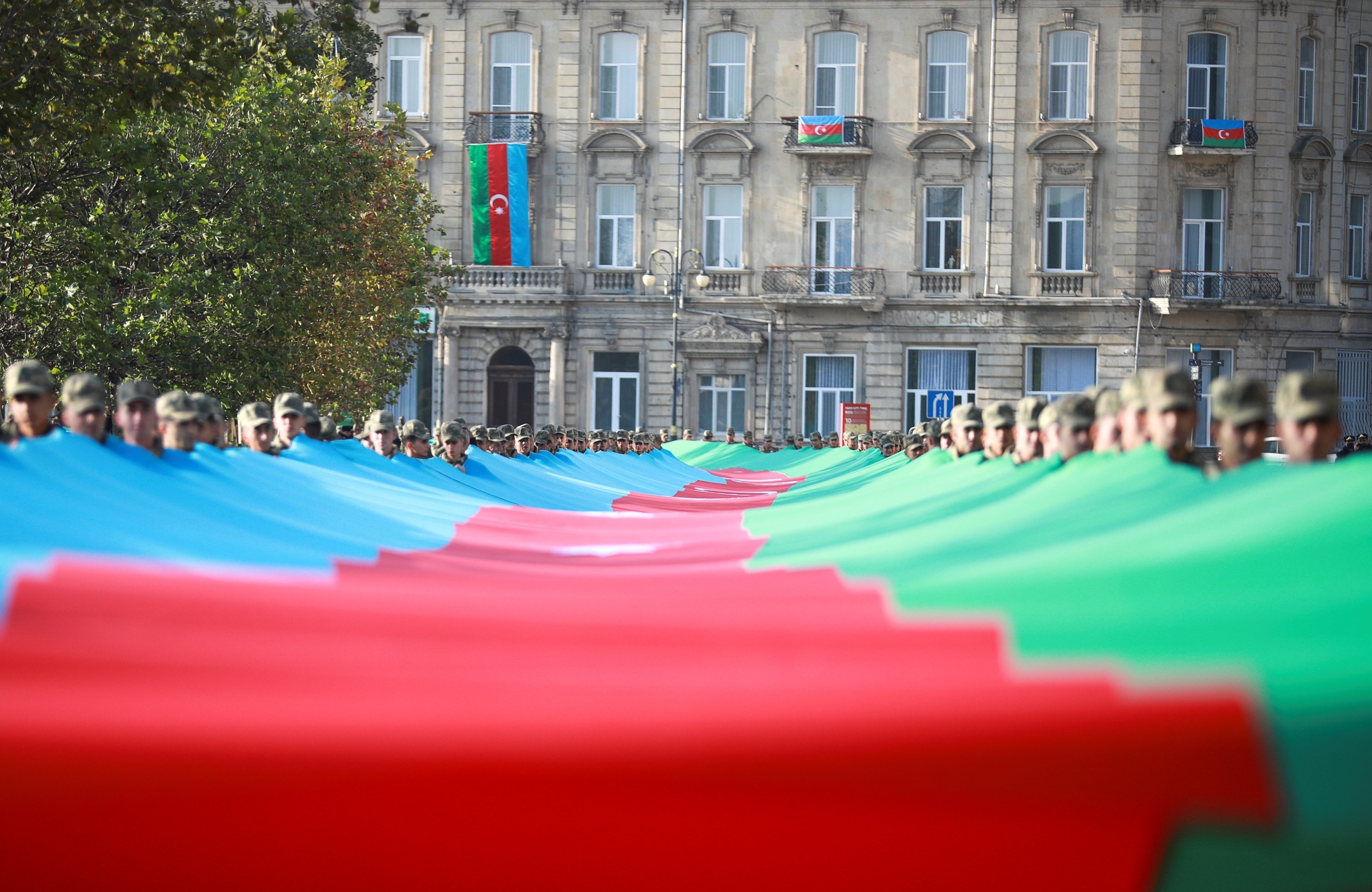
Thirty-three years after what is dubbed the Black January massacre, in which the Soviet military slaughtered dozens of civilians during peaceful protests in Baku, Azerbaijan is still seeking justice for the victims.
The memory of 150 people who were brutally killed by the USSR on Jan. 20, 1990, along with hundreds of others who were injured or imprisoned while protesting Soviet support for Armenia’s policy of aggression against historical territories of Azerbaijan, remains as fresh as ever for Azerbaijani people.
“We believe the bloody events of Jan. 20 that occurred as a result of military aggression against Azerbaijan will be evaluated within international law as a crime against mankind and humanity,” Sabina Aliyeva, the country’s commissioner for human rights, said Thursday in an official statement.
“We believe the perpetrators of this crime will be held accountable, and the criminals will not go unpunished,” Aliyeva stressed.
Black January is generally considered the turning point for Azerbaijan regaining its independence after 70 years of Soviet occupation.
On the night of Jan. 19-20, under direct instructions from Soviet leader Mikhail Gorbachev, the USSR's State Security Committee (KGB) and the Ministry of Internal Affairs entered Baku and its regions, massacring the civilian population, including women and children, using heavy military equipment and other weaponry.
Mass arrests accompanied the illegal deployment of troops and subsequent military intervention.
The Azerbaijani people lost all confidence in the USSR after the Soviet Army committed a massacre on Jan. 20, now a national day of mourning, thus accelerating the process that lead to the country's independence.
Azerbaijanis refer to Black January as a day of sorrow, but at the same time, as a day of pride, because the country's heroes who perished laid the groundwork for the state's independence.
“Although Jan. 20 was one of the most tragic days we have experienced in the recent past, the events were engraved in the memory of our people as a glorious history of heroism,” Aliyeva noted.
The events that led to the tragedy of Black January can be traced to the end of the 1980s when attempts to annex Nagorno-Karabakh to Armenia were gaining momentum and more and more native Azerbaijani people were being expelled from their historical lands.
Relations between the former Soviet republics have been strained since but particularly from 1991 onward when the Armenian military occupied Karabakh, what was and is still internationally recognized as Azerbaijani territory. Baku and Yerevan fought their first war over Karabakh then, which resulted in thousands of casualties but not the end of the Armenian occupation. Tensions boiled into another war in the autumn of 2020 when six weeks of particularly intense clashes claimed over 6,500 lives before a Russian-brokered truce ended the hostilities. Under a 2020 deal, Armenia ceded swathes of territory, and Russia stationed a force of 2,000 peacekeepers in the region to oversee a fragile truce.
The very next day following Jan. 20, the country’s national leader, Heydar Aliyev, sought to inform the international community about the crimes committed against humanity during a press conference in Moscow, declaring the tragedy “an affront to the sovereign rights of the people of Azerbaijan.”
By 1994, after a political and legal assessment, the names of the Soviet perpetrators of the massacre were made public and Jan. 20 was declared a national mourning day.
The country has since condemned the massacre, as well as the reprisals against innocent civilians, the injuring of hundreds including women, children, and elderly, and the information blockade that took place that day as a gross mass violation of the Universal Declaration of Human Rights, the International Covenant on Civil and Political Rights, and other international legal documents.
Aliyeva reiterated her country’s call to international organizations and the global community to conduct “as soon as possible” a legal assessment of the events of Black January.
As 2022 came to a close, tensions flared up again between the rival nations, this time involving protests by Azerbaijani environmental activists in the Lachin region over the illegal exploitation of natural resources by Armenia in Karabakh. Armenia has called on Russian peacekeepers deployed there to monitor the peace deal to unblock the Lachin corridor, the lifeline road connecting Karabakh to Armenia.
A ceremony to remember the tragic day also took place in Türkiye’s northeastern province of Kars bordering Armenia on Thursday.
Addressing the ceremony hosted by Azerbaijan’s Kars Consulate General at a hotel, the city governor and Deputy Mayor Türker Öksüz too denounced the massacre, saying, “Such an unlawful and inhumane massacre took place before the entire ‘civilized’ world.”
Black January went down in Azerbaijani history as one of the most painful incidents, Öksüz recalled.
“All our Turkic and Muslim brothers and sisters did was only protest through civil means the annexation of their sacred homeland Karabakh,” he said.
He argued the Azerbaijani people declared to the world “once again” that they would “never give up on their freedom and readily give up their lives for their sacred cause with the massacre they were subjected to.”
He hailed the struggle, solidarity and cooperation between Türkiye and Azerbaijan, emphasizing that the two countries “have always been and will always be friends and fraternal nations.”
“Türkiye will never forget our shared pain of Black January and other massacres we were subjected to,” Öksüz vowed.
For his part, Azerbaijan’s Consul-General to Kars Nuru Guliyev said the bloody massacre would be kept alive for future generations.
“A lot of blood was shed and many of our soldiers were martyred but most importantly, they were avenged,” Guliyev said.
Azerbaijan has been an independent state for 32 years since 1991, he noted and stressed, “We are proud of the country.”
The ceremony included a moment of silence for the victims of the massacre, the national marches of Türkiye and Azerbaijan, as well as a video film detailing the events of Jan. 20.