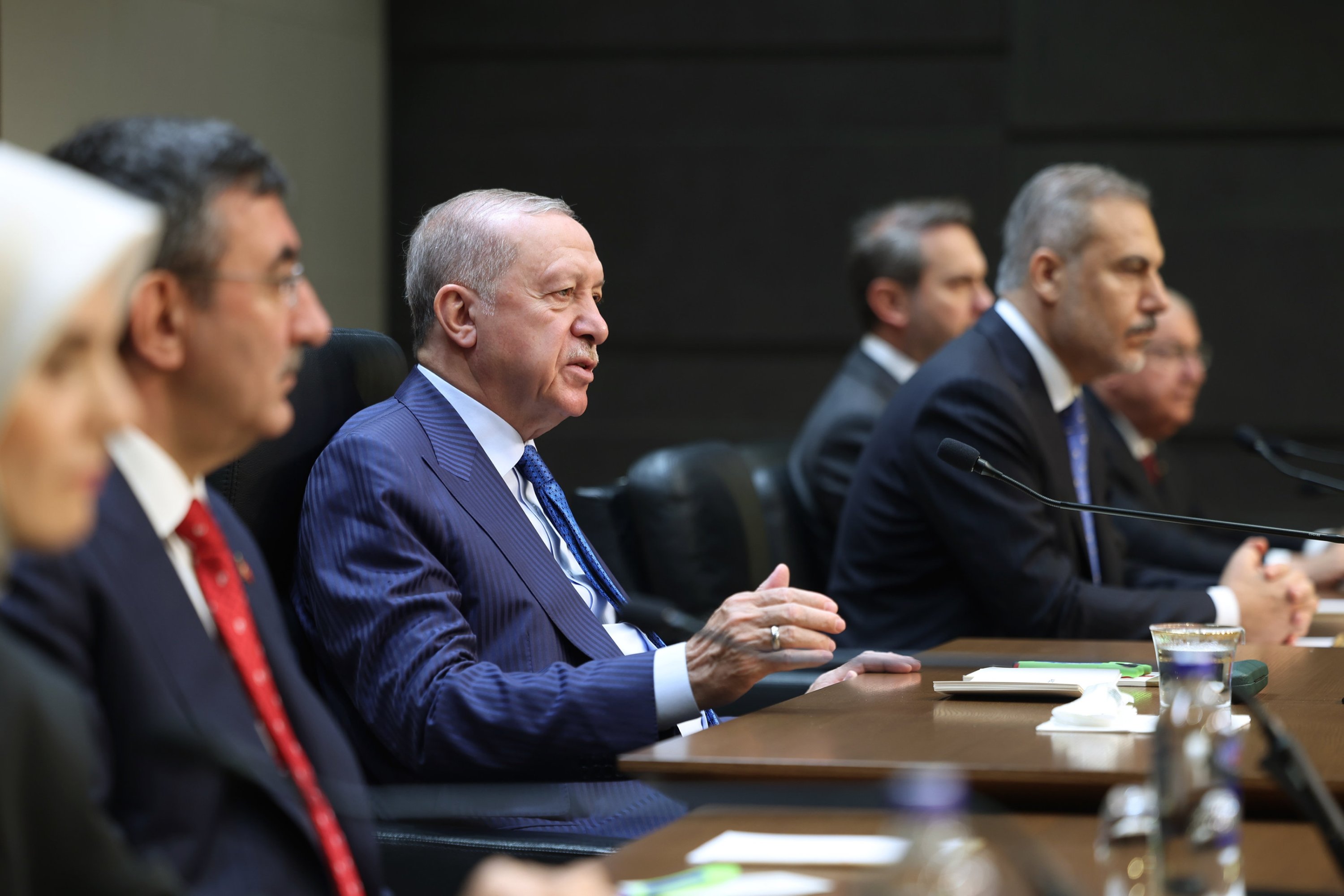
Answering reporters’ questions before his departure for New York from Atatürk Airport in Istanbul, President Recep Tayyip Erdoğan summed up his busy schedule in the United States, where he will attend the United Nations General Assembly.
A platform for leaders of countries big and small, the assembly will give Erdoğan a chance to delve into the causes he champions. Primary among them will be the plight of Palestinians in Gaza and the need for a two-state solution to resolve it, as the Turkish leader reiterated once again on Sunday.
Erdoğan will also be joined by Syria’s post-Assad administration at the U.N. General Assembly and he pledged to stand with them in their bid to recover the war-torn country.
A key entry on Erdoğan’s itinerary will be his first one-on-one meeting in the U.S. with his counterpart, Donald Trump. Erdoğan described the U.S. president as a “valuable friend” as he talked to journalists on Sunday and said they would meet on Thursday.
Erdoğan said this year’s General Assembly would be different than previous ones due to widespread recognition of the State of Palestine. “We hope these decisions would add momentum to realizing the two-state solution,” he said.
Britain was set to recognize a Palestinian state on Sunday, U.K. media said, ahead of key U.N. talks where several nations are poised to follow suit to pressure Israel over Gaza. Portugal's Foreign Ministry also said in a statement that Lisbon "will recognize the State of Palestine" and that "the official declaration of recognition will be made on Sunday.”
Although it would be a largely symbolic move, the U.K. would become the first G-7 country to move toward full recognition of a State of Palestine, with France and others expected to follow at the U.N. General Assembly. It is a watershed moment for Palestinian statehood, with the most powerful Western nations for years holding out against recognition, arguing it had to be part of any two-state solution negotiated as part of a deal to peace with Israel. But a growing number of longtime allies have shifted positions, as Israel has intensified its Gaza offensive.
President Erdoğan highlighted the theme of the assembly as “Better together: 80 years and more for peace, development and human rights.” Erdoğan, however, was critical of the U.N., especially “its current structure reflecting the circumstances 80 years ago and falling short of executing its primary duties.”
Erdoğan is a fervent advocate for reforms at the U.N., especially the structure of the five-member Security Council, where world powers decide on the fate of countries, with smaller countries having no rights. The Turkish leader describes his fight for reforms with the motto “the world is bigger than five.” His reform call escalated in the wake of Israel’s brutal campaign since 2023 in the Palestinian territories, which has claimed the lives of tens of thousands of civilians.
“There is no explanation for leaving the solution of humanitarian crises at the mercy of Security Council countries with veto power. I first voiced this fact 12 years ago at the U.N. General Assembly, telling them that the world is bigger than five. Developments have repeatedly affirmed the truth in our statement since then. Even the U.N. secretary-general started voicing the need for urgent reforms at the U.N. We supported reform efforts and will continue doing so,” Erdoğan said.
“In my speech at the General Assembly on Tuesday, I will particularly raise awareness of humanitarian disaster and oppression in Gaza,” the president said.
Erdoğan has long been a vocal advocate for Palestinian rights, emphasizing the need for an independent state with East Jerusalem as its capital. In previous U.N. addresses, he has repeatedly criticized Israel’s military operations in Gaza, calling on the international community to uphold international law and protect civilians. Last year, he urged nations that had yet to recognize Palestine to “stand on the right side of history” and take concrete steps toward Palestinian statehood.
On Sunday, he recalled his talks on Thursday with Palestinian President Mahmoud Abbas and said he had “extensive talks” with the Palestinian leader on recognition of Palestine. Palestine has always faced serious issues in the region and continues to do so. Türkiye has always been with Palestine and will remain such. The world, however, did not stand with them, unfortunately. Now we see some 140 countries recognizing Palestine. This is good news, and we will have more good news when more join them in recognition at the General Assembly. We hope that more countries will recognize Palestine,” he said.
Erdoğan has brought Israel's genocide in Palestine to the global agenda at U.N. meetings he has attended since his time as prime minister, becoming the voice of Palestine. In these meetings, he has called on the international community to act together against Israel's oppression, frequently emphasizing that the solution lies in the immediate establishment of an independent and homogeneous Palestinian state based on the 1967 borders, with East Jerusalem as its capital.
In his 2007 address to the 62nd General Assembly, which he attended as then-prime minister, Erdoğan said the Middle East conflict constituted one of the most significant sources of instability in the region where Türkiye is located. Stressing that they see the Palestinian issue, which has repercussions both regionally and beyond, as the fundamental issue at the heart of the Middle East conflict, he said the issue requires the cooperation of not only the region but also countries beyond the region. "We believe that a resolution of the Israeli-Palestinian conflict will have a positive impact on resolving other problems in the region. "We are ready to provide all kinds of support to the parties in their efforts to revitalize the peace process and to contribute to the planned international meeting," he stressed.
Erdoğan struck similar tones in his speech at the U.N. General Assembly in 2009, emphasizing that this is one of the regional issues Türkiye places particular importance on. A solution to the Palestinian issue would only be possible if everyone were treated fairly and equally, Erdoğan said, adding: "Ending the human tragedy in Gaza and establishing lasting peace is our humanitarian and conscientious responsibility."
In his speech to the 66th U.N. General Assembly in 2011, he said the failure to resolve the Palestinian-Israeli conflict and, on the contrary, the constant squandering of rights and law for the sake of political balances, is the greatest blow to the sense of international justice. There are hundreds of resolutions passed under the U.N. umbrella that Israel disregards, he noted. Highlighting that the U.N. is incapable of taking any steps to end the humanitarian tragedy experienced by the Palestinian people, Erdoğan said: "There are no sanctions against Israel, which readily uses phosphorus bombs, Israel, which possesses atomic bombs.”
"However, as soon as they sense such a climate in the environment, they start trying to figure out how to impose sanctions. Is this justice? Shouldn't this be questioned?
"If, as the international community, we believe in the ideal of establishing international peace and security, the founding purpose of the U.N., Israel must be pressured for peace, despite those who govern it, and clearly demonstrated that it is not above the law," he further highlighted.
Erdoğan, in his first address to the 69th U.N. General Assembly in 2014 as president, said: "The immediate implementation of a two-state solution in Palestine, the lifting of the blockade on Gaza and the establishment of an independent and sustainable Palestinian state alongside Israel are political, humanitarian and moral imperatives."
He noted that the two-state solution was discussed at the U.N. podium, but no action was taken, saying: "Talk is not enough. We need action. It is time for action."
In his address to the 79th U.N. General Assembly in 2024, Erdoğan expressed his satisfaction at seeing the representative of Palestine, after a long struggle, among member states.
"I hope this historic step will mark the final turning point on Palestine's path to U.N. membership.
"I invite other states that have not recognized Palestine to stand on the right side of history at this critical juncture and recognize the State of Palestine as soon as possible," he noted.
Erdoğan emphasized that Israel's stalling and deceptive tactics should not be given any further credence. "In an environment where U.N. Security Council Resolution 2735 is not being implemented, coercive measures against Israel must be put on the agenda.
"Israel's stance has once again demonstrated that it is essential for the international community to develop a protection mechanism for Palestinian civilians.
"Just as Hitler was stopped by the alliance of humanity 70 years ago, Netanyahu and his murderous network must also be stopped by the alliance of humanity," he added.
Noting that Türkiye is the country that sends the most aid to Gaza, Erdoğan said that Ankara, by halting trade transactions with Israel, has demonstrated its sensitivity on this issue. "We also stand with the people and government of Lebanon, against whom Israel has recently escalated its attacks," he further highlighted.
Erdoğan also expressed his support for the genocide case filed by South Africa at the International Court of Justice to ensure that Israel's crimes do not go unpunished.
Another issue dominating Erdoğan’s agenda is the new era in Türkiye’s southern neighbor, Syria. Ahmed al-Sharaa, the first president of the country after the fall of the Baathist regime, will make his inaugural participation at the General Assembly. Ankara has been quick to re-establish ties with Syria under the interim administration of al-Sharaa and pledged to contribute to the recovery of the war-torn country.
“It is a delightful development for us to have a new administration of our neighbor Syria there at the U.N. after its liberation with the Dec. 8 revolution following 14 years of bloodshed and darkness,” Erdoğan told reporters on Sunday.
“I believe this General Assembly would make contributions to efforts for our Syrian brothers and sisters to achieve permanent peace after they endured great suffering and paid hefty prices for their freedoms,” Erdoğan said.
The president noted that he would also host al-Sharaa and his foreign minister “soon” in Ankara and prior to that, would meet them in New York, at the Turkish House, which houses the Turkish diplomatic mission. “We will not abandon Syria and we will mobilize all resources for strengthening Syria,” Erdoğan said.
Apart from his U.N. speech, the highlight of Erdoğan’s visit will certainly be a meeting with U.S. President Donald Trump. It will be the first time the two leaders will meet in the U.S., although they have come together in several international events before and held frequent phone calls.
The president called Trump a valuable friend as he replied to questions about the upcoming meeting on Sunday, adding that they would discuss issues to boost bilateral cooperation from trade to investment and the defense industry.
“Regional issues will certainly top the agenda of our meeting. As two friends and allies, we understand the importance of close consultation and coordination. We expressed support earlier for Mr. Trump’s global peace vision and his efforts in that regard. We believe a fair peace has no losers. Leaders have a great responsibility to safeguard the peace, strengthen stability and end conflicts and tensions in our region. We always endeavored to conduct a shuttle diplomacy to find solutions through dialogue. We adhere to this stance. We desire an end to bloodshed and tears in our region and the prevalence of peace in every inch of this region. All our efforts are focused on achieving this,” he said.