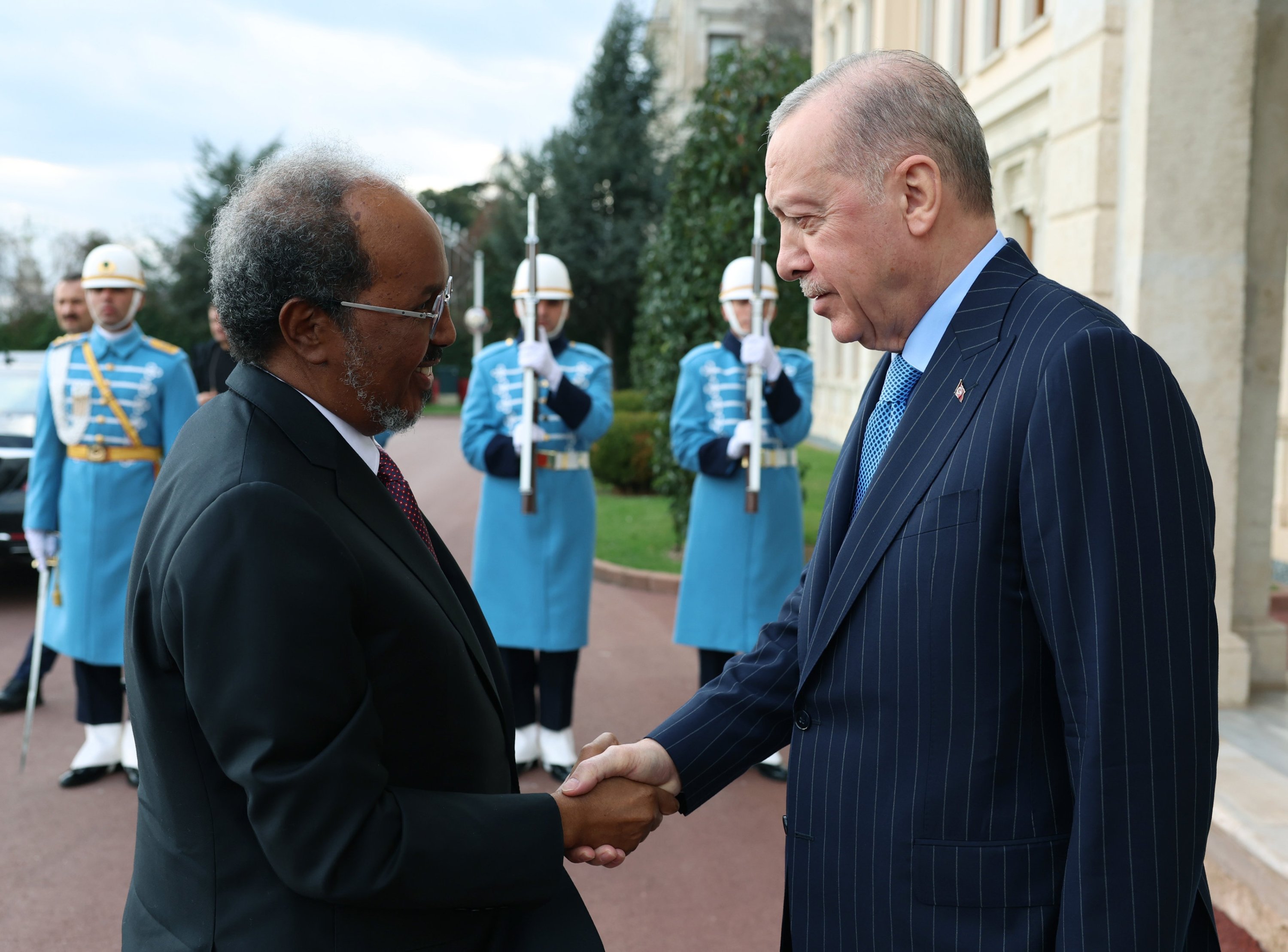
President Recep Tayyip Erdoğan and Somali President Hassan Sheikh Mohamud met on Tuesday, discussing Israel’s decision to recognize Somaliland, the breakaway region that Mogadishu considers part of its territory.
The bilateral talks mostly focused on the current situation in Somalia in the fight against terrorism, measures taken by the federal Somali government towards national unity and regional developments, as Burhanettin Duran, head of the Turkish Presidency's Directorate of Communications, previously announced on his X account.
On the other hand, Türkiye last week denounced Israel's recognition of Somaliland, a self-proclaimed republic, calling it "overt interference in Somalia's domestic affairs."
Türkiye’s U.N. envoy Ahmet Yıldız on Monday sharply rejected Israel’s decision to recognize Somaliland as an independent state, warning the move threatens Somalia’s sovereignty and risks undermining international peace and security.
Addressing an emergency session of the U.N. Security Council, Yıldız said the "principles of international order are once again challenged" with the latest Israeli move, stressing that Türkiye "firmly rejects Israel's announcement, which constitutes a clear and serious violation of international law and the charter of the U.N."
"Unilateral recognition of a region that is a part of a sovereign U.N. member state directly undermines principles of sovereignty, territorial integrity and non-interference," he said.
Yıldız described the announcement as "another example of the (Benjamin) Netanyahu government's unlawful actions aimed at creating instability at both the regional and global level," adding that such conduct cannot be normalized, ignored or excused.
He warned that the decision "sets a dangerous precedent with far-reaching consequences, undermining the sovereignty, unity and territorial integrity of the Federal Republic of Somalia, a U.N. member state, and is a blatant threat to international peace and security and risks encouraging fragmentation and instability, particularly in the corner of Africa and the Red Sea."
Yıldız said the move also amounts to "an explicit intervention in Somalia's internal affairs," emphasizing that "decisions regarding the future of the Federal Republic of Somalia and the Somaliland region should and will be taken by the Somalis alone."
Reiterating Türkiye's position, he said Ankara maintains its "full and unwavering support for the sovereignty, unity and territorial integrity of the Federal Republic of Somalia over its entire territory."
"We reject any measures that undermine Somalia's unity or weaken its internationally recognized borders, its focus and efforts to combat al-Shabab terrorism," he added.
Yıldız also rejected attempts to link the move to broader agendas, including "efforts aimed at the forcible displacement of the Palestinian people from their land."
Calling on the Security Council to act "to uphold its responsibilities under the U.N. Charter," he urged the council to also "respond clearly to actions that threaten the sovereignty of a U.N. member state as well as international peace and security."
Ankara, a close ally of Somalia, provides military and economic assistance to the country that has been devastated by civil war since the early 1990s.
Türkiye is helping to rebuild its army and infrastructure while ensuring its presence in East Africa, including at sea.
Somaliland declared independence in 1991, as Somalia was plunged into chaos following the fall of dictator Siad Barre.
The region has operated autonomously since then and possesses its own currency, army and police force.
It has generally experienced greater stability than Somalia, where al-Shabab militants periodically mount attacks in the capital, Mogadishu.
Diplomatic isolation has been the norm until Israel's move to recognize it as a sovereign nation, which has been criticized by the African Union, Egypt, the six-nation Gulf Cooperation Council and the Saudi-based Organisation of Islamic Cooperation (OIC).
The European Union has insisted that Somalia's sovereignty should be respected.
The recognition is the latest move by Israel that has angered Türkiye, with relations souring between the two countries in recent years.
Ankara has strongly condemned Israel's genocidal war in the Gaza Strip, cut off trade ties and joined an International Court of Justice (ICJ) case against Israel. Israel has opposed Türkiye's participation in a future stabilization force in the Palestinian territory.