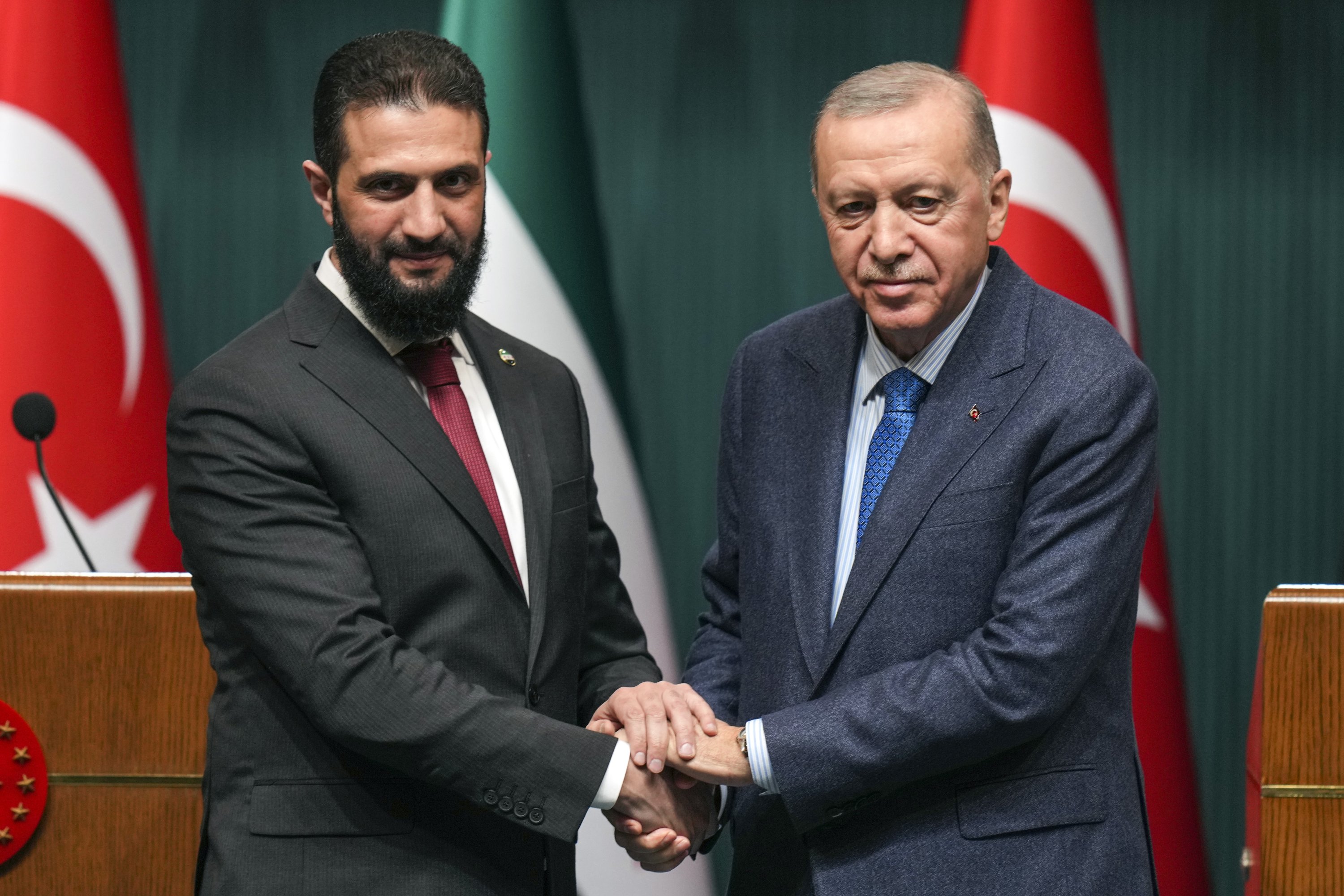
President Recep Tayyip Erdoğan has a busy schedule this month and next. He is expected to attend the United Nations General Assembly in New York, host leaders of the Organization of Turkic States (OTS) in October and meet top officials at the COP31 summit in the southern city of Antalya in November. Before and after these events, Erdoğan may make a much-anticipated visit to Syria, his first since the Assad regime collapsed in 2024.
Foreign Minister Hakan Fidan was in Damascus on Sunday and, among other matters, revealed that he discussed the details of the planned visit with his counterpart, Asaad al-Shaibani. Erdoğan himself has signaled in earlier speeches that he may visit Syria “inşallah” (Allah willing).
Erdoğan was reportedly expected to visit Syria in spring 2026, but the plan was shelved after the outbreak of the U.S.-Israel-Iran war. Based on his busy schedule, the visit may be pushed further and could coincide with the anniversary of the Syrian revolution in December. Regardless, the visit will be historic and cement Türkiye’s strong support for the al-Sharaa administration.
It has been 16 years since a sitting Turkish president visited Damascus, and although Erdoğan was on good terms with Bashar Assad early in his tenure, the civil war and the oppression of civilians completely changed his approach to the Baathist regime. Türkiye sided with the opposition, and when its security was threatened in the lawless environment of the civil war in its southern neighbor, it launched multiple cross-border military operations to clear northern Syria of terrorist groups.
The Turkish president’s visit will likely be heavy on symbolism, something that came up earlier during Fidan’s inaugural visit to Syria after the fall of the Assad regime, when he was photographed sipping tea at Mount Qasioun with President Ahmed al-Sharaa. It remains to be seen whether Erdoğan will visit the same spot, which was once a banned site for Syrians and a location where the Baathist regime’s brutal military units were deployed.
Erdoğan’s visit, on the other hand, will also go beyond mere symbolism, which could include prayers at Damascus’ landmark Umayyad Mosque, as there are many matters to discuss and many reasons for Türkiye to celebrate in post-Assad Syria. These include new steps to boost economic and security cooperation and an opportunity to demonstrate a changing regional order, with stronger Turkish-Syrian cooperation in a region where Israel has freely engaged in an expansionist campaign for the past three years.
Al-Sharaa, on the other hand, has met Erdoğan multiple times since their first meeting two months after the revolution, when al-Sharaa met the Turkish president as Syria’s new leader. Most recently, he was a guest at the NATO summit held in Ankara in July.
Among other things, Erdoğan’s visit is expected to focus on dissolving the SDF, also known as the YPG. The Syrian wing of the terrorist group PKK, which has killed thousands of people in Türkiye since the 1980s, finally bowed to demands from Damascus for integration into the security forces of the new Syria. Erdoğan has repeatedly pushed for the SDF’s alignment with Damascus, in a bid to minimize the security threat it poses to Türkiye and promote a united Syria in the postwar period.
YPG integration is still underway and is moving forward at a faster pace than in the period immediately after a 2025 deal was signed between the group’s leader, Ferhat Abdi Şahin, and President al-Sharaa. Türkiye itself is pursuing a similar plan to end the PKK, though it differs in terms of integration. The full dissolution of the YPG would complement the terror-free Türkiye initiative, which involves the disarmament of the PKK and the subsequent deferral of sentencing for PKK members.
In terms of the economy, Türkiye may announce new business deals with Syria. The postwar country, where infrastructure was razed to the ground in many places, has begun attracting investments and reconstruction deals. Türkiye is already a key player among global contractors and has extensive experience in infrastructure construction. Within months of the revolution, Damascus and Ankara signed deals to increase bilateral trade and establish a Joint Economic and Trade Commission (JETCO).
With Erdoğan’s visit, the two countries may also reaffirm their opposition to Israel’s expansionism, which also targets Syria. Israeli Prime Minister Benjamin Netanyahu visited Mount Hermon on the Syrian side of the Israeli-Syrian border earlier this month, one of several instances of what Syria and its allies consider illegal incursions into Syrian territory. His visit sparked outrage among Syria’s allies, including Türkiye.
Türkiye was also disturbed by Netanyahu’s attempt to portray an attack on Syria’s Abu al-Duhur airport as an effort to curb the Turkish footprint in Syria, claiming that Turkish troops could potentially be deployed at the site. Ankara has repeatedly accused Israel of attempting to destabilize Syria, both through direct attacks and through proxy forces opposing the al-Sharaa administration.
The Turkish president’s visit will be a show of force and unity between Türkiye and Syria against greater Israeli designs in the region. Türkiye is concerned about Israel’s alliance with historic foes of the country, such as Greece.
Overall, Erdoğan’s trip to Syria will cap the increasing Turkish engagement with a neighbor that shares a border of more than 900 kilometers (559 miles) with Türkiye, from hosting the largest number of refugees fleeing the civil war for years to supporting Syrian opposition forces during Assad’s rule. Thus, it could be yet another addition to Türkiye’s rising status as a major power broker in the region after years of being a mere observer.