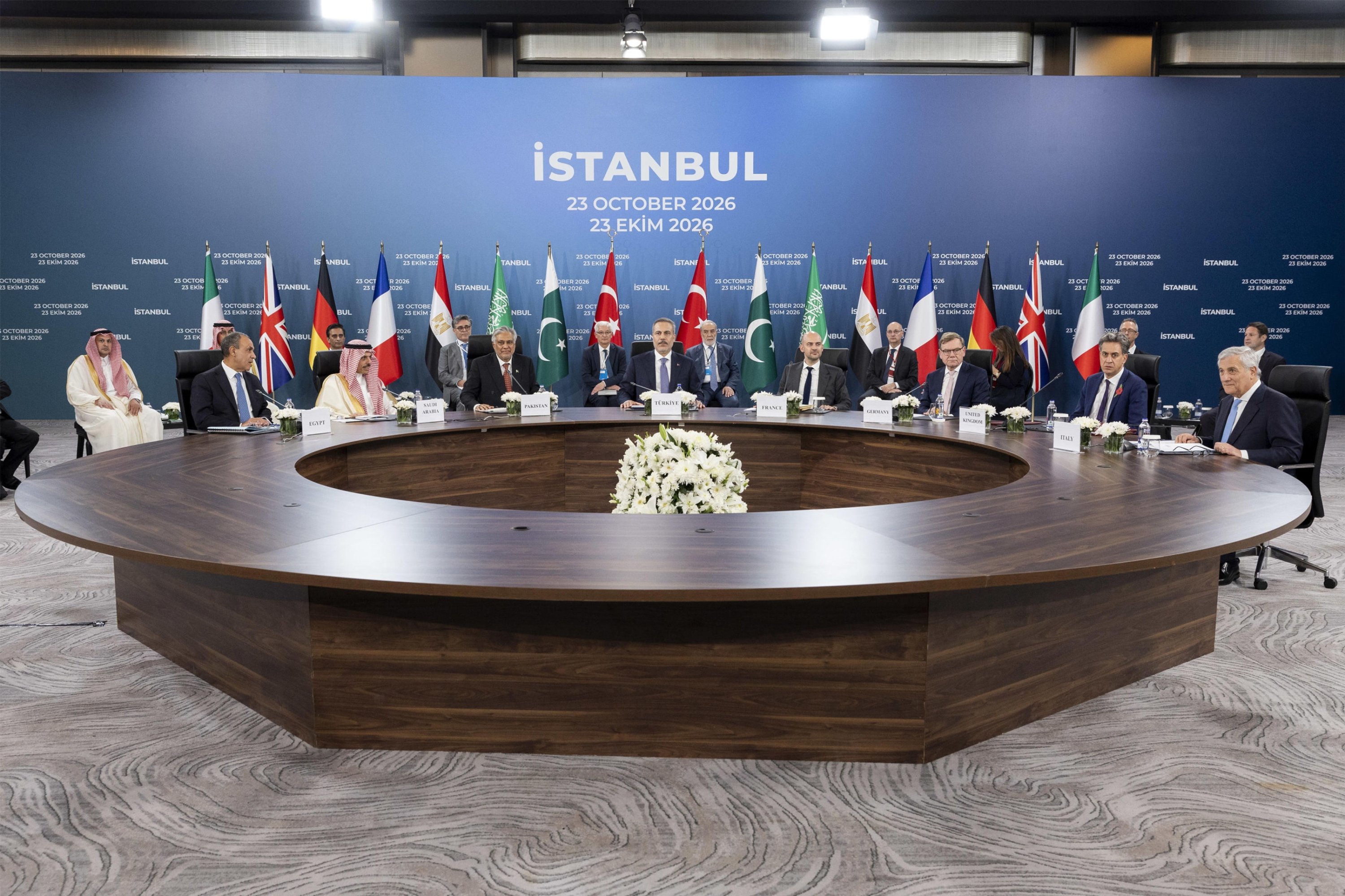
Türkiye, Egypt, Saudi Arabia and Pakistan on Friday condemned Israel's occupation of Palestinian territories as the main source of instability in the Middle East and beyond, demanding an urgent end to Israeli violence, illegal settlement expansion and the forced displacement of Palestinians while calling for the immediate implementation of a two-state solution.
In a joint statement issued following the R4 foreign ministers' meeting in Istanbul, the four countries warned that Israeli policies had deepened a sense of injustice among people worldwide and undermined prospects for lasting regional peace.
The ministers reaffirmed their support for the Palestinian people's right to self-determination and the establishment of an independent, sovereign, viable and territorially contiguous Palestinian state based on the June 4, 1967, borders, with East Jerusalem as its capital.
They stressed that implementing a two-state solution in accordance with relevant United Nations resolutions was essential to achieving comprehensive peace in the Middle East.
The joint statement also demanded an immediate end to Israeli violence and attempts to alter Jerusalem's legal and historical status.
The ministers condemned past and ongoing illegal Israeli settlement activities in the occupied West Bank and East Jerusalem, along with attacks by illegal Israeli settlers against Palestinian communities.
They also called for unrestricted humanitarian assistance to the Gaza Strip and urgent reconstruction efforts to address the devastation and humanitarian suffering caused by the conflict.
Addressing the ongoing military confrontation between the U.S., Israel and Iran, the four countries emphasized that dialogue and diplomacy remained the only viable means of resolving the crisis.
The ministers urged all sides to refrain from targeting civilians and civilian infrastructure, including commercial vessels, while warning against further military escalation.
They expressed support for the Islamabad Memorandum of Understanding and welcomed diplomatic initiatives aimed at preventing the conflict from spreading, reaffirming their commitment to a lasting negotiated settlement.
The statement also highlighted the strategic importance of maritime security and freedom of navigation, particularly in the Strait of Hormuz, a critical passage for international energy shipments.
The ministers warned that disruptions to major shipping routes threatened global supply chains and the transportation of energy, fertilizers and food, with particularly severe consequences for vulnerable populations.
They rejected measures restricting lawful maritime traffic and demanded the swift restoration of safe, secure and unrestricted passage through the Strait of Hormuz.
The four countries emphasized that protecting international shipping routes required coordinated action by the international community.
Turning to Yemen, the R4 ministers strongly condemned escalating attacks by the Houthi militia, particularly strikes targeting Saudi Arabia and its civilian infrastructure.
They also denounced Houthi attacks on commercial shipping in the Red Sea and the Bab el-Mandeb Strait, warning that such actions had intensified humanitarian suffering and threatened regional maritime security.
The ministers expressed solidarity with the governments of Saudi Arabia and Yemen and called on the Houthis to immediately halt military operations, threats and attacks.
They urged the group to return to the political process in good faith, stressing the importance of diplomatic efforts to restore stability in Yemen and the wider region.
Türkiye pledges continued regional diplomatic engagement
The joint statement followed a series of diplomatic meetings hosted by Türkiye, bringing together regional and European powers to address interconnected conflicts and security challenges across the Middle East and Europe.
Foreign Minister Hakan Fidan said Türkiye had hosted representatives from eight countries in Istanbul for the R4 and expanded R4+E3 meetings, which also included Britain, Germany, France and Italy.
In a statement shared on social media, Fidan said the discussions addressed regional and global challenges, emphasizing the need for coordinated diplomatic efforts to prevent further instability.
He said participating countries agreed that disputes should be resolved through dialogue and diplomacy, guided by the principle of regional ownership.
Fidan also emphasized Türkiye's determination to continue playing an active role in resolving regional crises, citing its strategic position connecting Europe and the Middle East.
"We hope this initiative, which we have spearheaded, will gain continuity and contribute to peace and stability in our region and beyond," Fidan said.
"With our central position between the two regions, Türkiye will continue to assume responsibility for resolving regional issues," he added.
The R4 ministers agreed to maintain close consultations and coordination on the issues discussed, underscoring their commitment to continued diplomatic engagement on regional security, humanitarian challenges and efforts to achieve lasting peace.