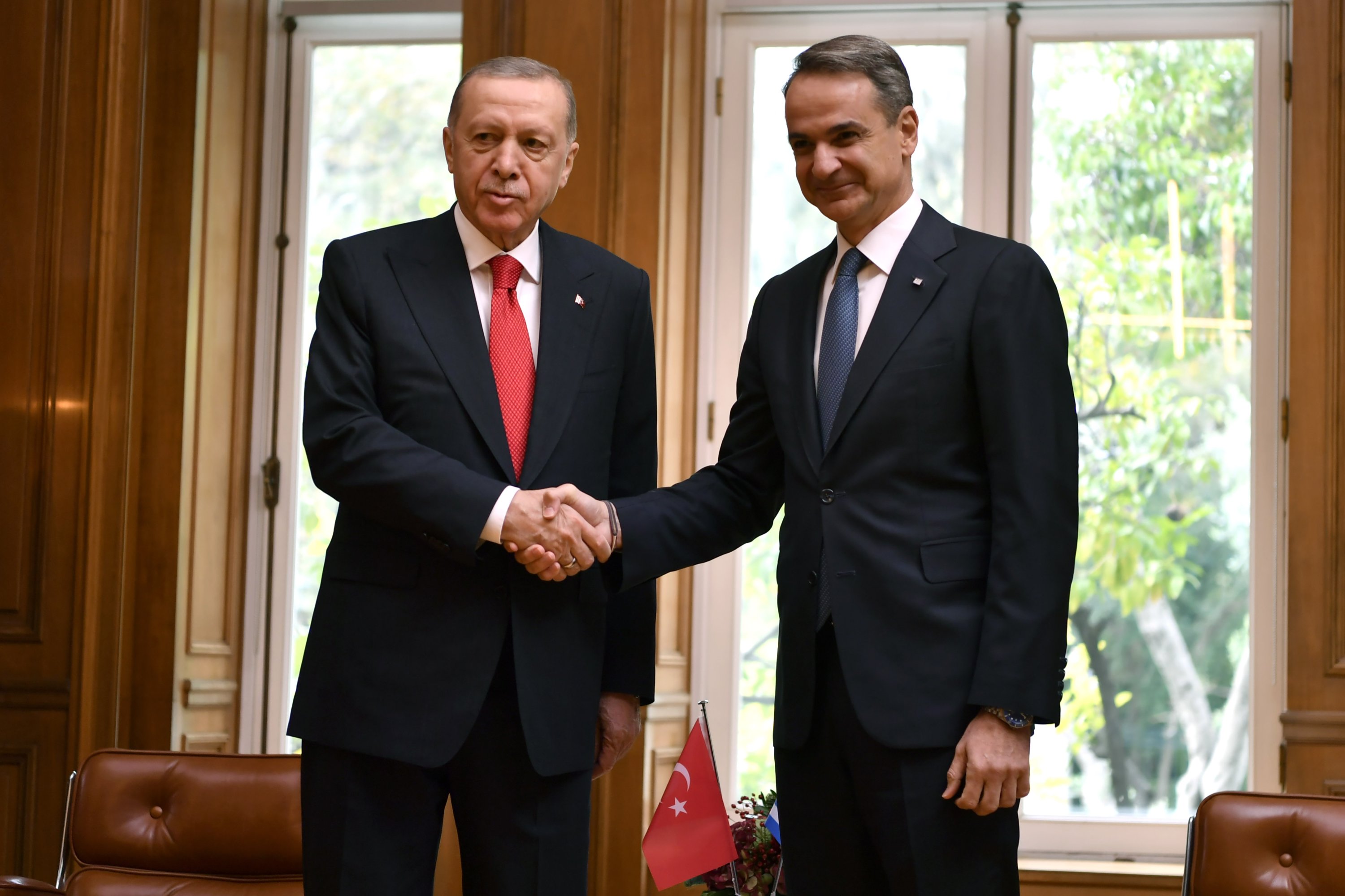
Greek Prime Minister Kyriakos Mitsotakis said he aims to build on recent diplomatic momentum between Greece and Türkiye despite longstanding tensions, according to an interview on Thursday, ahead of his visit to Türkiye on Feb. 11.
Speaking to Foreign Policy magazine, Mitsotakis said Athens recognizes a single core dispute with Ankara: the delimitation of maritime zones in the Aegean Sea and the Eastern Mediterranean.
“This difference goes back decades,” Mitsotakis said. He added that the two sides have worked constructively in recent years to ease tensions and maintain cooperation, even without resolving the long-running dispute.
“We cannot solve this major problem, which hasn’t been resolved for many decades,” he said. “But we can still have a working relationship, a constructive relationship on certain fronts.”
Mitsotakis underlined that he plans to clearly restate Greece’s position during talks in Ankara, while also seeking to build on progress made over the past year. He is scheduled to visit Türkiye on Feb. 11 as part of ongoing efforts to improve bilateral ties.
Most recently, Türkiye rejected statements by Greek officials regarding a possible extension of Greece’s territorial waters in the Aegean Sea to 12 nautical miles, stressing that such unilateral actions are unacceptable and contrary to international law.
Ankara’s stance on the issue is clear, the Defense Ministry sources told reporters at a weekly briefing on Thursday. They emphasized that a fair and lawful sharing of maritime jurisdiction in the Aegean is only possible through dialogue conducted in good faith. They warned that actions and claims that ignore existing disputes and violate Türkiye’s rights cannot have legal consequences for the country.
“As Türkiye, we advocate that a fair, equitable and internationally lawful sharing of maritime jurisdiction in the Aegean is only possible within the framework of mutual dialogue and good faith,” the ministry said. It added that Greece’s unilateral actions, claims and statements disregarding contested areas are unacceptable.
The ministry underlined that the Turkish military remains determined to protect the country’s interests in line with the “Blue Homeland” doctrine, a concept defining Türkiye’s maritime jurisdiction areas, including its continental shelf and exclusive economic zone.
“In line with the ‘Blue Homeland’ concept, the Turkish Armed Forces (TSK) are resolutely continuing their duty to protect all rights and interests in our country’s maritime jurisdiction areas,” the statement said.
Previously this week, the Greek prime minister also told local media that the dispute over the Aegean and the Eastern Mediterranean stands out as an obstacle in advancing Greek-Turkish ties and threatens the prevalence of Türkiye’s exclusion from EU funds.
Athens and Ankara have tried to overcome their differences in recent years, leaving behind a troubled past. Last month, diplomats from the two countries came together in the Greek capital for a “positive agenda” meeting.
Regarding his meeting with President Recep Tayyip Erdoğan during his Türkiye visit, Mitsotakis told Skai TV that Greece and Türkiye did not need arbitrators or intermediaries to discuss bilateral issues. He hailed improvement in relations since the Athens Declaration was signed during Erdoğan’s visit to Greece in 2023.
Mitsotakis noted that resolving their dispute in maritime delimitation would bring Türkiye closer to the European Union, of which Ankara hopes to be a member. He warned, however, that the prevalence of “casus belli” in the Aegean would prevent Türkiye’s access to European funds. Mitsotakis, quoted by the Greek TV, admitted that Athens used the issue as “leverage” against Türkiye, so that Ankara would “abandon misguided claims.”
Türkiye recently extended the navigation warnings, known as Navtex, in the wake of Greece’s violation of Türkiye’s maritime borders. Mitsotakis, who was accused by the Greek opposition of remaining silent on the issue, hit out at the warnings and claimed they were illegal and Greece would not seek Türkiye’s permission for running projects in those waters, such as electrical interconnection projects.