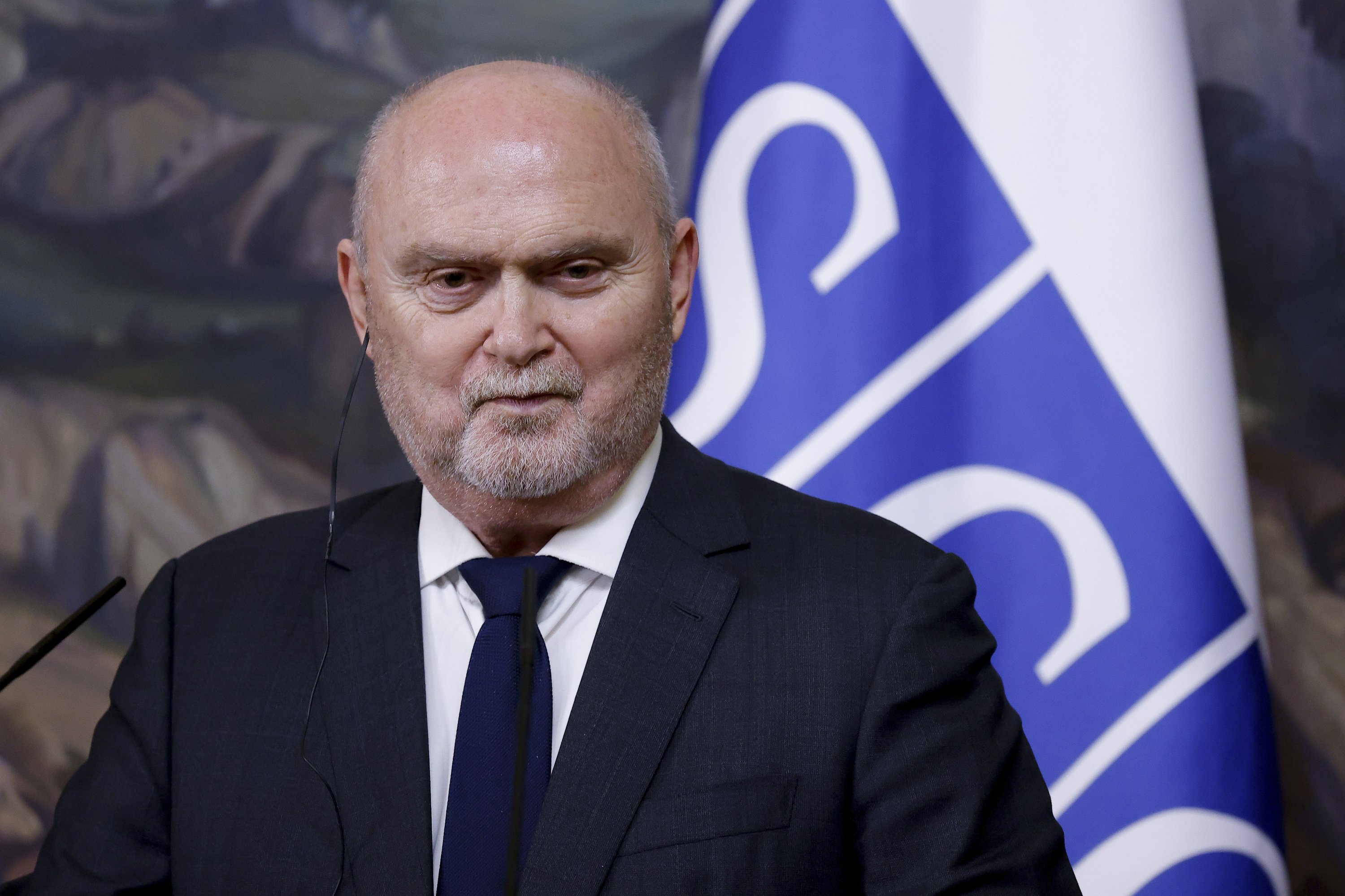
In a career that took him from embassies around the world to the post of foreign minister and finally, the post of secretary-general at the Organisation for Security and Co-operation in Europe (OECD), Feridun Sinirlioğlu saw how diplomacy worked and failed. As Türkiye’s candidate to succeed outgoing U.N. Secretary-General Antonio Guterres, Sinirlioğlu outlined his pledges for his possible next job. The vision statement of Sinirlioğlu, included in his application to the job, focuses on the comprehensive reform process at the international body and how the United Nations has a historic opportunity to become what it is envisioned to be after the accomplishment of reforms.
President Recep Tayyip Erdoğan fiercely advocates comprehensive reform at the United Nations, especially the Security Council, which he says fails to be inclusive and often underlines that countries outside major powers should have more say in international affairs. Erdoğan’s advocacy especially escalated during Israel’s genocidal attacks in Gaza, which have killed tens of thousands of people since 2023. The Turkish leader often accuses the international community, making up the United Nations, of failing to act against Israel to stop the genocide, though many countries, even a few among the Western countries that staunchly support Israel, were hailed by Erdoğan for breaking the silence.
Sinirlioğlu’s vision statement entitled “Upholding Multilateralism and Building Bridges” summarizes his policy promises if elected as the next U.N. chief.
Under the title of “A United Nations That Fulfills Its Mission,” the statement reminds us that the body was founded to “save succeeding generations from the scourge of war.”
“The UN Charter was forged through the wisdom of women and men who knew all too well the unspeakable price that war had inflicted on humanity. From the ashes of war and from the sacrifice of millions, the United Nations was established to maintain international peace and security. Throughout the decades, it has become the foremost global forum for building peace, advancing economic and social development, and promoting universal human rights. While much has been accomplished, humanity once again stands at a defining moment in its history.
“International peace and security are under unprecedented strain. War is ravaging peoples and lands across the globe; widening economic inequalities undermine the legitimate aspiration of future generations to achieve greater prosperity than those who came before them; demographic shifts and global migration patterns raise new challenges that demand coordinated international responses; human rights are violated in plain sight and weakened by intolerable double standards; and transnational threats, including organized crime and terrorism, challenge States’ sovereignty and threaten the security of all. At the same time, a new technological revolution is unfolding, generating both extraordinary opportunities and profound uncertainty,” Sinirlioğlu said in his statement.
“Only a United Nations that rediscovers its original historic mission and purpose can rise to the challenge. The Charter has been and remains our enduring beacon, providing the principles and framework for international dialogue and cooperation. I am convinced that it is what stands between humanity and the abyss of endless war and destruction. As Secretary-General, I would faithfully uphold, serve, and promote the Charter. With more than four decades of experience in diplomacy, I remain firmly convinced that the United Nations can once again guide humanity toward peace, prosperity, and dignity for all. I seek the office of Secretary-General because I believe the United Nations remains indispensable – not because it is perfect, but because no other institution possesses its universal legitimacy, convening power, and moral responsibility,” he added. The Secretary-General must be an independent guardian of the Charter, an honest broker among Member States, and a visionary leader of the world’s most complex multilateral institution. The role demands integrity, impartiality, courage, and the ability to listen carefully and to lead. These qualities are particularly vital at a time when the United Nations is called upon to undertake profound reform, reduce costs, and refocus on its core mission. Above all, the Secretary-General must serve all Member States impartially and work to build a better future for all,” he said.
Sinirlioğlu noted that diplomacy remained “the most powerful tool for reducing tensions and managing risks in an environment marked by mistrust.”
“The United Nations was founded on a simple yet enduring truth: security cannot be built against one another. As hard as it may be, it must be built with one another. That principle has not changed, and our responsibility to uphold it has never been greater. In this regard, resolving today’s complex conflicts requires keeping channels of communication open, and reopening those that have been closed. Engaging with those with whom we disagree is not a concession but a responsibility. It is essential for avoiding misunderstandings and reducing the risk of miscalculation in today’s volatile security environment. The Secretary-General, through the exercise of the Organization’s good offices and preventive diplomacy, can bridge divides, build trust, and help achieve results both at the negotiating table and on the ground. Our objective should not simply be to manage crises, but to prevent them. To that end, the United Nations should strengthen its capacities for early warning, mediation, peacebuilding, and cooperation with regional partners in order to reduce human suffering and the enormous costs of war. At the same time, UN peacekeeping operations continue to serve the cause of peace by fostering stability, supporting peace agreements, and protecting civilians. Although they are not an end in themselves, these operations create the conditions necessary to sustain peace and must remain agile, effective, and responsive through continuous review and reform,” he said.
Türkiye's nomination of Sinirlioğlu is intended to help overcome a deadlock in the selection process, Turkish Foreign Minister Hakan Fidan said Saturday.
"Our goal is to provide a diplomatic contribution aimed at overcoming the impasse," Fidan told Anadolu Agency (AA) and Turkish public broadcaster TRT.
In a letter dated Friday to the presidents of the General Assembly and the Security Council, Türkiye's U.N. Ambassador Ahmet Yıldız transmitted President Erdoğan's nomination letter, in line with the U.N. Charter and a General Assembly resolution.
Fidan said Ankara had been "closely monitoring" the selection process and anticipated that difficulties could emerge among the candidates, prompting Türkiye to consider putting forward its own nominee. He said the process had been underway for about a year, with several candidates from Latin America competing in line with the informal geographical rotation traditionally considered in selecting the U.N. chief. Türkiye respects the expectation that Latin America should have the opportunity to produce the next secretary-general, Fidan said, but added that the process had reached a stalemate.
He explained that the nomination of candidates from other regions when the selection process becomes deadlocked is not unprecedented in U.N. history.
Fidan said Türkiye decided to formally nominate Sinirlioğlu after the latest developments in the selection process, including voting involving the United Arab Emirates' candidate Lana Nusseibeh.
He added that Türkiye had already agreed to put forward its candidate if certain conditions emerged during the selection process. "Once the deadlock became clear, we officially submitted our own candidate to the U.N. with a letter signed by our president," he said.
He stressed that Ankara's decision was not simply an attempt to enter the competition but rather an effort to contribute to resolving the impasse.
Fidan said Sinirlioğlu is an experienced career diplomat with extensive international experience, including his previous service as Türkiye's U.N. ambassador.
Fidan stressed that Türkiye attaches great importance to multilateralism and the effective functioning of international organizations, particularly the U.N.
He said Erdoğan strongly supports a U.N. system that operates "genuinely and fairly," adding that Türkiye will continue contributing to efforts to strengthen the organization.
"Türkiye will continue to do everything it can to contribute to this," Fidan said, describing Sinirlioğlu's nomination as one part of Ankara's broader diplomatic efforts.
A candidate needs at least nine votes in the Security Council to secure the required support, while any of the five permanent members – the U.S., China, France, Russia and the U.K. – can block a candidate with a veto.
The eventual nominee must be appointed by the General Assembly, with that step generally considered a formality once the Security Council has reached an agreement. The term of Antonio Guterres, the current secretary-general, ends on Dec. 31.