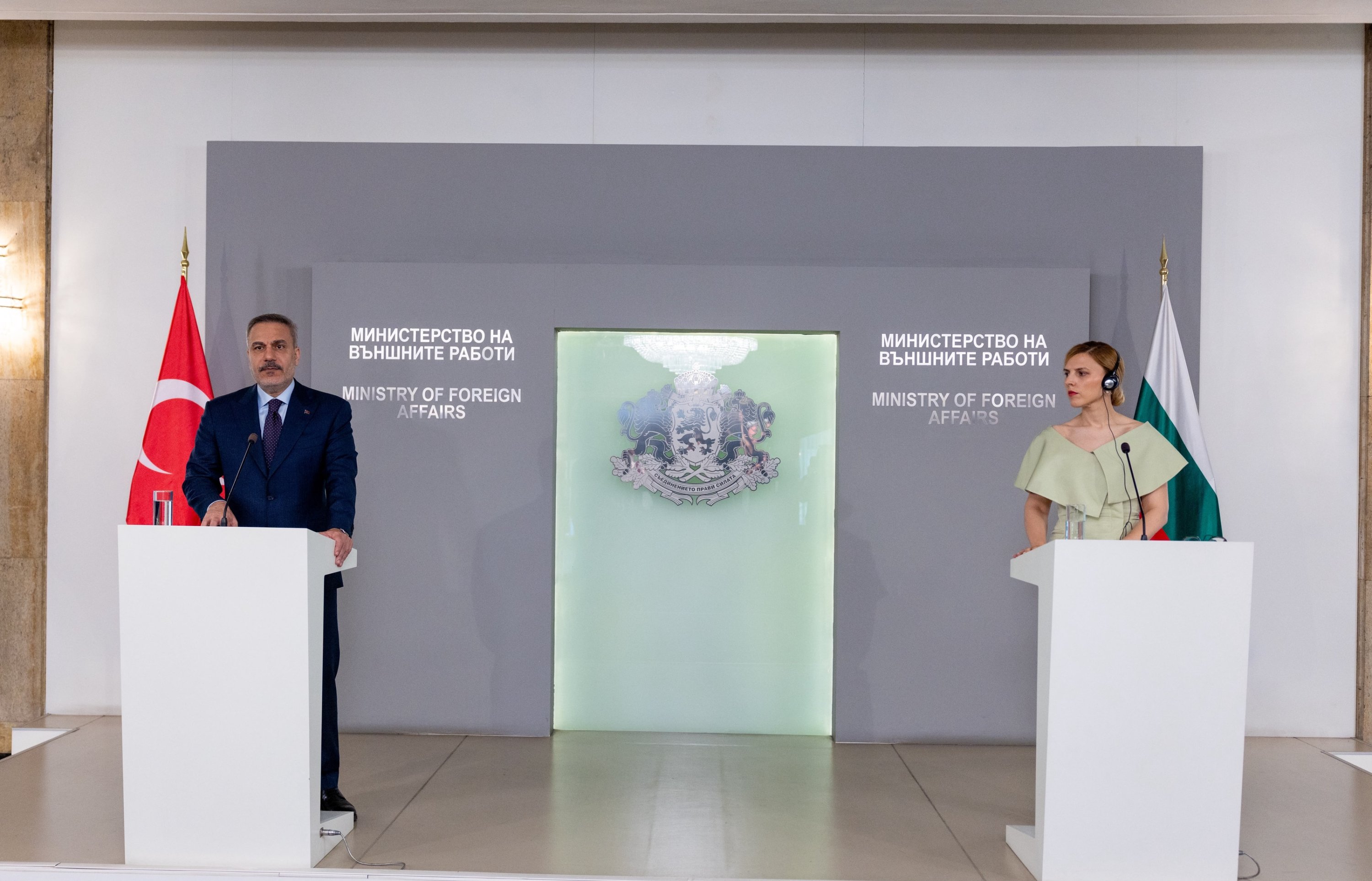
The U.S.-Israel-Iran war, bilateral relations, Black Sea security and ties with the EU dominated Foreign Minister Hakan Fidan’s joint news conference with his Bulgarian counterpart Velislava Petrova-Chamova in Sofia on Thursday.
Fidan arrived in Bulgaria earlier this week to attend the Southeast European Cooperation Process (SEECP) Summit and held bilateral talks with Petrova-Chamova.
The Turkish minister said at the news conference that mutual attacks in U.S.-Israel-Iran tensions had escalated in the past two days. “We are concerned. We recommend the sides cease attacks and return to the negotiation table and finalize the text (on a lasting peace) they are close to agreeing upon. We work to ensure it. We have seen that it is no benefit to anyone to escalate the conflict, to return to all-out war,” Fidan said.
The U.S. and Iran exchanged fresh attacks for a second consecutive night, heightening fears that the cease-fire agreed on in April might be unravelling.
Early on Thursday, the U.S. military said it had "completed" its latest round of strikes. In a post on X, the U.S. Central Command (CENTCOM), which is responsible for the region, said the attacks targeted military intelligence facilities, communications systems and air defense positions that it said posed a threat to U.S. forces and international shipping.
"The strikes are in response to Iran's unwarranted and continued aggression. U.S. forces remain vigilant, lethal and ready," it wrote. Iranian media reported explosions near the southern cities of Minab and Sirik, as well as on Qeshm Island and in the port city of Bandar Abbas.
Separate explosions were also reported near the commuter hub of Karaj, just a few kilometers west of Tehran, where state media said combat drones had been spotted.
The latest escalation followed U.S. strikes earlier this week on Iranian air defense systems, ground control stations and radar installations in response to the downing of a U.S. military helicopter. Iran subsequently launched attacks on U.S. bases in the Gulf region. Iran's armed forces said early Thursday they had again targeted Bahrain and Kuwait in response to the latest U.S. strikes. Kuwait temporarily closed its airspace to civilian aviation and said air defenses had been activated.
U.S. President Donald Trump meanwhile accused Tehran of repeatedly violating the truce that came into force on April 8, describing it as "the most violated cease-fire in the history of the world," according to comments reported by Fox News.
“No matter how difficult, how nerve-wracking it may be, the sides should carry the negotiations to a conclusion,” Fidan said Thursday.
On bilateral ties, Fidan said Türkiye and Bulgaria have a deepening strategic partnership. “We are acting as two neighbors and allies complementing each other in fields from border security and energy to transportation and commerce. A stronger Turkish-Bulgarian partnership is also beneficial for our wider region,” he said.
Fidan highlighted the deep historical ties and friendship between the two countries. “Lasting stability and prosperity in this region is through strengthening dialogue and cooperation. This was what was agreed upon at the SEECP summit as well. We highlighted that the countries should move forward with a regional ownership approach,” he stated.
The minister said Bulgarian Turks and Muslims played an exceptional role in strengthening bonds between the countries.
Fidan noted that the Turkish-Bulgarian border was a busy route and at their meeting, they reaffirmed their commitment to build a new border crossing north of the Kapıkule crossing.
“We also exchanged views on increasing the capacity of our border crossings and on highway and railway projects that will strengthen regional connectivity. We are grateful for the support provided by the Bulgarian authorities in ensuring smooth border crossings for our citizens traveling from Europe to our country during the summer months,” the minister said.
Fidan also spoke about the security of Black Sea, in light of the Russia-Ukraine conflict. “While deepening our military relations with Bulgaria both within NATO and bilaterally, we are also taking concrete steps in the context of regional initiatives. The Black Sea Mine Countermeasures Task Group, established together with Bulgaria and Romania, plays an important role in ensuring safe navigation in the Black Sea. We are determined to further advance the activities of this task force, which we currently command. The long-term guarantee of Black Sea security is undoubtedly the end of the war continuing to our north. We consider the establishment of peace between Russia and Ukraine essential for the stability of our region. As Türkiye, we will continue to provide active support to both sides toward this goal. Our expectation is to achieve a lasting and just peace based on international law as soon as possible,” the minister said.
On Turkish ties with the European Union, particularly the accession process, Fidan said this was discussed at their meeting.
"The multidimensional crises shaking our region and the world clearly demonstrate the strategic and indispensable nature of Türkiye-European Union relations. It is evident that a European (security) architecture in which Türkiye does not occupy its rightful place will remain incomplete and have a weakened capacity to cope with crises. The European Union's economic future depends on increasing its competitiveness, strengthening its resilience, and rebuilding supply chains in its neighboring geography. In this context, deepening economic integration with Türkiye is a strategic necessity for the European Union. It is essential that the European Union's defense and security initiatives be conducted in an inclusive manner that includes Türkiye, a strong NATO ally and a contributor to European security. In this regard, we greatly appreciate Bulgaria's valuable support for Türkiye's EU membership process,” he stated.