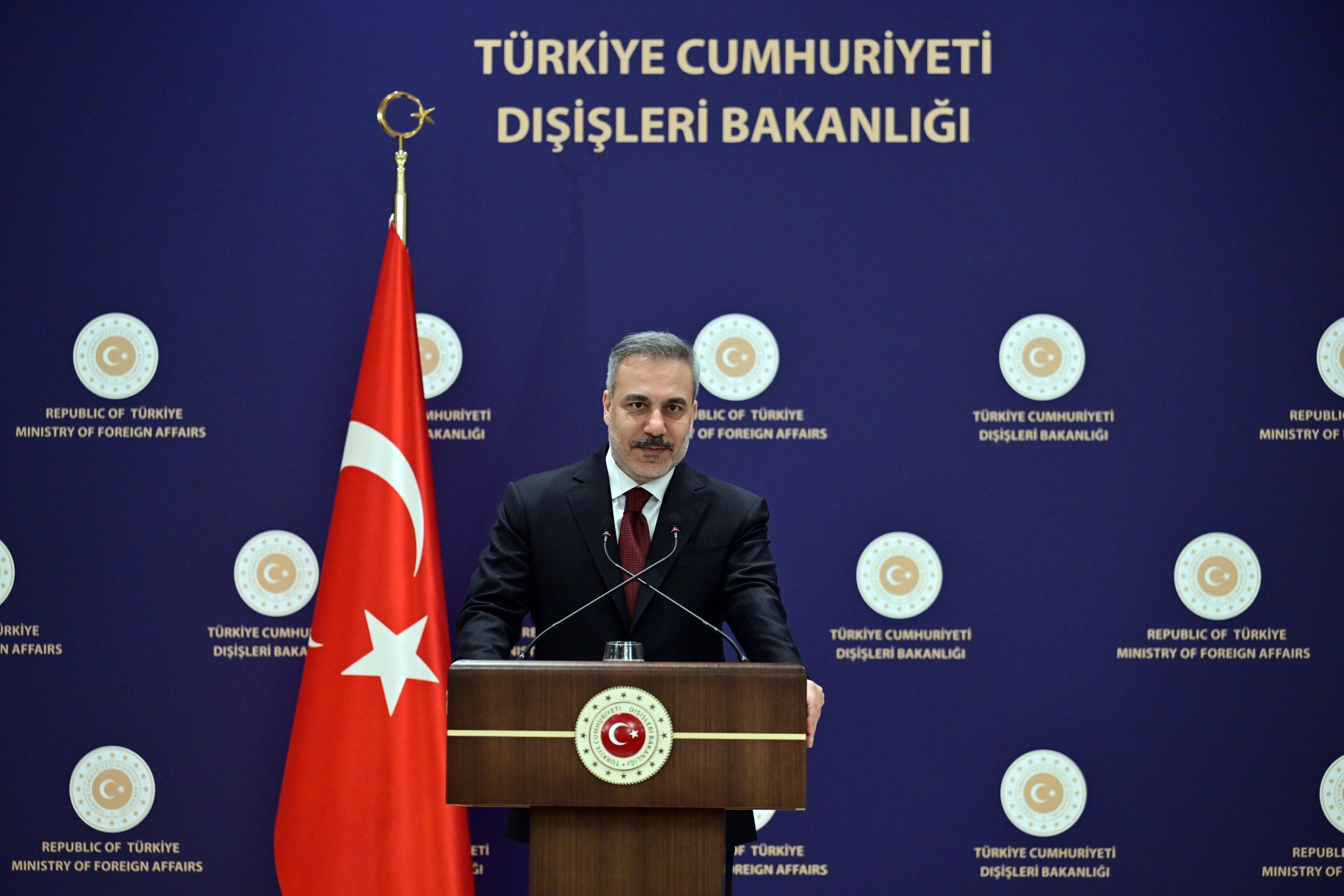
Speaking to journalists in Istanbul on Thursday, Foreign Minister Hakan Fidan said improvement of Turkish-Greek relations is always possible, but Greek politicians have long utilized Türkiye for their own political career.
“Greece’s domestic politics do not provide room for a solution in resolving issues between our countries. Greece should exhibit a strong will to resolve bilateral issues. Türkiye has enough maturity to move ties forward,” he said.
He said a new meeting between the leaders of the two countries may take place soon and confirmed upcoming high-level talks between Turkish and Greek officials. A political dialogue meeting is expected to take place this month and would be followed by talks under the so-called Positive Agenda framework. The two-day meetings are expected to address disputes in the Aegean and Eastern Mediterranean, regional developments and steps to improve bilateral relations.
After a long period of tensions marked by disputes over irregular migration, the Cyprus dispute, energy exploration and territorial sovereignty in the Aegean, Ankara and Athens have been taking confidence-building steps for a fragile normalization of their relations since late 2023.
The normalization sustained momentum in the past two years, with talks between leaders as well as sporadic high-level meetings of top officials to discuss sources of dispute.
Yet, both countries stand firm in their maritime rights, which are still not fully agreed upon after decades of hostilities dating back to the post-World War I period.
Fidan said Türkiye was determined to resolve its disputes with Greece and is ready to engage in sustained talks until a solution is reached.
“We will come to the table with the intention and the will to solve existing problems, and we will not leave that table until the problem is resolved,” Fidan said.
“That problem is primarily the disputes in the Aegean, including territorial waters and the continental shelf.”
He said President Recep Tayyip Erdoğan has both the vision and the political will to resolve the issue, citing his long and productive leadership. However, he argued that Greece’s domestic political dynamics limit the ability of Greek leaders to sign an agreement.
“I don’t say this to shift responsibility to the other side. Internal political balances in Greece do not leave much room for any political leader to resolve this issue and put their signature to it.”
He noted that Greek Prime Minister Kyriakos Mitsotakis was reelected in June 2023 with strong public support, while Erdoğan was reelected in May of the same year.
“Both our president and Mr. Mitsotakis saw this,” Fidan said. “There was, in fact, a desire to move forward by demonstrating real political will.”
He said Türkiye has repeatedly expressed its readiness to advance high-level talks and permanently resolve the dispute, but added that doing so requires separating domestic politics from foreign policy.
“In Turkish politics, I try to remain neutral on this issue, and I see that there is more than enough political maturity,” he said.
“But in Greek domestic politics, portraying Türkiye as a threat has always been a driving force.”
He said any Greek politician who attempts to improve relations with Türkiye inevitably pays a political price.
“A political leader in Greece is forced to choose between resolving problems with Türkiye and bringing peace to the region, or risking their own political career,” Fidan said.
“That choice is rarely made in favor of solving the problem. That is the reality, and it needs to change.”
Fidan said confidence-building measures should be implemented and people-to-people contacts expanded. He also warned against using unfounded issues as tools of domestic politics.
He said Türkiye responds politically when tensions rise or threats increase, and that the public expects such responses. Still, Fidan stressed that Erdoğan’s commitment to resolving the disputes remains unchanged.
“The president’s will in this direction continues,” he said. “These problems can be solved.”