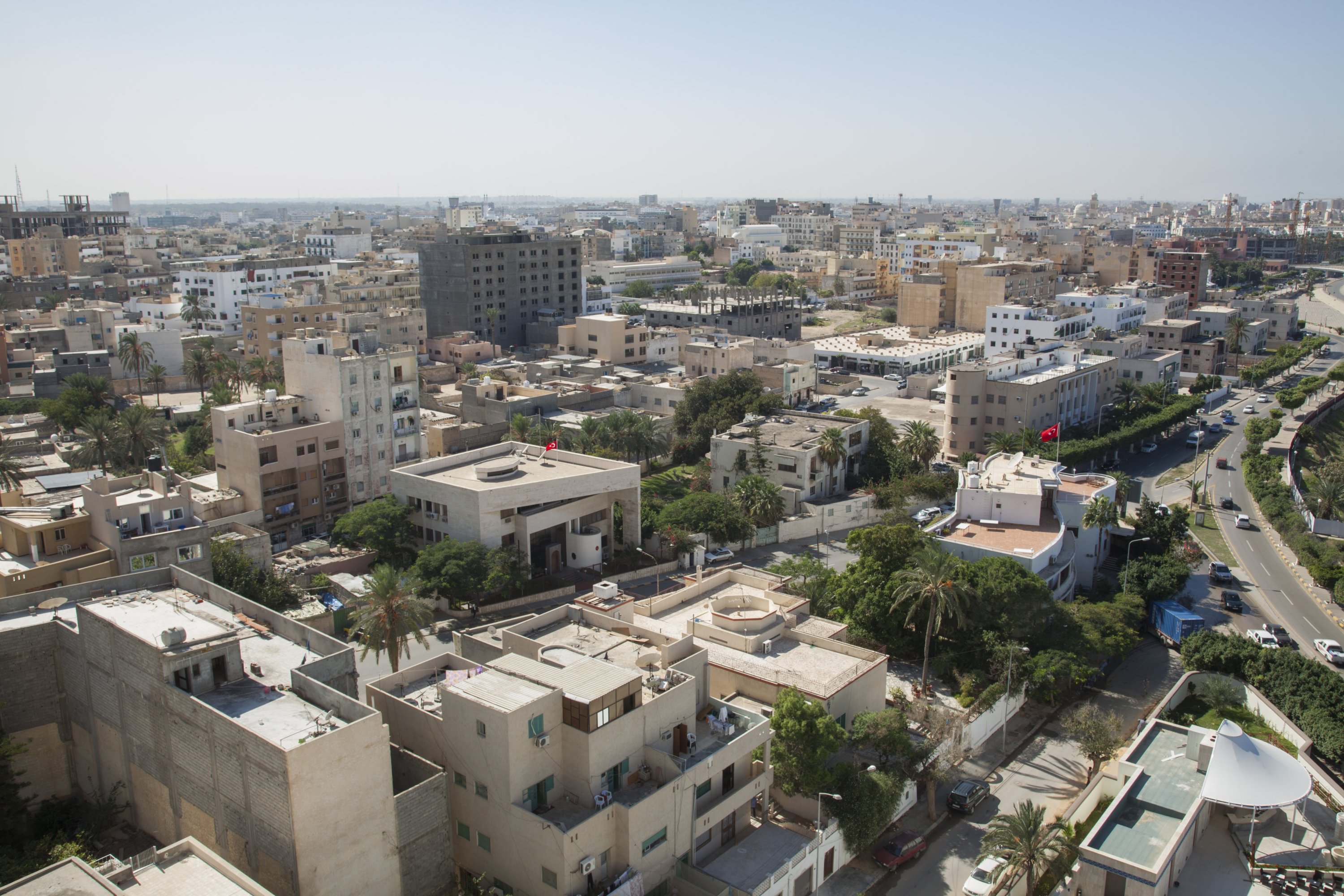
Türkiye’s diplomatic efforts and security strategy provided an “environment of non-conflict” in Libya, and this led to renewed negotiations between actors in the country’s east and west after a five-year hiatus, experts say.
They highlighted that the balance of security achieved by Türkiye in the North African country pushed the sides to finally understand that a prolonged conflict would not bring about a concrete outcome.
Hanna Tetteh, the U.N. secretary-general's special envoy for Libya, earlier lauded Türkiye’s stand on Libya that supported stability. Tetteh underlined in remarks on April 19 that without Türkiye’s support, western Libya in particular would not reach the stability it has.
The sides controlling Libya’s west and east met on April 29 under the supervision of the mission led by Tetteh and agreed on restructuring Libya National Election Commission. This paved the way for new talks on electoral laws, the main cause of political conflict in the country. Concerns, however, linger that a new deadlock may emerge in the country.
Professor Veysel Kurt of Istanbul Medeniyet University, who serves as research director at Middle Eastern Studies Center (ORSAM), told Anadolu Agency (AA) on Wednesday after a workshop on Libyan-Turkish relations in Tripoli that the Turkish-Libyan security deal signed in 2020 ensured stability in the country. Kurt stated that interventions by various international actors in Libya have had a negative impact on prolonging the political deadlock.
“At the point we have reached today, Türkiye has made significant diplomatic moves to establish relations with both the Tripoli government and the actors in Benghazi and to ensure reconciliation between them. Ultimately, it is important that these two actors meet face-to-face in Italy for the first time in a long while.”
Kurt assessed that reaching an agreement on the structuring of the National Election Commission at the meeting of Libyan parties is an important sign that the process is moving forward. Stating that to end the division in Libya, either one side must disappear or reconciliation must be achieved between the parties, Kurt said: “One of two scenarios is necessary to eliminate the division. Either one side will completely defeat the other and take full control, or a compromise will be reached. The first scenario did not happen. During the prolonged conflicts and civil war, neither Haftar’s side nor the Tripoli government was able to fully control the country. Therefore, what remains is the second scenario: ‘reconciliation.’”
“If the two sides cannot eliminate each other, then only one option remains: reconciling them. And despite all the difficulties, Türkiye achieved this. It was a very important matter for Libya to continue its political life as an institutionally and territorially unified country.”
Kurt noted that it is an optimistic development that Libyan parties have come together at the same table to address election laws. “Of course, after reconciliation is achieved, the rest of the matter will be decided by the Libyan people. In other words, what result will emerge from the elections, and which structure will take governing authority? This will be a decision made by the Libyan people.”
Associate professor Yunus Turan from Hacı Bayram Veli University also stated that, as in every period of history, Türkiye has always stood actively by Libya’s side after 2011.
Turan said that Türkiye has made serious efforts in terms of political and security paradigms for Libya’s national unity, territorial integrity and unification under a single umbrella.
“Türkiye has essentially proceeded with the motto of one Libya, one nation, one country. Up to now, Türkiye’s policies have demonstrated a consistent Libya policy in this regard. The picture that emerged from the meeting of Libyan parties in Rome showed how consistent and meaningful Türkiye’s Libya policy has been from the very beginning.”
“The point we have reached in 2026 has proven how much the Libyan people desire and approve of Türkiye’s policy. The international media did not accept this in this way and resisted it for many years, putting forward policies toward the fragmentation of Libya. But in the end, it became clear that the policy Türkiye has pursued from the beginning is the most consistent and the one most desired by the Libyan people,” he said. Turan added that recent developments show Türkiye is a unifying actor in the region and that its foreign policy resonates with the people of the region.
Burak Yetimoğlu, a lecturer at Hacettepe University’s Department of International Relations, stated that Türkiye played a very significant role behind the scenes of the UN-sponsored “4+4” meeting where Libyan parties came together.
Emphasizing the importance of military units from eastern and western Libya coming together at the EFES-2026 Exercise in Türkiye’s Izmir, Yetimoğlu said that Türkiye has made major contributions to bringing Libyan parties together around the same table in the 4+4 meeting.
Stating that Türkiye has taken important steps in building a bridge between eastern and western Libya and in shaping the country into a more stable and stronger structure under a single political framework, Yetimoğlu said: “Meetings like the 4+4 are very valuable. We see that Libyan parties are working on election timelines at the table in the 4+4 meeting. When we look at the past, we must certainly not forget the role Türkiye has played here.”