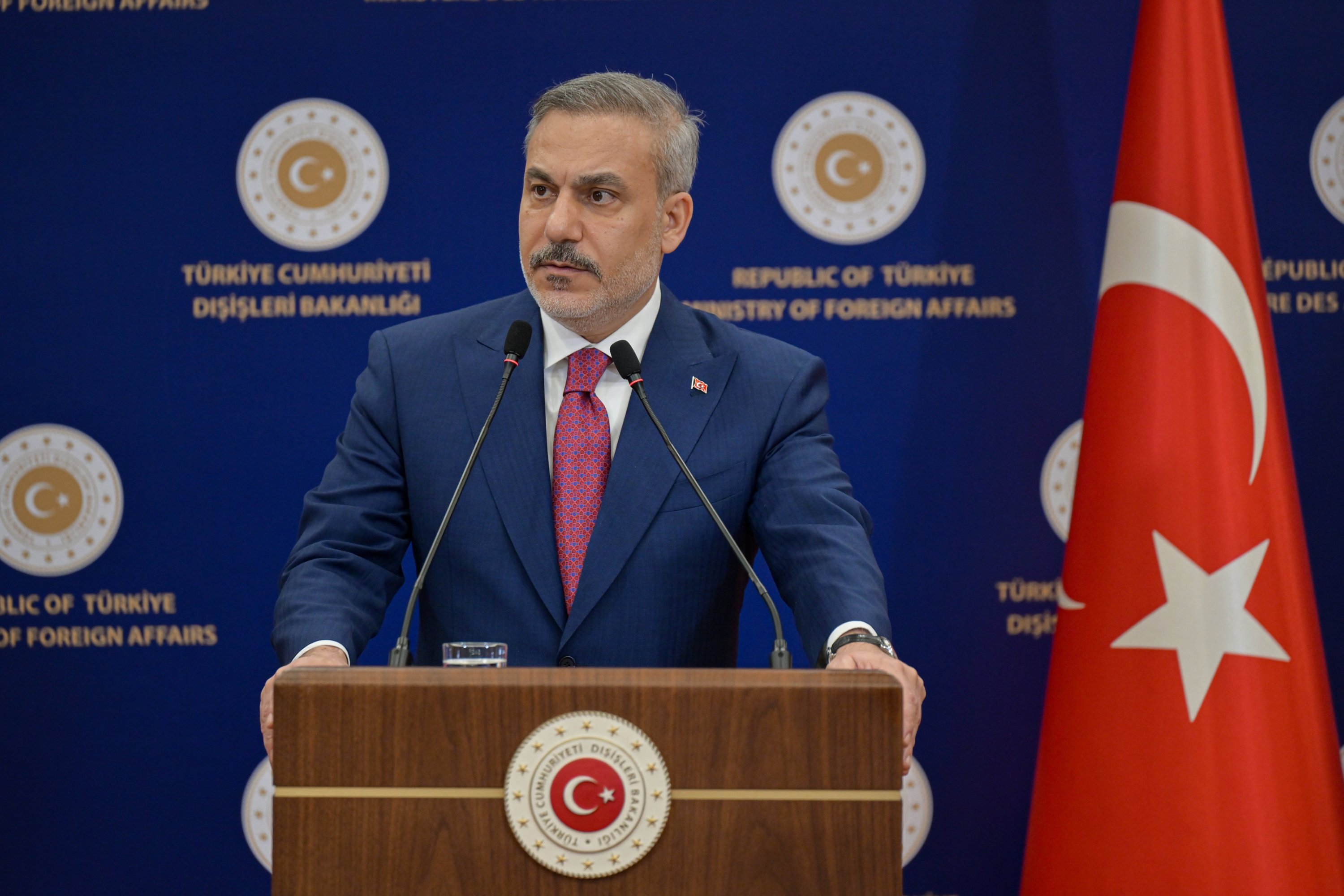
Foreign Minister Hakan Fidan on Monday hailed the "sincerity" of the United States and Iran on achieving a cease-fire. However, he warned that Israel may disrupt the process. Fidan also pointed out to Israel's emerging "state strategy" of finding "new enemies" in the region such as Türkiye.
Speaking to Anadolu Agency (AA), Fidan also commented on the situation in the Strait of Hormuz.
The minister has been at the forefront of Türkiye's peace diplomacy, contacting relevant parties to achieve cease-fire in US-Israel-Iran war.
"The whole world wants free international passage through the Strait of Hormuz. Hormuz should remain open through peace, using an international armed force is a challenge,” he said. He stated that Strait of Hormuz issue demonstrated that the war not merely "regional" but a conflict with global repercussions. He highlighted that the Strait was where up to 25% of natural gas and oil shipments went through. "We are facing a situation where a great logistics chain, production and industrial infrastructure is affected," he added. "The question now is how the Strait is going to be run." Fidan emphasized the importance of keeping international shipping routes open amid rising tensions in the Gulf. "What the entire world wants is that international transit remain free and not be obstructed," he said. He warned that stability in the waterway cannot be achieved through forceful measures. "Our position is to reopen it through peace. There are many difficulties in intervening here with an international armed peace force," he said.
He also noted that there was a thin line of being party to the conflict targeting Iran and keeping the Strait of Hormuz open. "But no country wants to be part of this war, Europeans in particular openly expressed this," he stated.
On Türkiye's stand, Fidan pointed out the stance adopted by President Recep Tayyip Erdoğan since the beginning of the war and this was "the policy of keeping Türkiye out of war." He said the situation in Hormuz had a significant impact on the global markets and Türkiye made every contribution to resolve the issue. The minister, however, added that Türkiye was not "very much dependent on Strait of Hormuz in terms of energy security, energy supplies." "Share of natural gas in electricity production dropped and share of renewable energy sources dramatically increased in past two decades. But we feel the indirect impact of the situation, especially on pricing. Energy supplies are delivered smoothly but pricing poses a problem. This may be a burden on the economy in the long run," he warned.
Fidan also warned about Israel’s actions in Syria and Lebanon. On incursions into Syria, Fidan noted that it also posed a major risk for Türkiye. He said Israeli attacks in Lebanon resembled what it has done in Gaza, underlining that it engaged in a depopulation campaign by destroying housing and infrastructure.
Türkiye’s top diplomat said such negotiations start out with maximalist demands, but the sides usually try to find common ground with the support of mediators. “We only hope that they will have a lasting intention to reach a cease-fire and sustain it. As far as I can see, they are sincere on this,” he said. Fidan noted they were in touch with the sides after the talks in Islamabad, and throughout Sunday, they held talks on assessing the point of deadlock in the talks and what Türkiye can do to resolve it. He pointed out the “Israel factor.” “We should always consider what Israel can do to disrupt it. We always highlighted this to the U.S. side,” he stated.
On the contents of the talks, Fidan said it should be acknowledged that it might not have been technically possible to agree upon a final document within a timetable of 15 days, based on the topics discussed at the Islamabad meeting. He said that if any progress can be made, the sides can agree upon an additional cease-fire for continuing talks for a time period between 45 and 60 days. “If the talks turn to the nuclear issue with an all-or-nothing approach, especially on the issue of uranium enrichment, the talks can hit a serious obstacle. Still, this may be overcome with the support of mediators, other countries,” he stressed. He warned that military approaches to securing key global sea lanes would be highly complex and urged diplomacy to ensure uninterrupted maritime trade through the Strait of Hormuz, a critical energy chokepoint.
He further commented on Israel's regional posture, saying: "We see that Israel may seek to designate Türkiye as a new adversary after Iran, as it cannot sustain itself without an enemy." "After Iran, Israel cannot live without an enemy," Fidan underlined.
"We see that not only Netanyahu's administration but also some figures in the opposition, though not all, are seeking to declare Türkiye the new enemy," he said. "This is a new development in Israel, turning into a state strategy," he added.
His statements follow social media posts by Israeli Prime Minister Benjamin Netanyahu and Israeli Defense Minister Israel Katz who targeted President Recep Tayyip Erdoğan in insulting remarks. Statements of Israeli officials, apparently aimed to encourage the opposition to take action against Erdoğan, backfired. Both government officials and the main opposition Republican People's Party (CHP) were united in their condemnation of Israeli officials' remarks, standing for Erdoğan against what they described as the words of perpetrators of genocide in Gaza.
On a question whether Israel shifted gears in its approach to Türkiye and whether it was a permanent policy, Fidan answered "both." "Israel has an inferiority complex due to our president's political leadership in the region. They cannot admit how Türkiye elevated its role in the region with its strategic balancing. They cannot steer Türkiye," he said. He said many countries oppose Israel's policies toward Palestine and Lebanon but Türkiye had a different diplomatic approach, standing out among others. "Our president's global leadership, his close ties with leaders, Türkiye's network of interaction, all of these affect Israel's rhetoric to create illusions about the truth. In this context, it is understandable that they attack our president, our political elite," he said.
Turning to Syria, Fidan described the situation as a major security concern for Turkiye. "We see a major problem area in Syria. This is a big risk for us," he said, referring to Israel's attacks. He added that Israel's current focus on its confrontation with Iran could delay but not rule out its future moves in Syria. "Because of the war underway in Iran, it is not doing certain things (against Syria), but that does not mean it will not. When the time comes, it will want to do it," he said.
Following the collapse of the Baathist regime in 2024, Israel declared the 1974 Disengagement Agreement between the two sides no longer valid, moved into the Syrian buffer zone and has since carried out near-daily strikes and incursions. Israeli forces target Syrian territory almost daily, carrying out ground incursions, particularly in rural areas of Quneitra and Daraa in southern Syria, detaining civilians, setting up checkpoints to search and question passersby, and damaging agricultural land. Türkiye views it as part of Israel's aggressive expansionism in the region and is worried that it may fuel instability in post-civil war Syria. Damascus is already trying to stay away from the spillover of the U.S.-Israel-Iran war.
Fidan also criticized regional cooperation formats involving Greece, the Greek Cypriot administration and Israel, arguing they heighten tensions rather than ease them. "Their cooperation does not bring more trust, it brings more mistrust. It brings more problems and war," he said. He also called for a wider regional security framework based on mutual respect for sovereignty and territorial integrity across the Middle East.