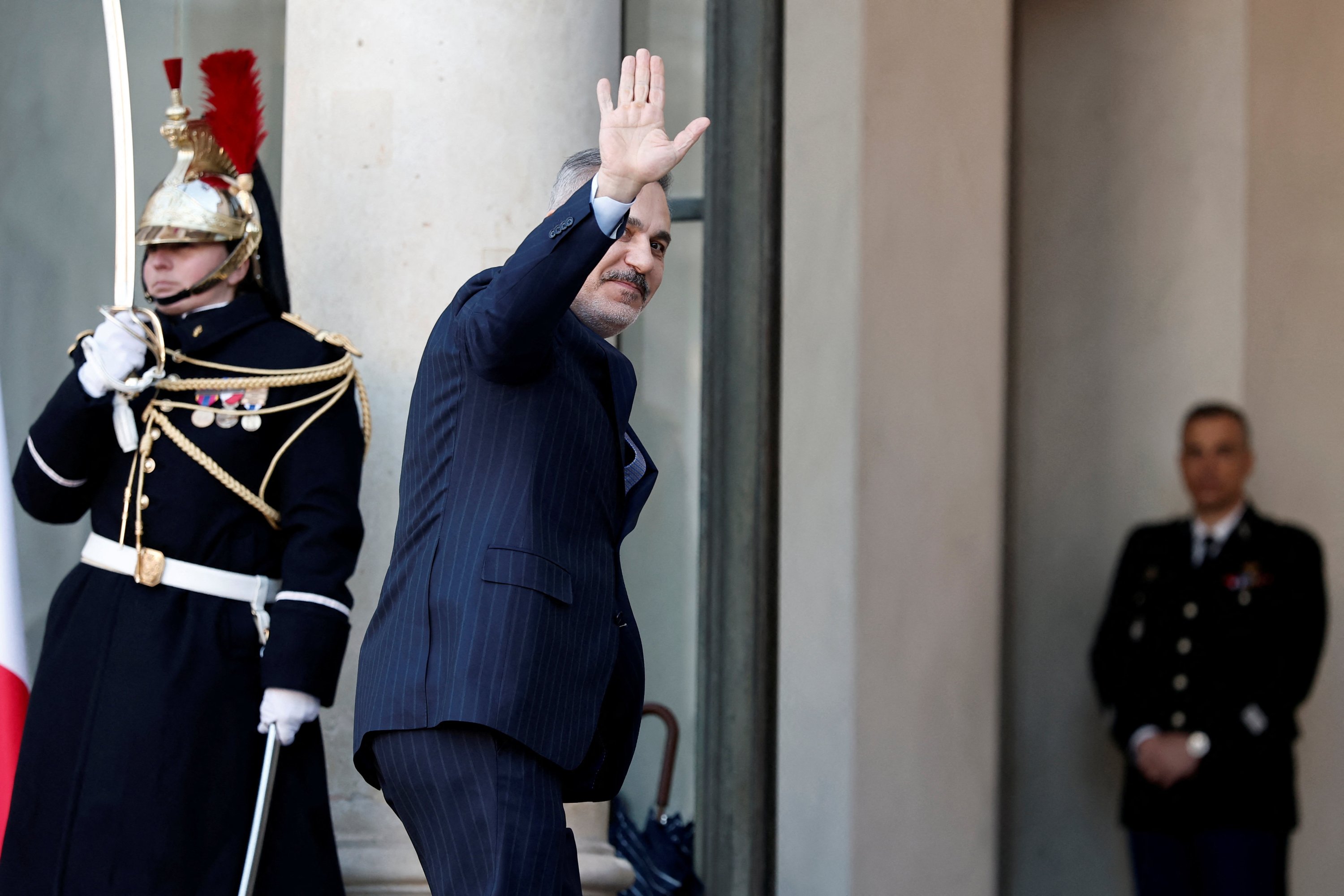
Speaking after attending the Coalition of the Willing summit in Paris on Tuesday, Foreign Minister Hakan Fidan told journalists that reaching lasting peace in the Russia-Ukraine conflict was "now quite close."
"In my view, after four years of war, we are now quite close to a lasting peace. At the very least, we see that several areas that are key to peace are being discussed in an exceptionally serious manner," Fidan told journalists at the Turkish Embassy in Paris late Tuesday.
"At the very least, we see that key areas essential to peace are being discussed in an exceptionally serious way. Türkiye has also contributed to this process. What we see is that, if signed, this will not merely be a peace agreement that ends the war in Ukraine. It will also determine, in the long term, the modalities of peace between Russia and Europe in the new era. At the same time, it will be a comprehensive agreement that shapes Russia’s regional policies going forward," added the foreign minister.
On what was discussed, Fidan said that they were concerned about issues such as monitoring a potential future cease-fire, maintaining Ukraine’s deterrence, and the possibility of military measures in case a cease-fire is violated.
"From the very beginning, militarily speaking, under the instructions of our president, our armed forces have always maintained a position that Türkiye would assume responsibility for a naval component to be established in the event of peace. I believe significant progress has been made on this. "Considering that Türkiye is a NATO member with the largest fleet in the Black Sea, it is only natural for Türkiye to assume responsibility for Black Sea security ... hopefully, the peace agreement will be signed as soon as possible, preventing further loss of life and bringing stability to the region," he further stated.
Fidan stated that another session on Tuesday focused on Ukraine's economic recovery in the event of a potential peace deal. He emphasized President Recep Tayyip Erdoğan's sensitivity on the matter and said no country is "more capable than Türkiye when it comes to healing wounds."
"We are good at healing both our own wounds and those of people in need. Economic investment and the expertise of our businesspeople, especially in infrastructure, are extremely important. We believe that once peace is achieved, Türkiye will play a major role in economic revitalization and development,” he added. Fidan said he also held meetings with heads of state, discussed important issues, and evaluated issues on the agenda with EU officials.
Following the largest meeting yet of the Coalition of the Willing, both European leaders and U.S. envoys hailed progress that hid tensions in recent days over assertive U.S. foreign policy in the Western Hemisphere under President Donald Trump.
But the security guarantees for Ukraine would only come into force once a cease-fire is agreed on to end the war. Russian leader Vladimir Putin's intentions remain unclear. Ukrainian President Volodymyr Zelenskyy and Trump's envoy Steve Witkoff said Ukrainian and American officials would continue talks on Wednesday, with Zelenskyy thanking Washington "for its readiness to provide a backstop in all areas." The "robust" guarantees would see the U.S. lead a truce monitoring mechanism with European participation, French President Emmanuel Macron said after Tuesday's talks that gathered representatives of 35 countries, including 27 heads of state or government.
Macron, Zelenskyy and British Prime Minister Keir Starmer signed a declaration of intent that foresees Britain, France and other European allies deploying troops on Ukrainian territory after a cease-fire.
The allies also agreed to establish a U.S.-Ukraine-coalition coordination cell in Paris. But a promise that Washington would commit to "support" the European-led multinational force "in case of a new attack" by Russia, which was present in the draft statement, was not in the communique released on Tuesday evening. Macron said that Paris could deploy "several thousand" French troops to Ukraine after the war.
Zelenskyy said the talks had "determined" which countries would take the lead on ensuring security and on reconstruction, as well as which forces were necessary and how they would be managed.
Fidan also said he had discussed several issues with Syrian Foreign Minister Asaad al-Shaibani, who was also in Paris for a separate trilateral meeting with the U.S. and Israel. He added that Ankara continues to monitor talks between the three sides.
"We are in constant consultation with both the Syrian side and the American side. After those talks, we met with him. We had the opportunity to discuss in detail a few issues – both the stage reached in today’s negotiations and the outcomes, or lack thereof, of the talks they held with the YPG a few days ago. We went over these matters very thoroughly,” Fidan said. The YPG is the Syrian branch of the PKK terrorist group. Fidan also said he met with the U.S. Ambassador to Ankara and Special Envoy for Syria Tom Barrack, adding that he was briefed on the trilateral talks and shared his views.
The Israeli army has carried out repeated incursions into Syrian territory since the fall of the Bashar Assad regime in late 2024, actions that Damascus has strongly condemned. Calling Israel's actions in Syria "provocative," Fidan said they were "an extension of Israel’s expansionist and fragmenting policies carried out on a broader scale in the region. "We see this clearly. It is extremely important for regional stability that the necessary assessments are made, analyzed, and appropriate measures are taken." Fidan said regional countries must address this situation, underlining that the U.S. could also play a significant role.
On Israel’s actions related to its recent recognition of Somalia's breakaway region of Somaliland, sparking international outrage, Fidan said this was one of Tel Aviv's projects aimed at spreading instability in the region.
Earlier on Tuesday, Israeli Foreign Minister Gideon Saar visited Somaliland nearly two weeks after the decision to recognize it as a separate state.
"We say clearly that actions aimed at breaking up the territory of a sovereign country in this way are unacceptable, that ‘divide, fragment and swallow or rule’ style policies in our region are now a thing of the past, and that countries in the region, acting in solidarity, will not allow this to happen," he said.
Fidan noted that long-standing internal problems exist between Somaliland and Somalia’s central government and said that a Turkish Foreign Ministry ambassador has been assigned as a mediator on this issue.
"However, within the framework of U.N. resolutions, our own policies, and international norms, we have always fully defended Somalia’s territorial integrity. We always expected them to resolve their own internal issues peacefully," he said.
Fidan asserted that Israel's recognition of Somaliland was actually a sign of "illegitimacy." "What difference does it make if an actor like Israel, which itself is the center of illegitimacy, supports Somaliland? ... We see it as a geostrategic move, an attempt to project power."