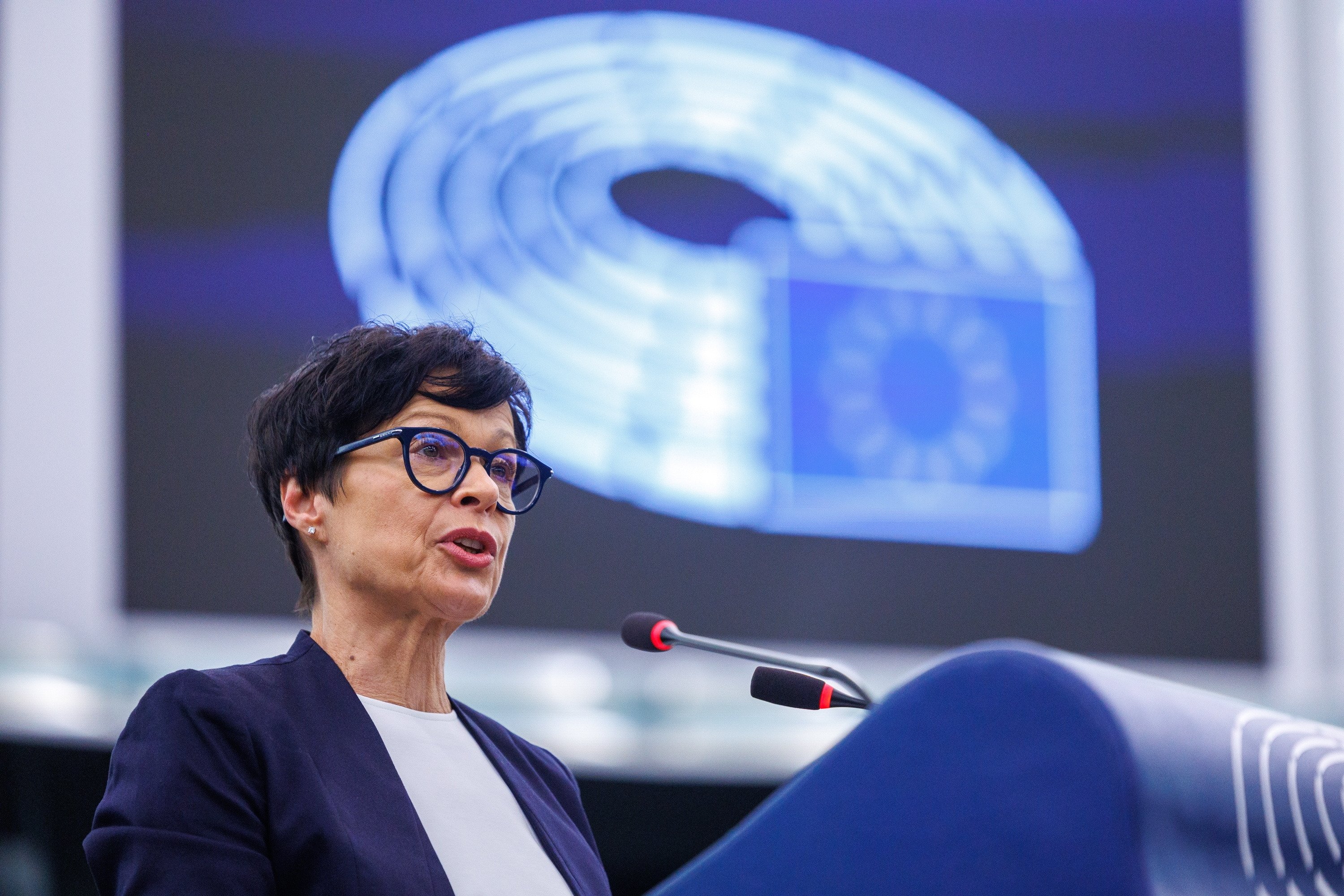
European Union Enlargement Commissioner Marta Kos said on Tuesday that Türkiye plays a pivotal role in the bloc's Connectivity Agenda, stressing that a strong Middle Corridor and deeper digital, energy and trade links would be difficult to imagine without Ankara's active participation.
Speaking ahead of the high-level opening event of the Connectivity Agenda Platform in Brussels, Kos welcomed the participation of Turkish Transport and Infrastructure Minister Abdulkadir Uraloğlu and said the EU would continue its engagement with Türkiye.
Kos said she would meet Turkish officials later in the day and announced plans to visit Ankara at the end of the month alongside EU foreign policy chief Kaja Kallas and EU Commissioner for Internal Affairs and Migration Magnus Brunner.
She noted that EU-Türkiye relations are currently progressing on two separate tracks, saying there has been no movement in Türkiye's accession process at this stage but significant opportunities remain under the connectivity agenda.
"I cannot imagine having a strong Middle Corridor and all these digital, energy and trade connections without Türkiye's strong participation," Kos said.
The commissioner added that the European Commission had received a list of potential connectivity projects from Türkiye's Foreign Ministry and was assessing them alongside proposals submitted by other countries, with work on the initiatives continuing.
Transport and Infrastructure Minister Uraloğlu called for faster visa issuance for transport workers and simpler customs procedures to prevent delays in global supply chains, warning that administrative bottlenecks can undermine even completed commercial deals.
Speaking to reporters following the high-level launch of the Connectivity Agenda Platform in Brussels, Uraloğlu said international trade cannot function efficiently if goods are delayed at borders despite being already produced, sold, and paid for.
"If road and rail transport visas are not issued on time, if customs crossings are not facilitated, and if digital infrastructure is not established, then in fact the work you have completed is wasted at customs gates or visa procedures," he said.
"We really need to make this easier. If we're not going to make it easier, then why are we doing trade at all?" Uraloğlu added.
The minister stressed that all countries are now deeply interdependent and no longer self-sufficient in production and trade, making efficient cross-border logistics more critical than ever.
"None of the countries, including the most developed ones, can be self-sufficient anymore," he said, adding that international trade must therefore be supported by faster administrative systems.
Uraloğlu said Türkiye is actively engaging with the EU to strengthen transport connectivity, particularly along the Middle Corridor linking Asia and Europe through Türkiye.
He said that there is growing recognition in Brussels that transport routes must be diversified and not dependent on a single mode or corridor, especially in light of recent global disruptions.
"Therefore, at this point, we see a determination and will to cooperate more strongly with Türkiye," the minister said.
Uraloğlu recalled that Ankara has long advocated major connectivity investments, including the planned Northern Rail Crossing over the Yavuz Sultan Selim Bridge in Istanbul.
He said the project has already received support from European funding mechanisms under World Bank leadership, and that additional EU credit instruments could be mobilized for future connectivity investments along the corridor.
On the sidelines of the event, Uraloğlu said he held talks with European Commissioner for Enlargement Marta Kos, adding that she is expected to visit Istanbul next week, with further bilateral discussions planned thereafter.
He also highlighted ongoing regional engagement with Armenia, saying he had a bilateral meeting with Armenian Territorial Administration and Infrastructure Minister Davit Khudatyan.
According to Uraloğlu, both sides are working toward reactivating previously operational road and rail crossings.
He said maintenance and preparatory works are progressing on both sides, with Türkiye having begun its own preparations while the Armenian side has also indicated readiness to proceed.
Uraloğlu added that improving regional connectivity could also help restore historical transport links along the Silk Road corridor, referencing ongoing efforts tied to the restoration of a historic bridge in the Kars Ani region.