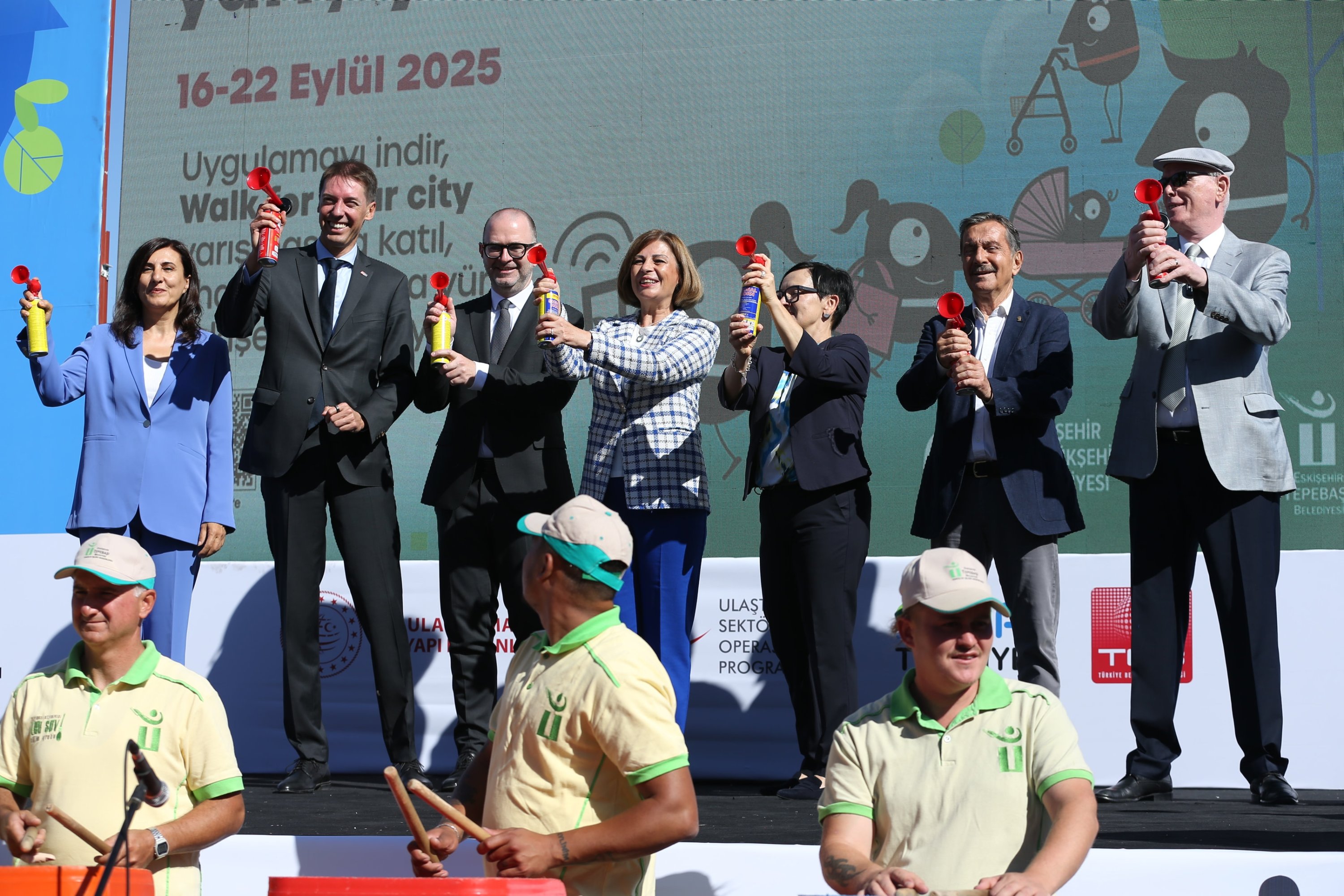
European Mobility Week officially launched in Türkiye on Monday with an opening ceremony in Eskişehir province, chosen as the host city for its pioneering role in sustainable urban transport.
The EU deputy head of the delegation, Jurgis Vilcinskas, told journalists that Eskişehir was selected because it is exemplary in sustainable transportation with its bicycle lanes, tram network and pedestrian-friendly urban design.
“Launching Türkiye’s European Mobility Week matters a lot! Because Eskişehir shows us that mobility is not about the past. It is about the future we want to create – for our children, our students, our workers, our elders,” Vilcinskas said, addressing participants during the event.
“Mobility must give every citizen the choice of how to move. The choice to walk or cycle safely, to ride a tram that comes reliably, or to take a bus that is clean and efficient.”
Vilcinskas underlined that mobility must also be affordable and accessible, noting that safety and inclusivity were as important as clean transport. Drawing on examples from Paris and Bologna, he said European cities had undergone difficult but rewarding transitions that improved air quality, revitalized businesses and transformed public life.
“Change is difficult – but change is worth it,” he emphasized, calling on Eskişehir to continue leading the way.
The official added that the EU would continue to support Türkiye’s sustainable mobility efforts through funds such as IPA III, as well as international financing mechanisms, including the Türkiye Investment Platform, the World Bank and the IFC.
For her part, Eskişehir Mayor Ayşe Ünlüce, during a meeting with journalists, highlighted the municipality’s ambitious plans to expand green transport infrastructure in close cooperation with the EU, the European Bank for Reconstruction and Development (EBRD) and the Union of Municipalities of Türkiye (TBB).
“To our existing 50 kilometers (31 miles) of bicycle lanes, another 70 kilometers will be added by the end of this year,” she said. “Expanding roads is a difficult task due to the narrow streets in the old city center. But newly built roads are automatically designed with bicycle lanes. Pedestrianization is also very common. Many roads have been turned into spaces used only by pedestrians.”
The mayor also announced plans to transition the city’s bus fleet to electric vehicles gradually. “We are determined to ensure that Eskişehir’s transportation system is sustainable, safe and environmentally friendly,” she added.
This year’s European Mobility Week will feature activities in 20 cities across Türkiye, promoting sustainable transport, clean energy and accessible mobility solutions.
Ahead of the opening ceremony, the mayor, EU delegation representatives and local residents walked together from the municipality building to the event area, symbolizing the week’s central theme of pedestrian-friendly urban living.