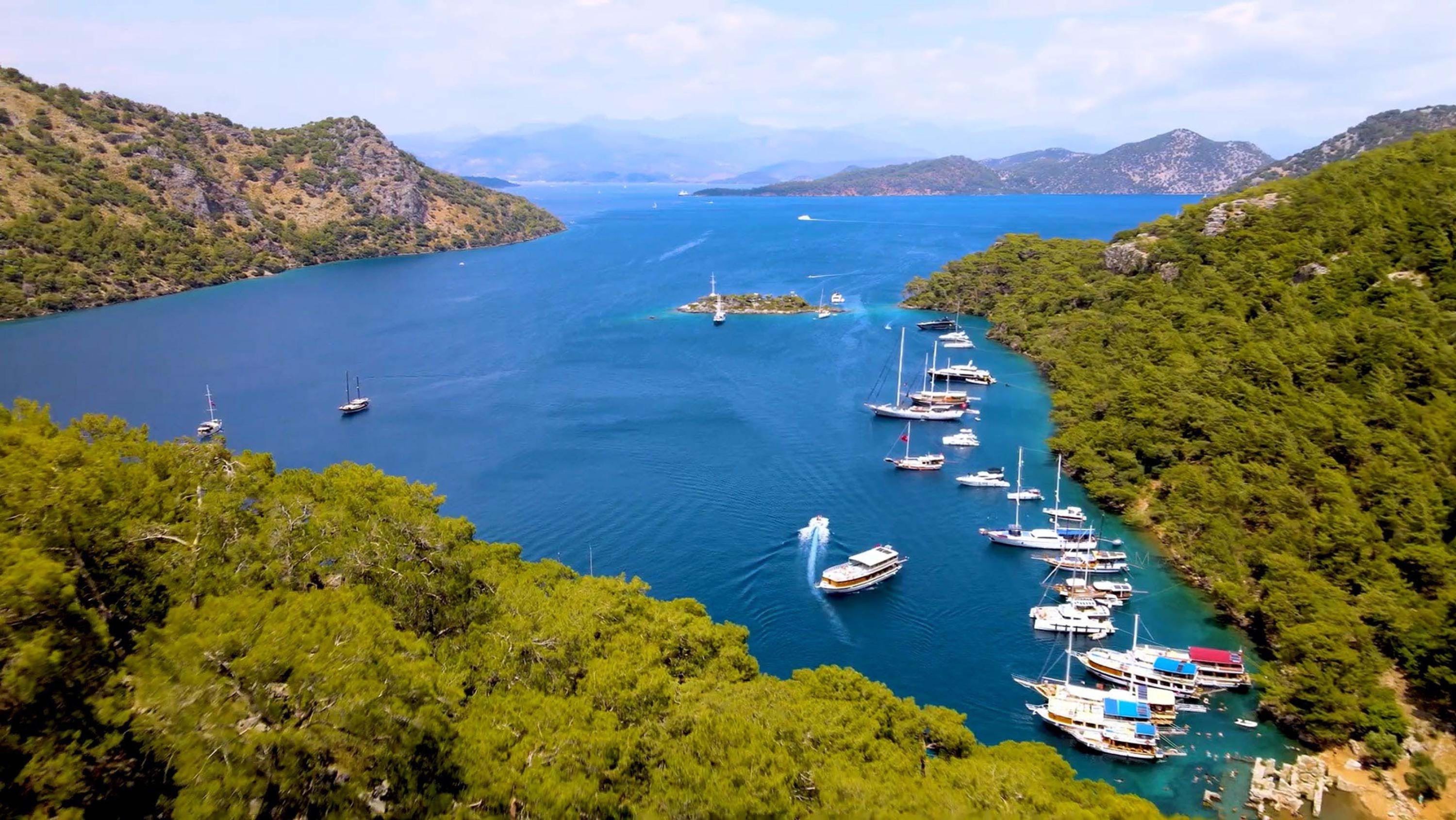
Türkiye’s declaration of marine parks in the Aegean Sea earlier this month annoyed Greece, which disputes Turkish maritime borders.
Greek media outlets reported that Greek Foreign Minister George Gerapetritis would raise the issue at an informal meeting of EU foreign ministers on Sept. 2. He is expected to reiterate Greece’s claim that the marine parks violate international law. Gerapetritis previously announced that Greece had issued a diplomatic note to Türkiye about the matter.
Two presidential decrees published in the Official Gazette on Aug. 16 reaffirmed Türkiye’s maritime rights in the Aegean Sea.
One decree designated an area between the Fethiye district of Muğla and the Kaş district of Antalya in the southern Aegean as a “national marine park,” while another applied the same designation to an area in the North Aegean Sea, near the coasts of Tekirdağ and Çanakkale.
For Türkiye, it is merely a move to protect marine biodiversity, but marine parks have been a source of contention with neighboring Greece for some time. Greek media outlets reported earlier this month that the Greek government was also moving forward with plans to declare a new national marine park in the southern Aegean Sea. The decree on the matter is now before a top court in the country and, according to the To Vima website, will be finalized in October.
Greece last year announced two marine parks, or areas designated for the protection of marine species, in the Ionian Sea and around the southern Cyclades islands, to the chagrin of Ankara. Türkiye argued that the declaration of marine parks, particularly near the islands, was political rather than aimed at protecting biodiversity and was an attempt to change the status quo in the disputed sea. Greek media outlets reported that new marine parks could be declared near the Dodecanese islands, or “On İki Ada” (Twelve Islands), as they are known in Türkiye. The islands were Ottoman domains until the early 20th century, before they were ceded to Italy. Italy, in turn, ceded them to Greece following World War II.
Ankara and Athens seek to improve relations after years of hostilities, but maritime jurisdiction remains a thorny issue. The countries, which came close to an all-out war in the 1990s over the Aegean Sea, remain vigilant, with Türkiye concentrating on developing its domestic defense industry. Greece relies on foreign partners to bolster its defenses. Embracing the doctrine of being effective and powerful at sea, as its predecessor, the Ottoman Empire, once was, Türkiye has over the past two decades developed an independent defense industry capable of operating in open waters, thereby shifting geopolitical balances in its favor. The navy plays a critical role in ensuring the security of maritime trade routes in the Eastern Mediterranean, the Black Sea and the Aegean Sea, while promoting regional stability.
Ankara’s proactive stance on marine spatial planning is part of a broader strategy to assert its maritime rights and uphold international legal norms in the face of what it sees as encroaching initiatives by Greece. Turkish officials maintain that marine protection efforts must be transparent, equitable and cooperative, particularly in semi-enclosed seas like the Aegean, where maritime boundaries remain unsettled.
As Türkiye moves to institutionalize its marine planning within international frameworks, it seeks to preempt efforts that may attempt to redefine maritime jurisdiction through environmental discourse. The broader message from Ankara is clear: Marine conservation is vital, but not at the cost of geopolitical stability or sovereign rights.
Safeguarding its rights in its “Blue Homeland” (areas of Türkiye’s maritime jurisdiction) is essential for Ankara, especially at a time of growing international cooperation, particularly involving Israel, Greece and the Greek Cypriot administration, whose maritime claims contradict those of Türkiye and other countries. In May, Türkiye unveiled plans for a “Blue Homeland law,” which is expected to be debated in Parliament when the next legislative term starts in October. Aiming to cover all legal aspects of maritime areas over which the country has sovereignty, the law will cement and clarify Türkiye’s rights across the Black Sea, Aegean Sea, Mediterranean and Marmara Sea.
Türkiye said Friday that Greece’s newly announced spatial planning framework covering parts of the Aegean Sea would have no legal effect on Ankara, reiterating its position on longstanding disputes between the two neighbors. Foreign Ministry spokesperson Öncü Keçeli said Greece’s Special Spatial Framework for Industry and Supply Chains, announced Friday, would not create any legal consequences for Türkiye regarding the interconnected disputes in the Aegean.
“The Special Spatial Framework for Industry and Supply Chains announced by Greece today (Aug. 28), which also covers the Aegean Sea, will have no legal consequences for our country in the context of the interconnected Aegean disputes between the two countries, including geographical formations whose sovereignty was not transferred to Greece by international treaties,” Keçeli said.
He reiterated Ankara’s call for Athens to pursue an approach consistent with the Athens Declaration on Friendly Relations and Good-Neighborliness, signed by the two countries on Dec. 7, 2023. Keçeli also stressed Türkiye’s readiness to cooperate with Greece as one of the two coastal states of the Aegean Sea.
“We once again emphasize that, as Türkiye, we maintain our position that an approach consistent with the Athens Declaration on Friendly Relations and Good-Neighborliness should be adopted, and that as one of the two coastal states of the Aegean Sea, we are always ready to cooperate with Greece,” he said.