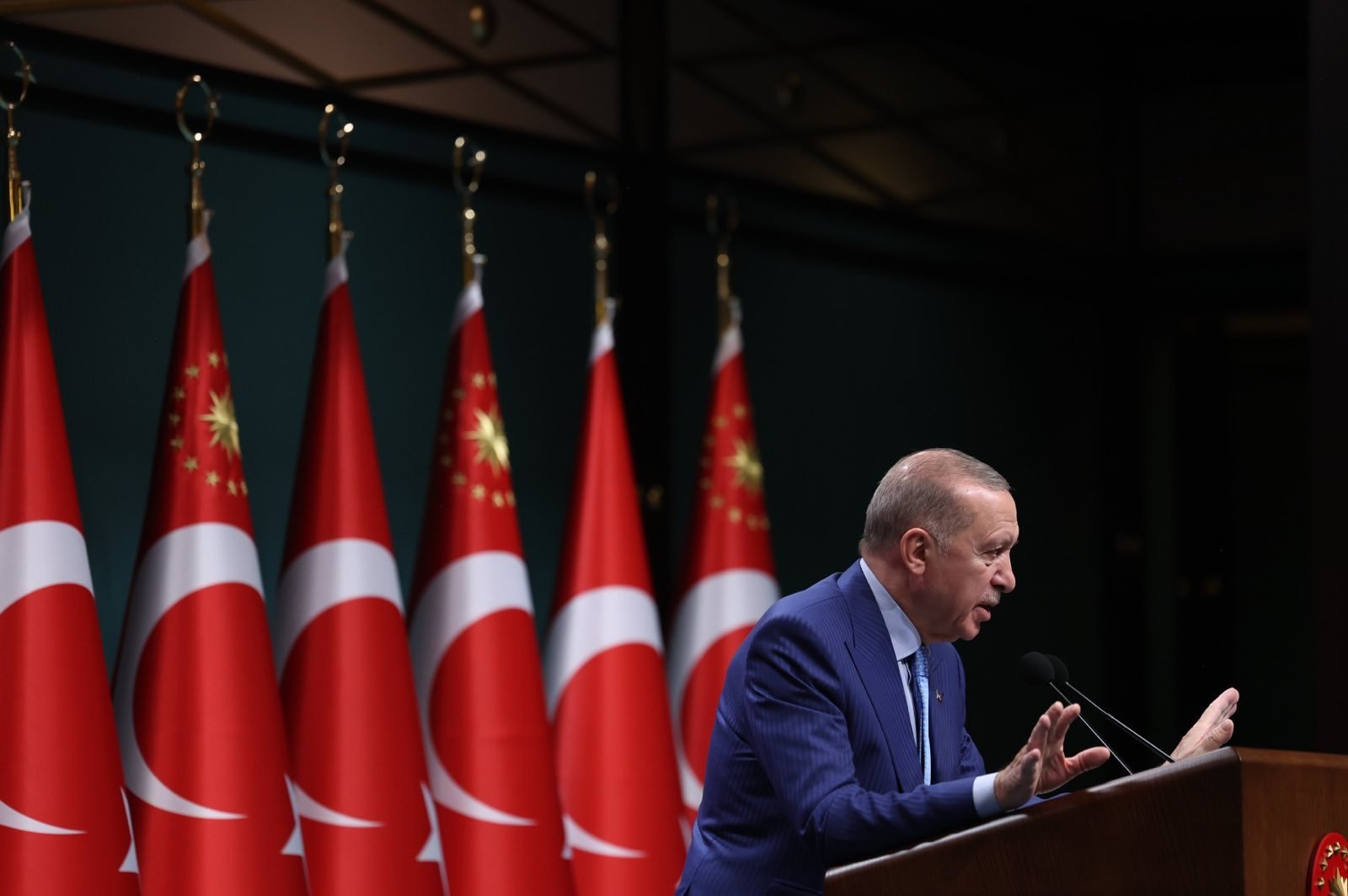
Speaking to a meeting of Türkiye’s ambassadors in the country's capital on Tuesday, President Recep Tayyip Erdoğan said Ankara supports a stable Syria, but Israel’s violation of Syrian territories has been the biggest threat to the stability.
Syrian government data shows that since December 2024, Israel has carried out over 1,000 airstrikes on Syria and more than 400 cross-border raids into the southern provinces.
After the fall of the Assad regime in late 2024, Israel expanded its occupation of the Syrian Golan Heights by seizing the demilitarized buffer zone, a move that violated a 1974 agreement with Syria.
Ankara views Israel as a major threat to the overall stability of the region, especially after the start of a new round of Palestine-Israel conflict in 2023. Since then, Israel has made incursions into Lebanon and Syria and engaged in a brief but tense conflict with Iran. At one point, Erdoğan raised concerns that Israel’s expansionism may target Türkiye in the future. Israel has been a fierce opponent of Türkiye as Erdoğan escalated his rhetoric against the Netanyahu administration’s genocide in Gaza. Tel Aviv opposes Türkiye’s inclusion in a planned “Gaza Stability Force” for recovery efforts in the Palestinian enclave after a cease-fire. The force, touted by the U.S., is expected to involve peacekeeping forces from several countries, including Türkiye.
Erdoğan said Syria has a historic opportunity after the fall of the Assad regime, and Ankara would continue supporting them in this new era.
The president said the Daesh terrorist group, which has been blamed for recent attacks in Syria against U.S. soldiers, was another threat to Syrian stability but warned against U.S. cooperation with the YPG, the Syrian wing of the PKK terrorist group, under the guise of fighting Daesh. “We already give all support to the Syrian government as the only NATO member that fought Daesh on its own,” he said.
He said Türkiye made “necessary calls” for implementation of the March 10 deal while highlighting that Türkiye and Syria have been neighbors for “a thousand years.”
“If (the YPG) resists, it will turn into a crisis,” Erdoğan said. The YPG, which claims a self-styled autonomy in northeastern Syria, signed the said deal with Damascus for its integration into Syrian security forces. However, the deal has not been fully implemented as the Syrian administration opposes demands for decentralization by the terrorist group.
“It is clear who will benefit from the fragmentation of Syria. A safer tomorrow for Syria is only possible with a vision of common history and all segments of society,” he said.
Erdoğan also criticized attacks on commercial vessels in the Black Sea tied to the Russia-Ukraine conflict. The president, who advocated a fair peace to end the conflict, warned that attacks would not benefit either Russia nor Ukraine.
The Ministry of National Defense on Monday announced that Turkish fighter jets had shot down an out-of-control drone coming from the Black Sea.
The device "was detected and tracked as part of routine procedures" and identified as "an unmanned aerial vehicle that had lost control," the ministry said in a statement. Türkiye dispatched F-16 fighter planes, and "to prevent any adverse consequences, it was shot down in a safe area outside a populated area."
Erdoğan warned on Saturday against the Black Sea becoming an "area of confrontation" between Russia and Ukraine, following several strikes in recent weeks on ships in the region.
A Turkish vessel was damaged on Friday in a Russian airstrike near the Ukrainian port city of Odesa, just hours after Erdoğan spoke with Russian President Vladimir Putin.
The Turkish leader earlier complained of a "worrying escalation" in the Black Sea, after attacks claimed by Ukraine on tankers linked to Russia off the Turkish coast.
Türkiye, whose northern shore faces Ukraine and annexed Crimea, has maintained close ties with both Kyiv and Moscow since the Russia-Ukraine conflict began in February 2022.
In his speech on Tuesday, Erdoğan noted that they brought together the two countries three times to resolve the conflict. “Istanbul Talks have been a diplomatic success. We also led several initiatives, such as Black Sea grain deal and the prisoner swap. We prevented the conflict from spilling over into Black Sea by adhering to the Montreaux Agreement. Yet, recent attacks seriously threaten maritime security in the Black Sea. It is of no benefit to any side to target commercial, civilian vessels. We made clear warnings to both sides,” he said.
Commenting on ties with Armenia, Erdoğan stated that they would take “some symbolic steps” for normalizing relations in 2026.
“South Caucasus has longed for peace for years, and now it is going through a historic phase. Azerbaijan and Armenia are closer to a peace agreement than ever. We are in touch with Azerbaijan and advancing the normalization process with Armenia in parallel with their process,” he said.
Türkiye and Armenia have no diplomatic relations, and their shared border has been closed since the early 1990s. Both sides have engaged in cautious normalization talks in recent years, with Ankara welcoming signals from Yerevan that emphasize regional peace and cooperation.
Borders have remained closed since 1993 following Armenia’s illegal occupation of the Azerbaijani territory of Karabakh. Relations began to thaw after the 2020 Karabakh war, with both sides appointing special envoys to pursue normalization talks and negotiating the reopening of their land border. So far, limited agreements have allowed third-country citizens and diplomats to cross, but a full reopening remains elusive.