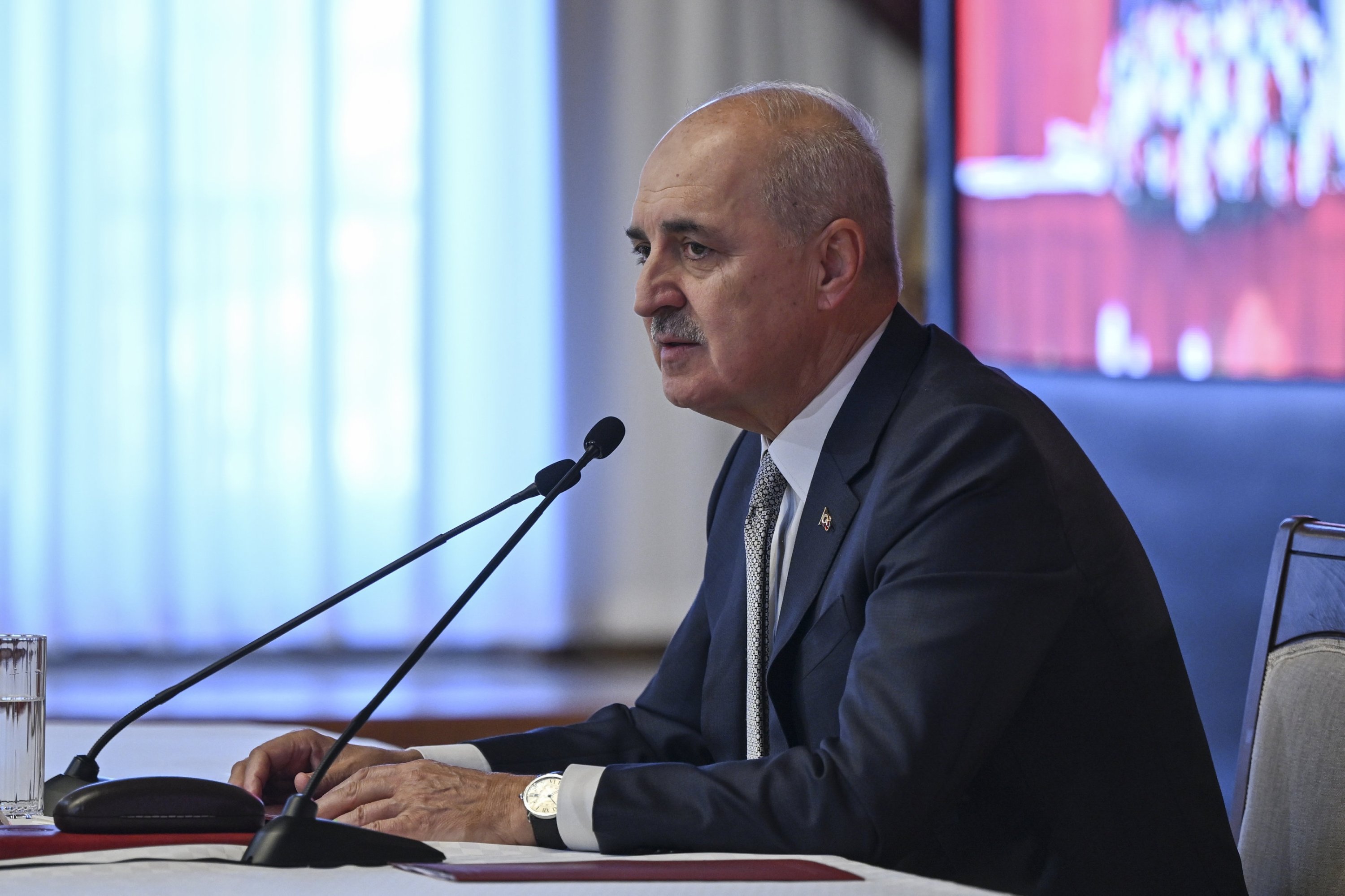
The parliamentary terror-free Türkiye commission plays a vital role in supporting a transparent and rapid peace process, Parliament Speaker Numan Kurtulmuş said Friday.
Speaking at the 28th Legislative Year Evaluation Meeting at the Parliament Ceremony Hall, Kurtulmuş explained that a final meeting may be held where key officials, including the National Intelligence Organization (MIT) head, justice minister and foreign minister, provide their perspectives on the commission’s progress.
Responding to a question on whether the PKK’s jailed leader, Abdullah Öcalan, would be heard, Kurtulmuş said: “From the beginning, everything in the commission has taken place openly, in line with the unanimous decisions we made. No meeting has been confidential, except for one session involving MIT and relevant ministries. The commission has not yet placed this matter on its agenda, and any future decisions would require a qualified majority, not a unilateral decision by me.”
He noted that the commission’s initial deadline is set for Dec. 31, with the possibility of extending the work in two-month increments if necessary.
Kurtulmuş highlighted the process’s transparency, openness and commitment to public accountability, adding that societal approval is a key component.
“The aim of the hearings is not just to present certain viewpoints but to increase societal consent. Civil society organizations expressing their opinions help expand awareness and understanding in their communities,” he said.
Kurtulmuş stressed the importance of balancing sensitivity with urgency.
“We must consider the rights and dignity of the Kurdish community while also respecting the sensitivities of the broader Turkish population. This balance has guided the process so far,” he noted.
On the PKK’s disarmament, he said symbolic steps, such as the weapons-burning ceremony in Iraq’s Sulaymaniyah and Öcalan’s call for the group to dissolve within and outside Türkiye, signal that the process could accelerate.
He emphasized that Parliament acts as an observer and overseer, while actual verification of disarmament is the responsibility of security institutions such as MIT and the General Staff.
“Where, who and how many weapons were surrendered is not within Parliament’s remit,” Kurtulmuş said.
Regarding future legal regulations, Kurtulmuş repeated that the commission itself does not draft laws. Its primary role is to monitor, guide and present a comprehensive framework to Parliament. Individual commission members will contribute proposals, which will be discussed and consolidated into a final report. Once the main framework is agreed upon by all parties, passing relevant legislation will be swift.
“The legislative process will follow naturally, and necessary laws will be enacted in a short period,” he said.
The terror-free Türkiye initiative was launched last year by government ally Nationalist Movement Party (MHP) when its leader, Devlet Bahçeli, implied that the government should facilitate access to Öcalan so that he could call on the PKK to lay down arms. Bahçeli’s proposal was endorsed by President Recep Tayyip Erdoğan, who had earlier hinted at the initiative with messages of unity between Turks and Kurds.
The PKK has long justified its campaign of terrorism as a fight for the rights of Kurds. Both Bahçeli and Erdoğan have repeatedly said that ending terrorism and maintaining unity were essential for Türkiye’s "home front” in the face of Israeli aggression in the region, pointing to the fact that Israel may target Türkiye next as part of its expansionist policies.
Öcalan responded positively to Bahçeli’s call and urged the PKK to lay down arms. In July, the PKK started the disarmament process with a ceremony in northern Iraq. The complete disarmament of the group is expected to be concluded by the end of 2025.