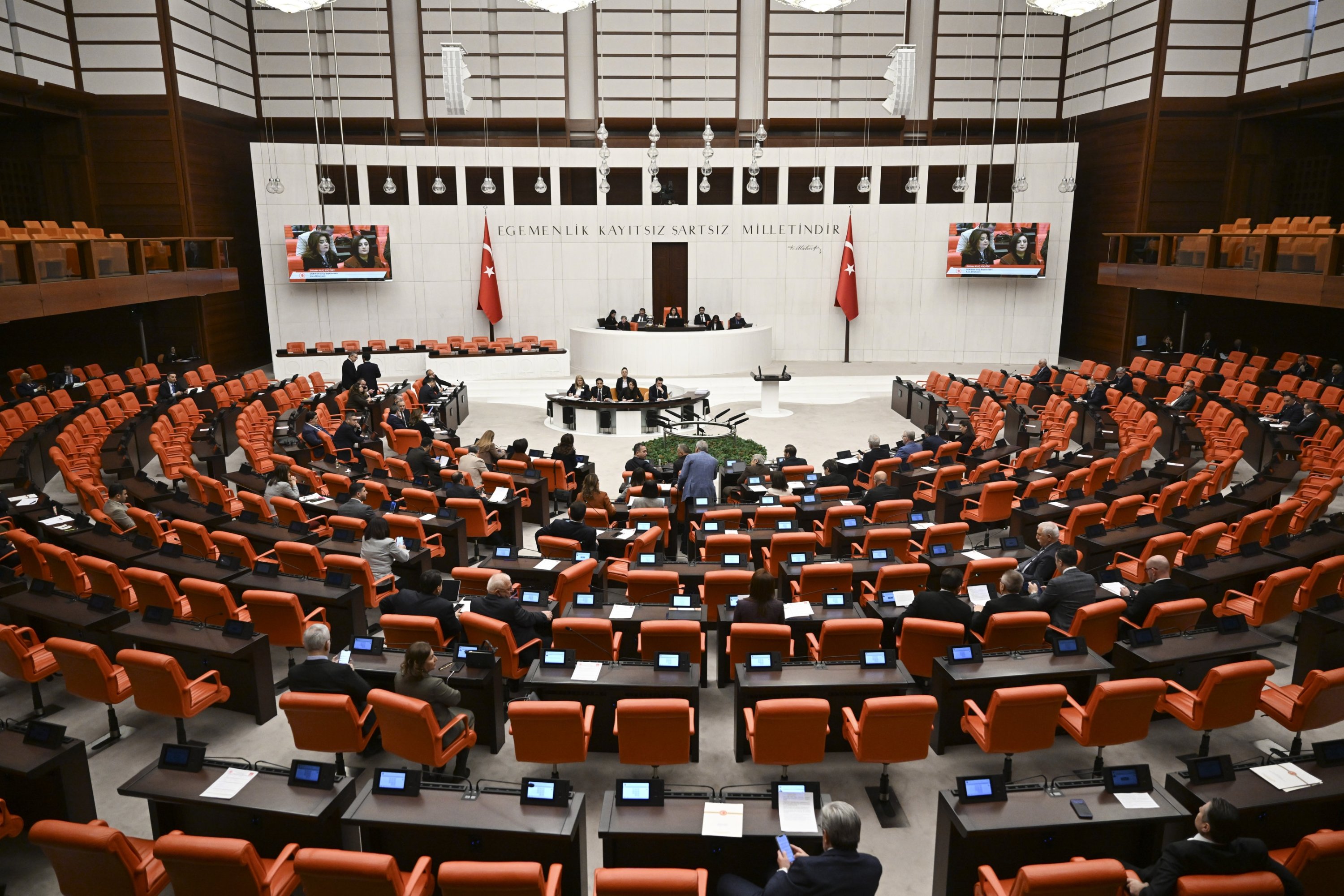
The next session of the Turkish Parliament will begin on Tuesday, with a busy agenda for lawmakers.
Parliament’s General Assembly will debate and likely vote on a string of topics, including a one-year extension to the Turkish navy for deployment in the Gulf of Aden, Somali territorial waters, the Arabian Sea and its vicinity, raising minimum pensions and a bill on increasing fines for violation of traffic safety rules.
A presidential decree for the extension of naval missions for another year, starting from Feb. 10, 2026, will be before Parliament first and will likely be passed as President Recep Tayyip Erdoğan’s Justice and Development Party (AK Party) holds a majority and lawmakers are usually unanimous on approval of military missions overseas.
The motion for the Gulf of Aden, Somalia and Arabian Sea was first approved by Parliament in 2008 and extended every year since then. The Gulf of Aden, near Yemen and close to the Bab al-Mandeb strait, the world's fourth-biggest chokepoint for oil transit, is a strategic energy route for Middle Eastern crude oil. The Arabian Sea and Somalia are adjacent to the Gulf and the Strait.
The deployment provides security for Turkish-flagged vessels and commercial vessels linked to Türkiye and contributes to joint operations by other countries against sea piracy and maritime terrorism. The motion also facilitates the delivery of humanitarian relief to the said areas.
Türkiye says that it also helps the Turkish army's naval components to gain regional experience and support national policies regarding the relevant countries while bolstering Türkiye's regional and international role within the U.N. system and its "visibility" in the international community.
The Turkish navy, which dominated the Mediterranean during Ottoman times, has raised its profile again in recent years, especially by boosting its inventory with locally made vessels and weapons and radar systems. Nowadays, it is also engaged in a major mission to keep the Black Sea safe from drifting mines in a joint task force with Bulgaria and Romania.
Parliament will also discuss a draft bill containing amendments to decrees on pensions and the use of e-scooters. One proposal raises the lowest pension from TL 16,881 to TL 20,000 and increases employer support for the minimum wage from TL 1,000 to TL 1,270. Around 4.9 million retirees will benefit from the increase.
There are about 17.7 million retirees in Türkiye. Pensions and the minimum wage are thorny issues for the government, which strives to lower inflation while the cost of living dramatically increased in the country over the past few years. The opposition is pushing for a substantial rise in pensions in the country where the aging population is gradually increasing. The same bill will also introduce more supervision on operators of e-scooter companies and fines for operators violating the safety laws.
Parliament will also continue the debate on a landmark draft bill that increases fines for violations of traffic safety. So far, 17 articles of the bill have been approved. The bill includes fines for drivers with modified license plates and a suspension of driving licenses. Drivers of commercial vehicles such as trucks and taxis will also be mandated to install devices, such as taximeters and distance-measuring devices, to record the kilometers a vehicle covers during commercial activities. The bill also introduces a suspension of driving license up to 90 days for motorists exceeding speed limits in residential areas, a TL 15,000 fine for motorists cutting off emergency vehicles.
Drivers stalking other motorists in road rage-related incidents and those stepping out of a vehicle with the intent of attacking other drivers in such incidents will be fined TL 180,000 and their driving licenses will be suspended for 60 days. Traffic safety officers will be authorized to impound their vehicles for 30 days.