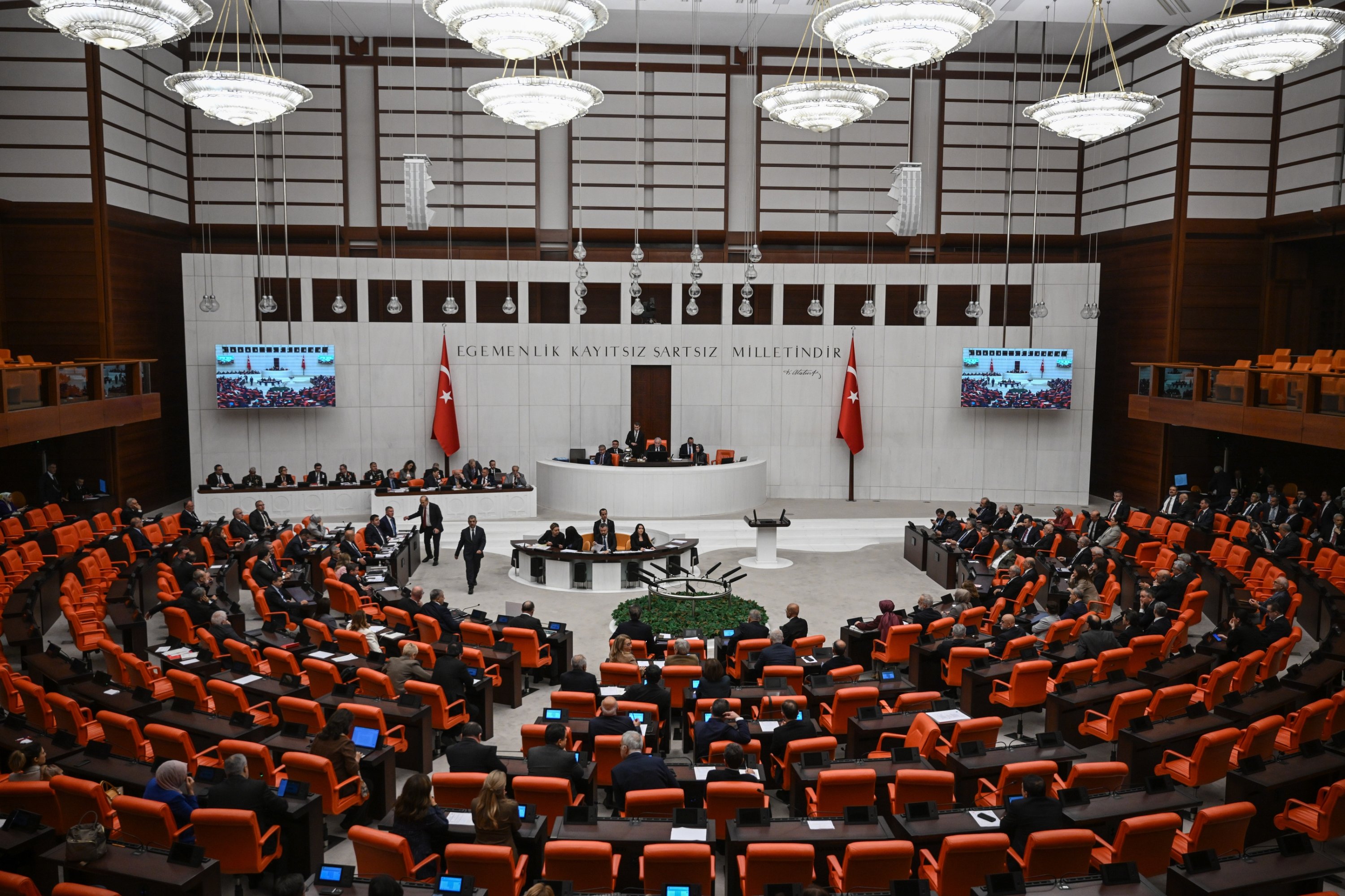
The first article of a bill approving the Mecca agreement on joint defense among Türkiye, Pakistan and Saudi Arabia was adopted by the Turkish Parliament early Thursday.
Following the completion of discussions on the bill as a whole at the General Assembly, lawmakers proceeded to debate its individual articles on Wednesday.
Following the adoption of the bill's first article, Deputy Parliament Speaker Celal Adan suspended the session until further deliberations scheduled for late Thursday.
Türkiye, Saudi Arabia and Pakistan signed the Mecca Joint Defense Agreement at a trilateral summit in Mecca on Aug. 7, pledging to strengthen collective security, deepen defense cooperation and promote peace and stability in the region and beyond.
The opposition Republican People’s Party (CHP) is among supporters of the alliance. The party’s parliamentary group chair, Faik Öztrak, told the session where the bill was discussed that the agreement offered Türkiye an opportunity to establish a new regional security structure outside NATO, with Türkiye at its center.
"This agreement is particularly significant in that it opens up a new autonomous space in the East-West balance. It is also noteworthy that Iranian President Masoud Pezeshkian has said they are ready to join the agreement, that Syria's foreign minister has announced that Damascus is considering joining it, emphasizing the Middle East's need for joint defense systems and deterrence, and that the foreign ministers of the countries party to the Mecca agreement have met with Iran's foreign minister in Tehran. Keeping the Mecca agreement within the boundaries of 'defense and deterrence' and maintaining security diplomacy with Iran are guarantees against the outbreak of a new Shiite-Sunni conflict in the region,” he said.
Fuat Oktay, chair of Parliament's Foreign Affairs Committee and a lawmaker for the ruling Justice and Development Party (AK Party), said at the session: "The agreement stipulates that a 'comprehensive consultation and objective assessment mechanism' be activated in the event of an attack against one of the parties, with decisions taken by consensus, or joint agreement. Accordingly, there is no question of our country being drawn into an uncontrolled process against its own will. Furthermore, the deployment of the Turkish Armed Forces abroad to participate in conflicts is possible only through motions approved by the parliament, pursuant to Article 92 of our Constitution."
Describing the Mecca agreement as a regional security ring that complements Türkiye's own security, Oktay said: "It is evident that the Mecca alliance is fully compatible with our 360-degree security approach, our fight against terrorism and regional stability. Türkiye's profile as a country that assumes responsibility in its region is welcomed by all countries. Some of our lawmakers have also criticized the absence of a common definition of terrorism. As you know, there is no multilateral international agreement that contains a common definition of terrorism accepted by all parties. Such a definition is not even included in NATO's founding treaty. Under the Mecca agreement, any form of support related to counterterrorism will be determined through consultations, following an assessment of the situation and needs, and on the basis of an agreement reached among the parties."
"The Mecca Joint Defense Agreement is fundamentally about solidarity and deterrence,” Hulusi Akar, former army chief and defense minister who now serves as an AK Party lawmaker, said.
“We already have military cooperation agreements with both Pakistan and Saudi Arabia. This agreement further develops those relations. Drawing on our past experience and in light of our needs, this agreement has been brought to the agenda. It is in no way an alternative to NATO; rather, it is a complementary partnership and is not directed against any country. None of our troops are currently deployed abroad, and should such a deployment become necessary in the future, it will certainly be subject to parliamentary approval. There is no issue on that front. We are working to institutionalize these relations. I would also like to draw your attention to the fact that other countries may join this partnership if they express such a wish or interest. However, their participation would also be subject to parliamentary approval,” he said.