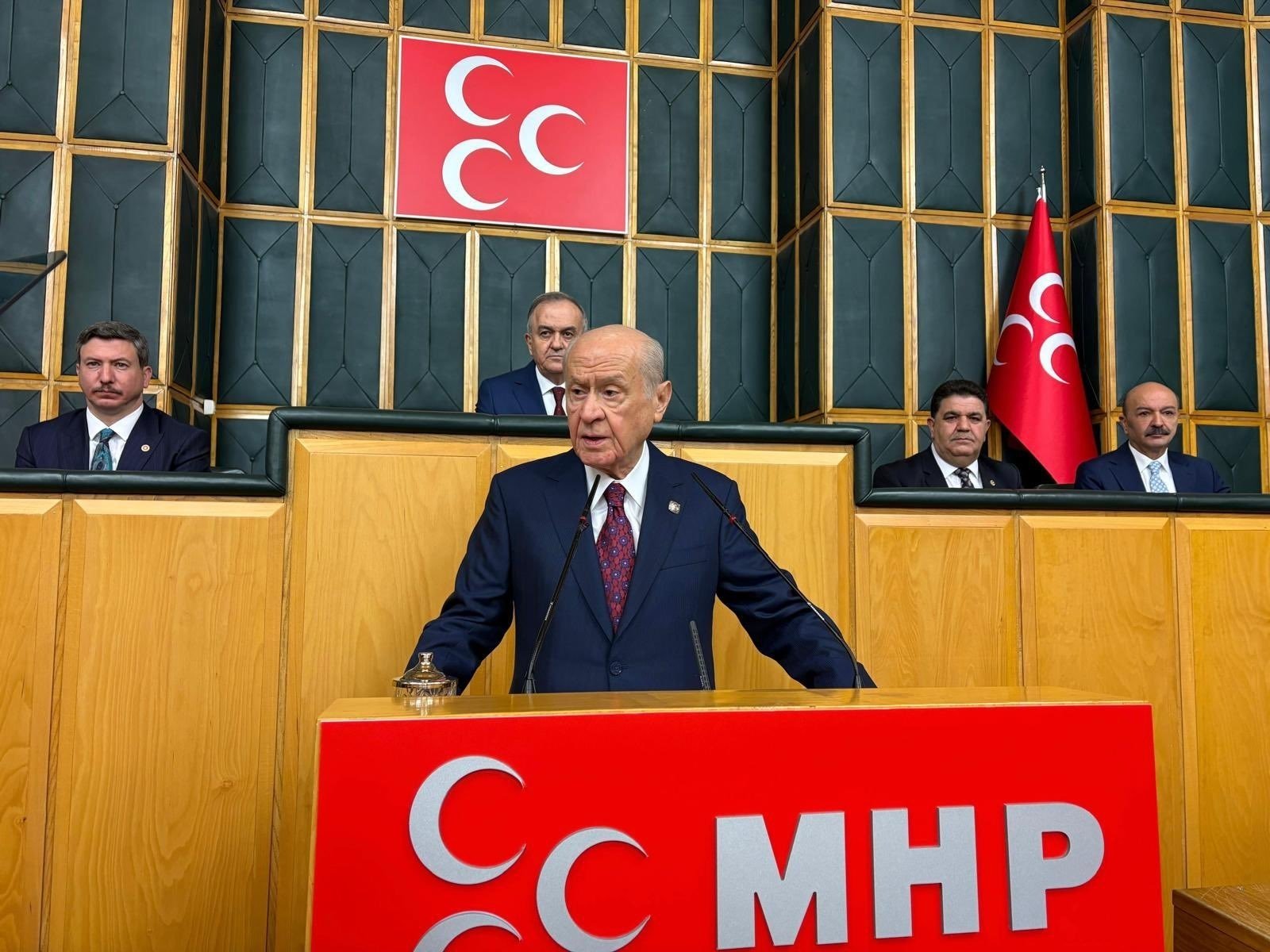
Nationalist Movement Party (MHP) Chair Devlet Bahçeli on Friday strongly condemned Israel’s strike on Syria’s Abu al-Duhur military air base, calling it an “unacceptable attack” on international law, peace and regional stability, and warned Israel against provocations targeting Türkiye.
In a written statement, Bahçeli said the attack on the air base in the Idlib countryside, which targeted Syrian infrastructure and capabilities, constituted another violation of Syria’s sovereignty and territorial integrity.
“Whether it is a manifestation of historical expansionism and disregard for the law or an attempt aimed at the approaching elections, what has been done is an unacceptable attack on law, peace and regional stability,” he said.
Bahçeli urged Israel to "refrain" from “provoking Türkiye,” testing Ankara’s patience or taking steps that could directly or indirectly interfere with Türkiye’s national security interests.
“Türkiye is not a country seeking conflict,” he remarked. “However, it is not a country that will ignore threats directed against it, stand by while its sovereign rights are violated or leave its national security at the mercy of others.”
The MHP leader said Ankara was closely monitoring Israeli actions in Syria that intersect with Türkiye’s security interests, as well as efforts to exclude Türkiye from the Eastern Mediterranean and policies he said encouraged regional fragmentation.
He stressed that Türkiye did not seek war with Israel or any other country, but warned that its preference for diplomacy and restraint should not be interpreted as weakness or a lack of deterrence.
Bahçeli also rejected any attempt to establish permanent areas of occupation in Syria, alter de facto borders, expand buffer zones or exploit ethnic and sectarian groups for geopolitical purposes.
Such steps would be “unacceptable for Türkiye,” he said.
Bahçeli outlined a seven-point proposal aimed at establishing a broader regional security architecture and achieving lasting peace.
He called for expanding security cooperation under the Mecca Agreement signed by Türkiye, Saudi Arabia and Pakistan and proposed developing it into what he described as an “Islamic Peace Force” encompassing countries and regions facing Israeli attacks.
Bahçeli also proposed establishing a temporary Middle East Peace Coalition or Council consisting of the United States, Russia, China and the European Union to help restore regional stability.
Under another proposal, he called for a Middle East Security and Peace Conference to be convened at Türkiye’s initiative under United Nations auspices. The conference, he said, should develop a road map for a permanent two-state solution to the Israeli-Palestinian conflict and wider regional stability.
Bahçeli also proposed an “Ankara Declaration” setting out principles guiding Türkiye’s approach to regional security and making clear that Ankara would respond to any potential Israeli attack.
His proposals further included establishing a neutral International Cease-Fire Monitoring Mission under the U.N. to document violations, oversee the security of humanitarian corridors and monitor the protection of civilians.
He also called for an International Mediation Contact Group to institutionalize multilateral diplomatic efforts and ensure continuity in negotiations.
His final proposal envisaged “gradual diplomatic pressure and incentive mechanism” combining political and economic pressure with military deterrence, while offering diplomatic and economic incentives if Israel complied with international law, ended settlement expansion and returned to negotiations.
Bahçeli reiterated his support for an independent, sovereign Palestinian state based on the 1967 borders, with East Jerusalem as its capital, saying such a state remained essential for lasting peace.
“Türkiye is not an actor that will go from door to door in the face of attacks on its sovereign rights,” Bahçeli said, warning that Israel should take Ankara’s warnings seriously.