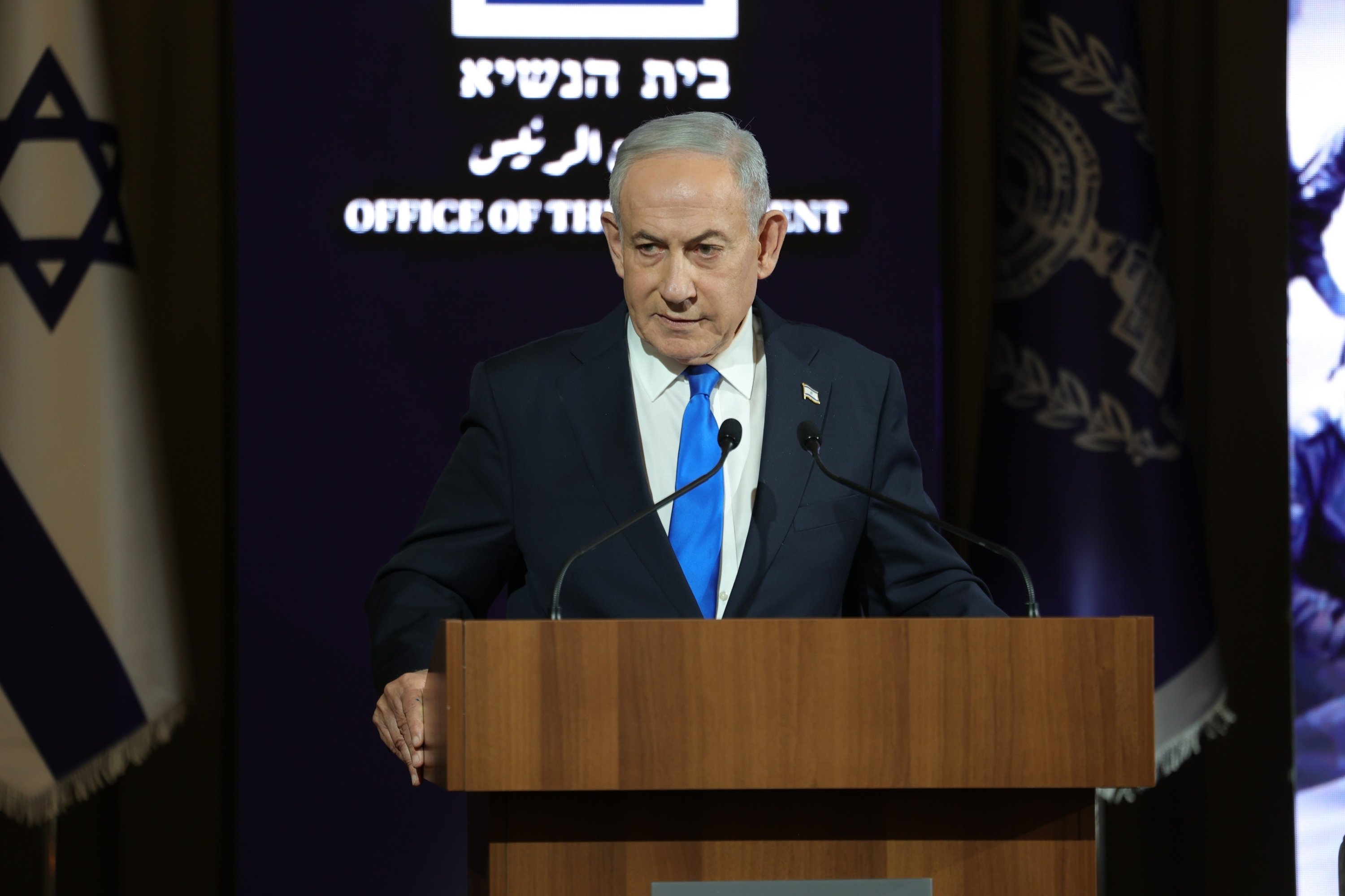
Israel’s recent strikes on a military base in Syria’s northwestern Idlib province and the use of President Recep Tayyip Erdoğan’s image in an election poster by Prime Minister Benjamin Netanyahu’s Likud party bearing the slogan “They want Netanyahu to lose” are seen by experts as signs of the growing political and strategic pressure Netanyahu is facing.
“The circumstantial aspect of the issue is that, as Israel heads into an election period, Prime Minister Benjamin Netanyahu’s main concern is finding a new political target,” Gökhan Çınkara, an associate professor at Necmettin Erbakan University and director of the Global and Regional Studies Center, told Daily Sabah.
“This was already evident in the campaign poster he used for the election,” he said, adding that the decline in support for Netanyahu’s Likud party could be seen as another indication of the pressure he faces.
As Israel’s Oct. 27 elections approach, political parties have stepped up their campaigning.
A new election poster displayed by Prime Minister Benjamin Netanyahu’s Likud party on a billboard in Tel Aviv features images of Turkish President Recep Tayyip Erdoğan alongside Iranian leader Mojtaba Khamenei, Hezbollah Secretary-General Naim Qassem and New York Mayor Zohran Mamdani.
“They want Netanyahu to lose. Don’t let them win,” as seen in the poster.
The campaign comes amid an increase in rhetoric targeting Türkiye and President Erdoğan by Israeli politicians ahead of the Oct. 27 vote.
Çınkara also remarked that Netanyahu’s political predicament and lack of a clear policy agenda has led him to target figures such as New York Mayor Zohran Mamdani and President Recep Tayyip Erdoğan in an effort to consolidate his electoral base.
Alongside Netanyahu’s campaign move involving Erdoğan, diplomatic pressure on Tel Aviv is also mounting over the war in Gaza. On Tuesday, Jared Kushner, U.S. President Donald Trump’s son-in-law and special envoy, met Netanyahu to discuss efforts toward a cease-fire in Gaza.
The talks, which lasted about four hours, focused on obstacles to a cease-fire and arrangements for the postwar period. According to U.S. media reports, Kushner urged Netanyahu not to obstruct efforts to reach a cease-fire agreement.
Ufuk Necat Taşçı, assistant professor of International Relations at Çanakkale Onsekiz Mart University also noted that Israel entered the conflict with Iran on the basis of flawed intelligence assessments, while largely failing to achieve its main objectives.
He pointed to factors including Gadi Eisenkot’s growing political prominence and internal divisions within Netanyahu’s Likud party as signs of mounting domestic pressure.
As Kushner met Netanyahu, Trump also made remarks on Gaza, pointing to Hamas’ decision to lay down its arms.
“Israel should stop bombing Gaza,” Trump said.
Trump also stated it would not be appropriate for him to become directly involved in Israel’s Oct. 27 elections, though he said he could endorse a candidate.
Furthermore, Merve Suna Özel Özcan, associate professor and the vice chair of the International Relations Department at Kırıkkale University, said anti-Türkiye rhetoric is increasingly being used as a tool for electoral mobilization in Israel, with President Erdoğan portrayed not only as a regional rival but also as an external threat that could help Netanyahu rally support and bolster his political position.
She noted that portraying Türkiye as a potential security threat is not a new development in Israel, pointing to the Nagel Committee report, which had previously raised concerns over Ankara’s growing regional influence, particularly in Syria.
“Against this backdrop, Erdoğan’s appearance in Israeli election propaganda and the targeting of potential Turkish military capabilities in Syria should not be viewed as developments that emerged overnight,” the expert said. “Rather, they are the political and military manifestations of a threat narrative that has been developing for some time.”
Recently, Haaretz, an Israeli newspaper known for its criticism of Prime Minister Benjamin Netanyahu's government, published an analysis arguing that Netanyahu has portrayed Türkiye as a major threat in an apparent effort to gain an electoral advantage while also examining Ankara's bid to acquire F-35 fighter jets from the United States.
The analysis recalled that President Erdoğan and U.S. President Trump projected a warm rapport during the NATO summit in Ankara and that Washington signaled openness to a potential F-35 sale to Türkiye. It said those developments have been met with growing concern within both the Israeli government and the Israeli public, stating: “The election is approaching, and the 'Mr. Security' campaign has begun. In a calculated move, Benjamin Netanyahu last week launched a blitz of interviews, phone calls and statements in an attempt to block the sale of F-35 jets to Türkiye.”
Özcan offered that the changing regional environment following the Mecca Agreement should also be taken into consideration, while cautioning against portraying the agreement as an anti-Israel alliance.
All three countries support a two-state solution to the Israeli-Palestinian conflict based on the 1967 borders, the expert noted.
“From Israel’s perspective, therefore, the issue is not simply the emergence of another military mechanism, but the possibility that regional powers are beginning to build their own security and stability architecture,” she emphasized.
In an interview with the UAE-based The National, Foreign Minister Hakan Fidan last month discussed tensions between Türkiye and Israel, as well as the Israeli government's regional policies.
Fidan said there was no reason for a direct confrontation between Türkiye and Israel, arguing that Netanyahu has increasingly resorted to hostile rhetoric as he seeks a new political adversary ahead of the country's upcoming elections.
Aylin Ünver Noi, professor of International Relations and Vice Rector of Beykoz University, indicated that “This should be viewed as an attempt to group together figures who oppose Israel’s regional policies, particularly its policies toward Hamas and the Palestinians.”
Whether the strategy will prove effective remains uncertain, she said, but the choice of figures featured in the campaign is significant because they have been associated with opposition to Israeli policies on the Palestinian issue.
“Türkiye and, in this context, the New York mayor should also be assessed from this perspective,” the expert added.
New York Mayor Zohran Mamdani said last month that the city cannot enforce the international arrest warrant for Israeli Prime Minister Benjamin Netanyahu, but called on the federal government to act.
In the video, Mamdani described the Israeli prime minister as a "war criminal" and said he is not welcome in New York City.
"It is clear that we do not have the independent legal authority to enforce this warrant," he said in a video posted on X. "The federal government, however, does and I call on them to join the ICC and execute this warrant," he added, referring to the International Criminal Court.
Noi also described Türkiye’s broader foreign policy as focused on promoting regional and international stability and peace, pointing to Ankara’s diplomatic engagement in several conflict zones stretching from the Balkans and the South Caucasus to conflicts in Africa.
Israel has been carrying out incursions into Syrian territory since the December 2024 since the overthrow of the ousted Bashar Assad regime, including sending troops into a U.N.-patrolled buffer zone that separated Israeli and Syrian forces in the Israeli-occupied Golan Heights since 1974.
Israel, on Tuesday, carried out airstrikes on the Abu al-Duhur Military Air Base in Syria’s northwestern Idlib province, drawing attention from both Türkiye and regional countries.
Özcan stated that Israel’s latest strike in Syria should also be assessed within this broader context, arguing that the targeting of Abu al-Duhur Air Base could reflect Israeli concerns over Türkiye’s potential future military capabilities in the country.
“Although the base has remained largely inactive for some time, its potential future use by Türkiye suggests that Israel is concerned not only about existing threats but also about capabilities that could emerge in the future,” she said.
In a statement issued Aug. 18, the Foreign Ministry of Türkiye condemned the Israeli forces that carried out airstrikes on the military facility, located in the Idlib countryside, in the early hours of Tuesday.
"We strongly condemn the airstrikes carried out by Israel early this morning against the Abu al-Duhur Military Air Base in the countryside of Syria's Idlib," the ministry said.
The ministry criticized Israel for "recklessly" continuing attacks targeting Syria's infrastructure and capabilities while violating the country's territorial integrity and unity.
Ankara also urged the international community to take a firmer stance against Israel's increasingly aggressive actions in Syria.
Çınkara also added that another key issue for Israel since the Oct. 7 attacks has been how to restore its eroded deterrence.
“Against this backdrop, Israel tends to perceive virtually any military activity in the region as a potential threat,” he underlined. “This has become one of the main factors driving Israel’s increasingly aggressive military posture in places such as Lebanon and Syria.”
Meanwhile, Presidential Communications Director Burhanettin Duran also strongly condemned the Israeli airstrike on the Abu al-Duhur Military Air Base.
"These attacks targeting Syria's sovereignty, territorial integrity and infrastructure are a continuation of a reckless policy of aggression that threatens regional peace and stability," Duran noted.
He said that Türkiye, under the leadership of President Recep Tayyip Erdoğan, would continue to support Syria's sovereignty and territorial integrity and oppose any attempt that threatens peace and stability in the region.
“Israel does not want a strong, unitary state on its border because it perceives such a state as a potential security threat,” Noi argued.
She also said the latest Israeli strikes should also be assessed against efforts to rehabilitate Syrian military infrastructure and Türkiye’s close relations with the new Syrian authorities.
“Türkiye has a fundamentally different approach,” Noi stressed. “Ankara wants to see a strong, unitary Syrian state and seeks to ensure its own security through stable relations with its neighbors.”
Türkiye’s broader regional policy is based on having stable and capable states along its borders and developing cooperative relations with them, according to her.
U.S. special envoy for Syria Tom Barrack said Thursday that Washington is working to establish a deconfliction mechanism among Israel, Türkiye and Syria following an Israeli strike on a Syrian air base near the Turkish border.
Referring to the possibility of a Turkish military response, Barrack said Türkiye, after observing aircraft heading toward its territory, may have “understandably prepared to respond.”