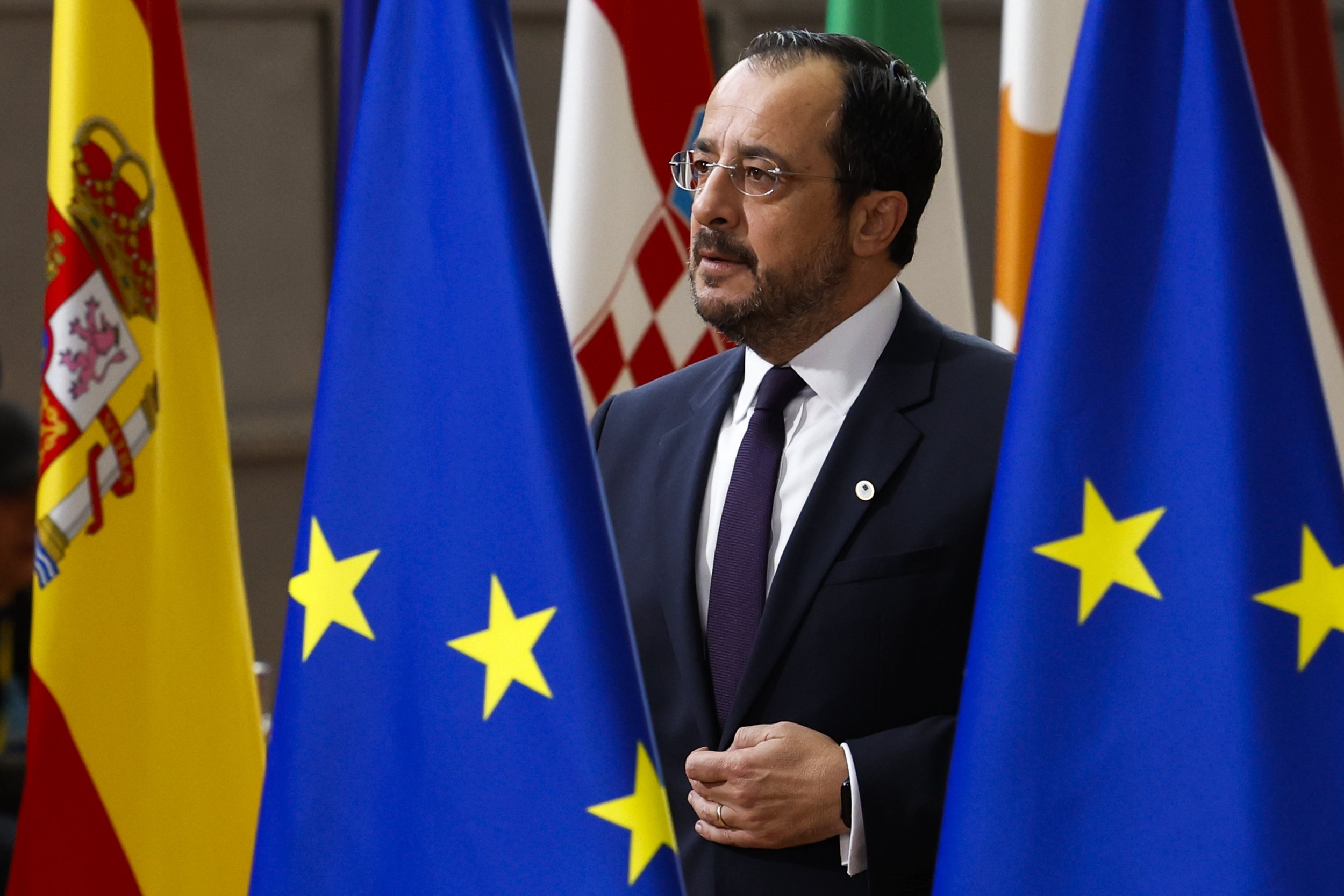
The Greek Cypriot administration is preparing to take over the rotating presidency of the Council of the European Union in the first half of 2026. While the development is largely symbolic, the Greek Cypriots’ agenda in Brussels could pose emerging diplomatic challenges for Türkiye, particularly regarding the long-standing Cyprus dispute. Experts warn that the Greek Cypriot presidency may undermine an emerging mutual will between Türkiye and the EU to further defense cooperation.
Speaking to Daily Sabah, professor and political scentist Ali Fuat Gökçe stated that “The Greek Cypriot administration has recently been developing policies against Türkiye and the Turkish Republic of Northern Cyprus (TRNC) including a defense cooperation with the U.S, military exercises, the deployment of Israeli air defense systems on the island and the training of Greek Cypriot youths in Bulgaria, Poland and the Czech Republic under a so-called 'Special Security Force' that can be considered non-peaceful.”
Under the EU’s rotating system, member states hold the presidency for six months, coordinating legislative activity, guiding inter-institutional negotiations and representing the council in dealings with other EU bodies. Hungary took over the presidency on July 1, 2024, completing its term at the end of the year before handing the position to Poland for 2025 and Cyprus for early 2026.
Gökçe also warned that the training of young people under the label of a “Special Security Force” has naturally raised questions about whether a new EOKA-like structure is being formed, pointing to growing concerns over the Greek Cypriot administration’s intentions. He said the failure to abide by issues agreed upon during talks between TRNC President Tufan Erhürman and Greek Cypriot leader Nikos Christodoulides, coupled with the sharing of photographs taken in front of the image and weapon of EOKA founder Georgios Grivas, sends a clear political message.
“All these policies of deadlock undermine trust and will negatively affect the situation on the ground, including during the Greek Cypriot administration’s upcoming term as president of the EU Council,” he argued.
Moreover, associate professor Emete Gözügüzelli from Social Sciences University of Ankara, also noted that the Greek Cypriot administration views its preparations for the EU’s rotating presidency not merely as an administrative responsibility but as a strategic opportunity to strengthen its geopolitical position in the Eastern Mediterranean, increase diplomatic pressure on Türkiye, TRNC and reshape the international framework of the Cyprus issue in its favor.
“For the Greek side, hydrocarbon resources are not only an economic prospect but also a tool to reinforce sovereignty claims and international legitimacy, with the short-term aim of embedding its self-declared exclusive economic zone into official EU energy and security documents, a move that would marginalize Türkiye’s maritime claims and the TRNC’s rights,” she asserted.
Gözügüzelli also reminded that the Greek Cyprus also seeks to frame Türkiye’s “Blue Homeland” doctrine as destabilizing while accelerating drilling activities with companies such as ExxonMobil, ENI and Total, portraying Türkiye’s own exploration efforts in Brussels as “escalatory steps” and pressing the EU for stronger political language and, if necessary, new sanction mechanisms.
Recently, the newly re-signed maritime boundary agreement between Lebanon and the Greek Cypriot administration was criticized by the Turkish ministers and TRNC officials, asserting that the deal ignores the rights of Turkish Cypriots and exceeds the authority of the Greek Cypriot side, saying the deal risks further destabilizing the eastern Mediterranean.
On the other hand, Ali Oğuz Diriöz, an academician at TOBB University of Economics and Technology, also pointed out that “another development that should not be overlooked is the likelihood that, over the next six months, particularly Central Asian republics and several other countries may take steps to open representations in southern Cyprus or upgrade the level of diplomatic relations,” he said.
Diriöz also marked that with Greek Cypriot administration’s 2026 EU Council presidency would also elevate the Cyprus issue on the EU’s agenda.
Turkish-EU defense ties
While Türkiye has become prominent in the defense industry and strengthened the defense cooperation with European states over the past years, the objections from Greece and the Greek Cyprus have also mounted.
Regarding Türkiye and the EU defense relations, Gökçe reminded that Greece and the Greek Cypriot administration have already vetoed Türkiye’s participation in the EU’s Security Action for Europe (SAFE) defense program, and he added, “During this period, the Greek Cypriot Administration may adopt more hard-line policies aimed at altering the status quo on the island in its favor and pressing for the withdrawal of Turkish troops.”
The SAFE Program, adopted by EU leaders in May, is meant to provide competitively priced, long-term loans to accelerate urgent defense procurement.
It forms part of the European Commission's ReArm Europe Plan/Readiness 2030, aiming to mobilize over 800 billion pounds in defense spending.
“Greece and the Greek Cypriot administration could seek to overcome the impasse by putting the Greek Cypriot administration’s potential NATO membership forward as leverage against Türkiye, a scenario that could prompt Ankara to suspend broader defense cooperation with the EU,” Gökçe continued.
Türkiye, which is a member of NATO but not the EU, is technically eligible to access EU defense industry financing and joint procurement programs as part of the bloc's 150-billion-euro ($176-billion) SAFE initiative.
However, Greek Prime Minister Kyriakos Mitsotakis recently reiterated that he would not approve Türkiye's involvement in the SAFE program due to ongoing disputes in the Aegean and the casus belli dispute between Ankara and Athens.
Additionally, Gözügüzelli also remarked that the EU Council presidency of the Greek Cypriot administration is expected to create a complex period in Türkiye-EU relations using its veto power on issues including the modernization of the EU-Türkiye Customs Union, visa liberalization, cooperation in energy, transport and NATO-EU coordination with references to “provocative activities in the Eastern Mediterranean” and “violations of Cyprus’ sovereign rights.”
“The aim is to portray Türkiye as a marginal actor in the eyes of Europe, a dynamic that could push Ankara more firmly toward a NATO-centered security posture and increase the risk of its exclusion from EU defense projects,” she added.
Türkiye’s defense industry has become one of the world’s top 10 defense exporters by minimizing its dependence on foreign sources for key technologies, the head of the Presidency of Defense Industries (SSB), Haluk Görgün, stated last month.
On the other hand, Diriöz also offered that Türkiye could respond by strengthening dialogue with Central and Eastern European countries such as Hungary, Poland and Romania, which are NATO allies and share overlapping interests with Ankara in defense industry cooperation, and Türkiye could seek to coordinate positions with these countries on keeping European defense firmly anchored within NATO.
“Europe’s political center of gravity is increasingly shifting eastward from Brussels and Eastern European countries do not view Türkiye as a security risk to Europe but rather as a highly valuable ally,” Diriöz indicated.