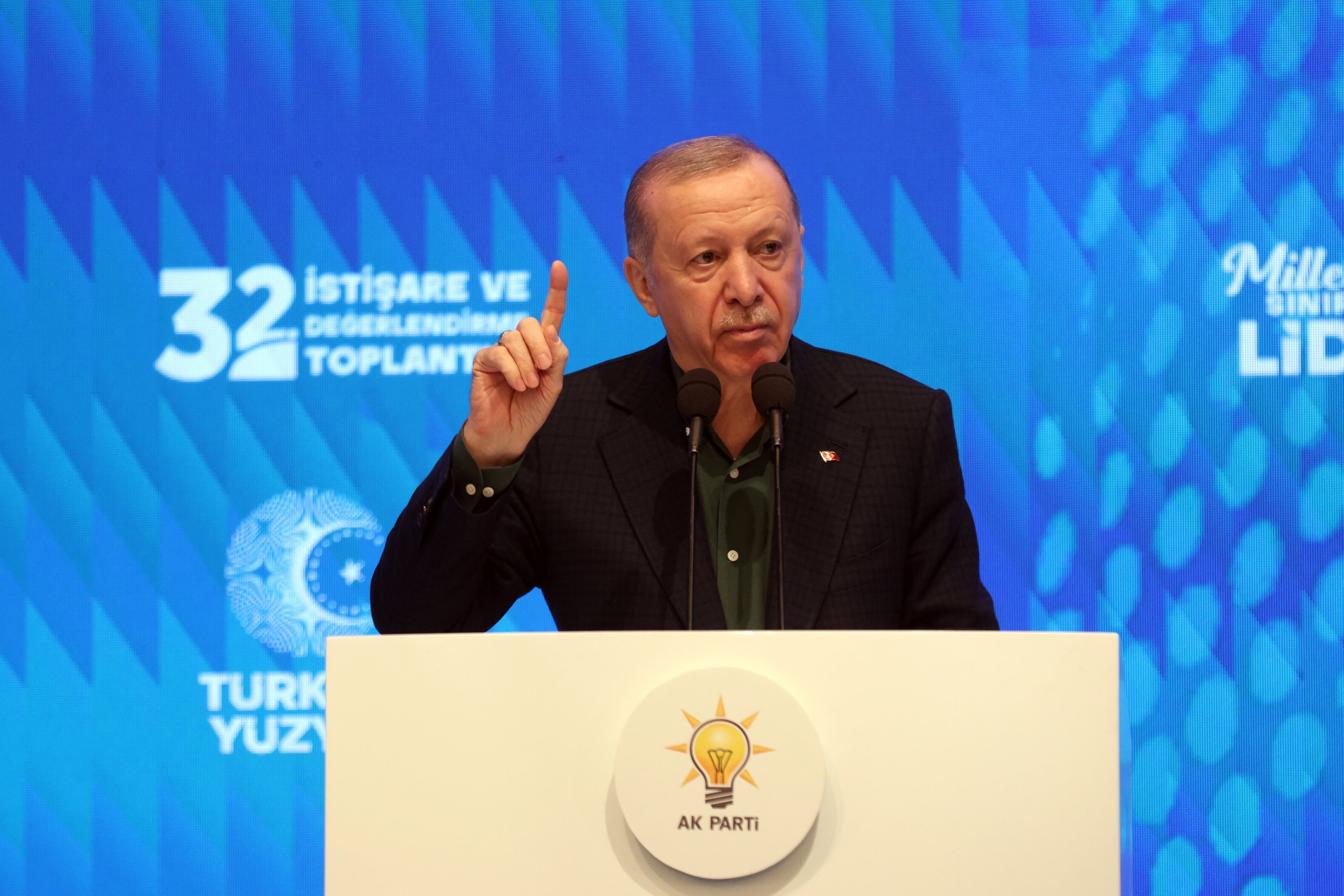
President Recep Tayyip Erdoğan on Saturday hailed the start of a new chapter for Türkiye with the disarmament of terrorist group PKK.
Speaking at an annual consultation meeting of his ruling Justice and Development Party (AK Party) in the capital Ankara, Erdoğan called for full support of the disarmament process that began with a handover of the first batch of weapons by the PKK.
Thirty PKK terrorists burned their weapons at the mouth of a cave in northern Iraq on Friday, marking a symbolic but significant step toward ending decadeslong violence that killed over 40,000 people in Türkiye.
"As of yesterday, the scourge of terrorism has entered the process of ending. Today is a new day; a new page has opened in history. Today, the doors of a great, powerful Türkiye have been flung wide open," Erdoğan told members of his AK Party.
He said the recent steps have united the nation, and now the parliament will play a critical role in setting up a legal framework for completing the disarmament process.
"I hope that our parliament will support this process with the broadest possible participation," Erdoğan said.
Ankara has taken steps toward forming a parliamentary commission that will oversee the disarmament.
Erdoğan described the terror group's decision to lay down arms as a victory for Türkiye, stating that Turks, Kurds, Arabs - all 86 million citizens - emerged as winners.
Underlining a broader vision of regional unity, Erdoğan also said: "Today, the spirit of Malazgirt, the Jerusalem alliance, and the core of the War of Independence are being reshaped."
Addressing the recent "terror-free Türkiye" initiative, the president made clear that the process is not the outcome of any negotiation, bargaining, or give-and-take process.
Stressing national unity, Erdoğan added: "The Republic of Türkiye is our shared home, our common roof. All 86 million of us are one, united, and brothers for eternity."
He further noted that the scope of the initiative extends beyond Türkiye's borders, stressing that a terror-free Türkiye is not only an issue for Kurdish citizens at home but also for Kurdish communities in Iraq and Syria, with the process actively discussed with them.