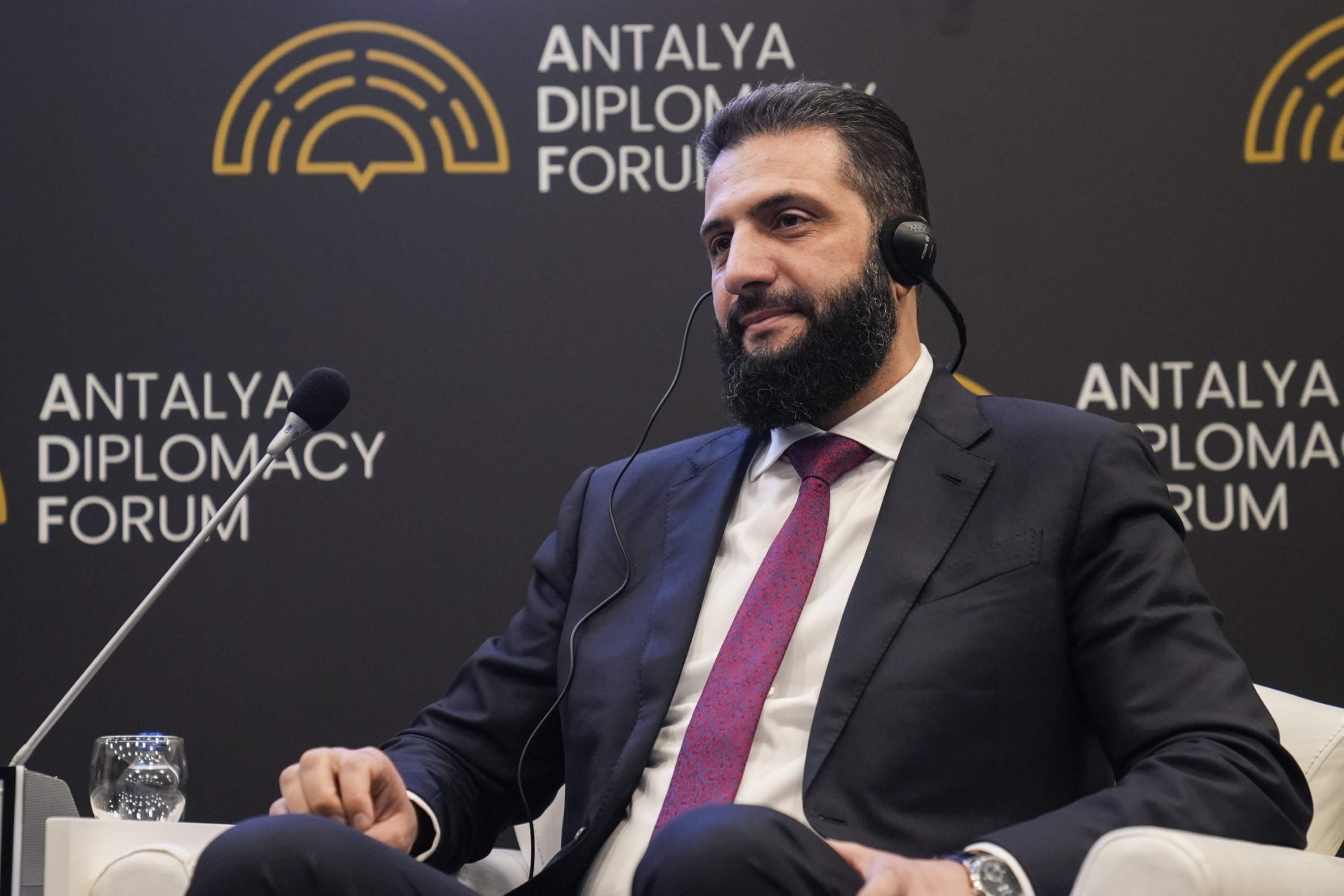
Syrian President Ahmed al-Sharaa said Friday that a strengthened partnership between Syria and Türkiye could serve as a cornerstone for regional stability and global security, as his country seeks to rebuild ties and reposition itself after years of conflict.
Speaking to Anadolu Agency (AA) on the sidelines of the Antalya Diplomacy Forum (ADF), al-Sharaa emphasized the historical and geographic ties between the two countries, describing their relationship as a foundation on which broader cooperation could be built.
“The Syria-Türkiye partnership is a base upon which many things can be constructed for the future of regional and global security,” he said.
Al-Sharaa noted that Syria had been largely isolated from the region and the international community under the former regime, but said the country’s transition had opened new opportunities to restore diplomatic and economic relations.
“The liberation of Syria from the former regime created an opportunity to rebuild ties regionally and internationally,” he said, adding that Türkiye had been a consistent supporter of the Syrian opposition for more than a decade.
He described Syria as moving from a period of crisis into a period of opportunity, highlighting ongoing efforts to attract investment and deepen cooperation with regional partners, particularly Türkiye.
Addressing energy security and supply chains, al-Sharaa said Syria’s geographic position offers strategic advantages as a transit corridor linking East and West.
He pointed to disruptions in global energy markets following recent regional tensions, including conflict involving Iran, as increasing the importance of alternative routes.
“Syria can provide a secure corridor for energy supply and trade routes,” he said, noting connections linking the Arab Gulf to Türkiye through Syria and Jordan, as well as access to the Mediterranean Sea.
He also referred to the so-called “Four Seas” project, a regional integration initiative aimed at connecting energy and trade networks across the Caspian Sea, the Mediterranean, the Red Sea and the Gulf. Al-Sharaa said the project reflects a broader global demand for secure supply chains and diversified energy routes.
As part of economic cooperation, al-Sharaa said Syria and Türkiye are working on establishing a free trade zone in the northwestern province of Idlib, located along key transit routes connecting Idlib, Latakia, Aleppo and Damascus.
He added that infrastructure projects are underway, including airport expansions and port investments, with Turkish companies playing an active role in Syria’s reconstruction efforts.
On internal developments, al-Sharaa said progress had been made in integrating various armed groups into a unified national framework.
He noted that forces linked to the YPG terrorist group are being incorporated into state structures, while remaining foreign military elements in northeastern Syria have withdrawn.
“The integration process between the Syrian state and these forces is ongoing and progressing positively,” he said, describing it as critical for national stability.
On Jan. 30, the Syrian government announced that it had reached a comprehensive agreement with the U.S.-backed YPG aimed at ending divisions in the country and launching a new phase of integration.
The ministry said the completion of the handover of U.S. sites "represents a natural outcome of the successful integration of the YPG into national structures, and of the Syrian state assuming full responsibility for combating terrorism and addressing regional threats on its territory.”
Recently, the Syrian Foreign Ministry also announced that the government has taken control of all military bases previously used by U.S. forces deployed in the country as part of the international coalition against Daesh, marking a significant shift in control over northeastern regions.
The ministry said in a statement that it "welcomes the completed handover of military sites where United States forces were previously present in Syria to the Syrian government," adding that the move was carried out "in full coordination between the Syrian and American governments."
Moreover, reflecting on the Antalya forum, he praised Türkiye’s role in hosting international dialogue platforms and contributing to global diplomacy.
“Türkiye has become a country with significant influence both regionally and globally,” he said.
He concluded with a message to the international community, urging engagement with a changing Syria.
“Syria is no longer defined by crisis,” he said. “It is becoming a place of reconstruction, stability and a new future, a historic opportunity.”