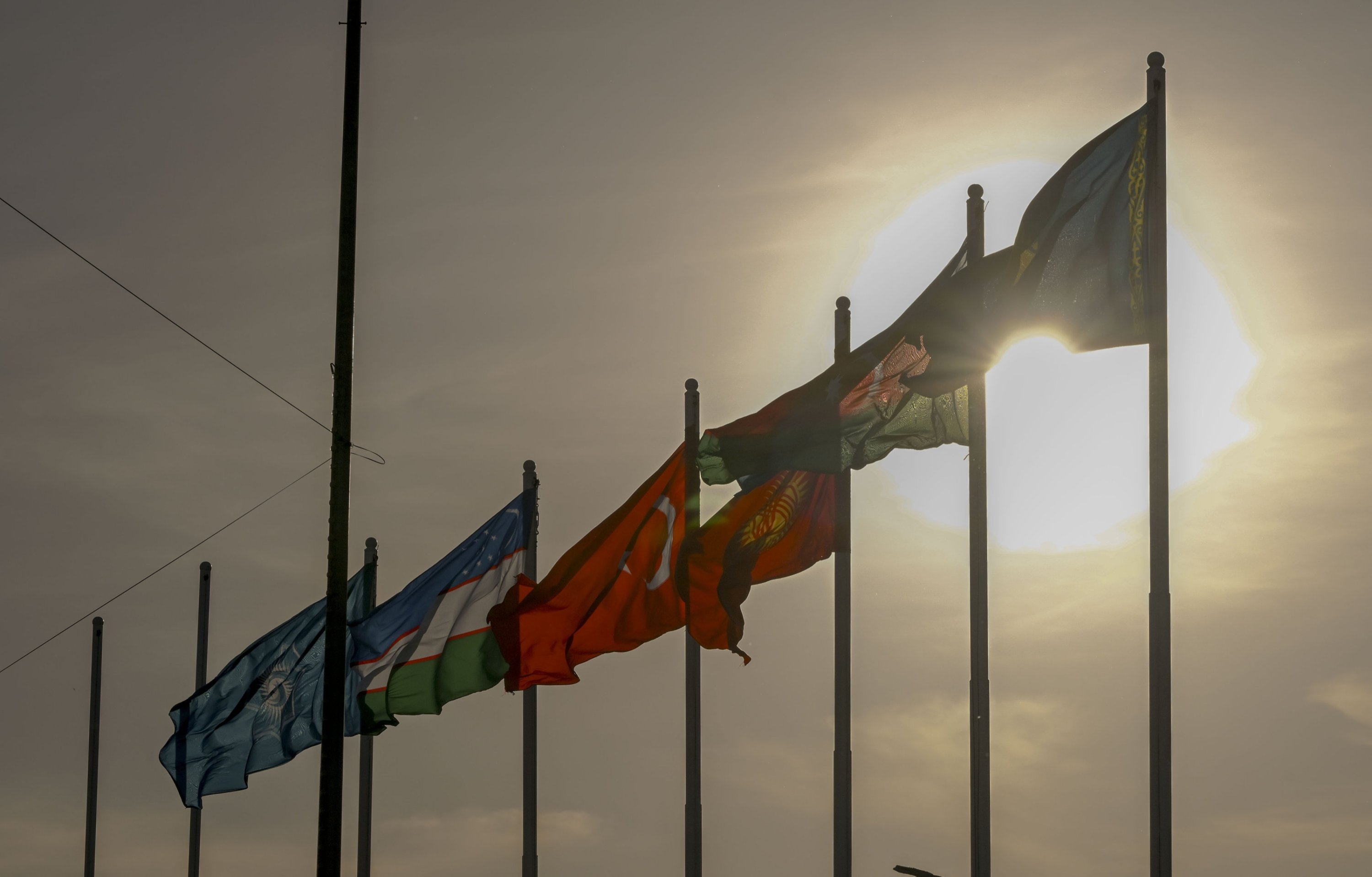
As paradigms change, alliances are being rebuilt or severed across the world at a faster pace than in the 20th century. For Türkiye, the strategy is clear: reaching out to old friends and mending ties with former foes without concessions on principles.
Throughout its history, though, the Republic of Türkiye has always counted on good relations with one particular group: the Turkic world. As it prepares to take over the rotating presidency of the Organization of Turkic States (OTS) toward the end of this year, co-founder Türkiye is gearing up to bolster it further. This is what President Recep Tayyip Erdoğan outlined during and after an informal summit of the Turkic world’s leaders in Kazakhstan earlier this month.
Erdoğan, who frequently quotes great Crimean Tatar intellectual Ismail Gaspıralı’s vision of “unity in language, work and opinion,” takes pride in crowning relations with the Turkic world with the foundation of the OTS. As he was returning from Kazakhstan, Erdoğan told journalists that the Turkic world can take on a more efficient role for the peace and stability of the region.
“The Turkic world has a great economic, cultural and strategic potential and we are striving to activate this potential and develop more cooperation in diplomacy, energy, commerce, transportation, security and defense,” Erdoğan said.
Professor Mehmet Seyfettin Erol, president of the Ankara Center for Crisis and Policy Studies (ANKASAM), notes that the OTS achieved “great momentum” in 2016 and in the subsequent years.
“This is now a dynamic structure that evolved from a cooperation platform based on cultural identity to a more institutional, multi-faceted and ‘techno-geopolitical’ body,” Erol told Daily Sabah.
The OTS membership now spans an area hosting more than 170 million people, and the combined gross domestic product (GDP) of the member countries exceeded $2 trillion. These are significant figures for Türkiye, which yearns for more foreign investment and drumming up support for Turkish investors across the world.
According to Erol, the OTS, with its multi-dimensional geopolitical connectivity, an economic integration model based on win-win policies, and constructive, peaceful strategic diplomacy based on balance, is “virtually an antidote” in an era where global powers compete and fight over the control of “sources” and “corridors” in the context of energy resources (primarily oil and gas), critical minerals, precious metals, and shipping routes or supply chains.
Sources and corridors are primary areas of interest for Türkiye, which year by year diversifies its energy resources and taps into the potential of taking part in well-established global routes for which it serves as a transit point, a bridge, and stands to become a beneficiary.
“In this context, the OTS, located at the heart of critical energy, trade and transportation routes between Europe and Asia, is increasingly regarded as a rising geopolitical sphere whose importance has become undeniable in light of the growing prominence of the Middle Corridor along the east-west axis, the expansion of Trans-Caspian transportation networks, and the search for alternative transit routes between China’s Belt and Road Initiative and European markets,” Erol said.
“Developments such as the Russia-Ukraine war and crises stemming from the Red Sea and the Middle East have highlighted the importance of secure and diversified logistics corridors, making the OTS geography visible not only in the context of ‘East-West’ routes but also 'North-South’ corridors. Centering cooperation aimed at peace, stability and prosperity against attempts to redesign the world through chaos, the OTS is emerging as a human-centered civilizational movement and a ‘central geography’ that serves as a ‘balancer of imbalance’ in the East-West context, increasingly becoming an indispensable and rising regional power sought after for cooperation and drawing the attention of the entire world,” Erol added.
Assistant professor Sinan Demirtürk of Gazi University, who serves as chair of the Türkiye Policy and Strategic Research Foundation (TURPAV), says the OTS is central to Türkiye’s Turkic world policies.
“Especially after the Nakhchivan Agreement of 2018, the Turkic Council transformed into a great organization under the name OTS. This is an international body with political roots and also a body preparing the infrastructure for military and economic integration. The OTS has the potential to create a new pole and establish a new hub of power globally,” Demirtürk told Daily Sabah.
Demirtürk pointed out that this reality has become more apparent after Azerbaijan’s Karabakh victory, noting that the victory built a significant ground of stability in the region: “Its outcome demonstrated to Turkic states that their cooperation, political integration and proximity had regional consequences.”
The rise of the Turkic world as a united force in the broader region has transformed it into a key actor in global affairs, rather than a bunch of post-Soviet states and their allies on the margins. For the U.S., for instance, it is now viewed as a hub of alternative supply chains and investment situated geographically on the periphery of Russia and China.
For Türkiye, these states possess vast opportunities, both separately and as a composite entity. Demirtürk noted that cooperation between Türkiye and Turkic states has elevated and may climb to new highs, pointing specifically to the Turkic World 2040 Vision adopted five years ago to foster deeper cooperation in energy, tourism, business, and military fields.
“The U.S.-Iran war in particular highlighted how security is of paramount importance in the region and the rising value of the Middle Corridor. Turkic states stretch across the Middle Corridor, which is the world’s most important energy supply security route. This route also makes up one of the world’s most important logistics hubs and overland commerce fields,” Demirtürk said.
The immense potential of multilateralism in the Turkic world may not lead to a new era of a Pan-Turkist movement, but the OTS’s stable growth in terms of economy and diplomatic influence could inevitably lead to something greater: a bloc similar to the European Union.
Demirtürk pointed out that OTS members are successfully advancing their bilateral relations while creating a crucial regional balance.
“In this sense, the OTS is rising as a consequence of Russia’s diminishing power in Central Asia. Through their harmony and political cooperation, the OTS established a new balance against Russia, and at the same time, they are both developing relations with China, which has a significant economic and political clout in the region. The OTS is working toward building a regional geopolitical balance against China’s influence,” he said.
Erol affirmed that the OTS can indeed transform into a regional power with full integration similar to the EU, noting that the current conjuncture of threats makes it a necessity rather than an option. However, he remains cautious about a swift transformation: “Rationally speaking, it is difficult for the organization to evolve into a EU-like, fully integrated structure in the short run. Although they have a background with common history, geography, culture and civilization, and they increasingly reinforced their economic integration capacity through developments in trade volume, investment relations, energy cooperation, digital transformation and customs coordination among member states, obviously, they still have a long way to go,” Erol said.
“The EU comparison, on an institutional level, means a common legal system, common market, common currency, high political compliance, supranational institutions, regulatory mechanism and overall, an advanced integration model based on partially shared sovereignty. Whereas, the OTS currently has a more flexible structure based on states’ sovereignty and a pragmatic, multi-layered cooperation model. Therefore, there is a need for a pragmatic approach matching more with (the EU) reality, an approach that will shape the OTS through a less flexible but functional regional integration model. We need a transition model that will carry the OTS gradually to the full integration in the vein of the EU,” Erol stated.
To achieve this, Erol suggested an integration model based on network-based collaboration, circling back to Gaspıralı's motto: “This integration model was set before us decades ago. This unity-integration can be achieved through a ‘Turkic model integration’ based on unity in language, work and opinion,” he stated.
Demirtürk noted that while cultural unity, a shared history, and spiritual solidarity form the main foundation of the OTS, the organization no longer sees the future solely through these lenses. Instead, they pursue a rational process that strengthens alliances and closely follows regional dynamics.
“In this regard, the Secretariat of the Organization, its central institutions, are rapidly implementing steps that can enhance harmony, rapprochement, political integration and economic integration among these Turkic republics. A closer examination shows that institutional bilateral cooperation among these republics has reached an unprecedented level. It is evident that a common vision for the Turkic world is being pursued step by step through shared cultural policies, the development of a common alphabet, and the establishment of bilateral cooperation and coordination among ministries, general directorates, and institutions. In this respect, institutional cooperation has become functional across many sectors and fields, from culture to the alphabet, from the writing of a common history to a common Turkish language, from a shared geographical vision to the construction of large digital platforms and spaces where artificial intelligence can be jointly developed. We also observe that these efforts are being carried out within a coordinated framework by ministries and institutions of the relevant countries, with regular reporting to the OTS,” Demirtürk noted.
The recent informal summit in Kazakhstan’s Turkestan saw countries agreeing upon further cooperation on technologies, such as satellite development and operations. The OTS agreed to endorse joint enterprises to deepen integration on technological partnerships, enhancing scientific potential and human resources to that extent. The multilateral cooperation in this field was perhaps most tangible on the nano-class CubeSat-12U satellite project. The Turkic states agreed to step up efforts for the launch of the satellite by 2026.
Countries also agreed to develop a legal framework for cooperation on AI and digital technologies.
The OTS has also planned a string of events on global platforms, such as events during World Space Week in October, including the International Astronautical Congress, which will be held in Türkiye, to tout Turkic states’ visibility in space sciences and cooperation. Likewise, Turkic World Space Days are also planned for the near future.
On Türkiye’s role in securing more connectivity and achieving greater geopolitical power, Erol believes Türkiye’s well-tested position as a rising power can help steer the Turkic world.
“The OTS is an integration initiative that acts with an understanding of common wisdom and collective leadership, drawing lessons from past experiences. Accordingly, there is an institutionalization process and a consultation-based decision-making mechanism built upon this foundation. OTS members are clearly aware of one reality: If you have no power, you have no voice, and you ultimately become prey to the wolves. It is by no means desired for the OTS region to remain a ‘passive stage’ of the ‘New Great Game.’ The goal is to become a constructive and peaceful geopolitical center of power within the world order currently being rebuilt. At this point, the geopolitical, geostrategic, and geoeconomic capacities and potentials possessed by each OTS member state, as well as their guiding approaches and roles in line with this objective, are of great importance,” Erol stated.
Erol laid out specific operational contributions Ankara can provide across multiple key sectors.
“Türkiye can play a role within the OTS that encourages and accelerates institutionalization in the fields of logistics/supply chains and energy security, particularly in the context of the Middle Corridor and, alongside it, the “Development Road,” which is increasingly becoming inevitable as an integrated route. In this regard, the swift opening of the Zangezur Corridor and the uninterrupted functioning of Caspian crossings are undoubtedly of critical importance. For the Turkic world to finance this process and transform into an economic power, it is crucial not only to realize the integration process itself but also to use its existing resources effectively and efficiently so that it can become a center of attraction. At a time when global capital is seeking safe havens, Türkiye can take steps to ensure that the Istanbul Financial Center is also perceived and supported as the OTS Financial Center. Such a step would provide the Turkic Investment Fund, which focuses on supporting strategic infrastructure projects across the region and accelerating trade through the digitalization of customs procedures, with a stronger motivation and vision extending from the regional to the global level,” Erol added.
Regarding the unstable global security architecture, Erol expanded further on the defense requirements.
“In a geopolitical environment where threats and risks have reached unprecedented levels, the search for security has emerged as a primary issue of survival for all nation-states and integration initiatives. In this regard, it should not be overlooked that the issue of “corridor and resource security,” which places the OTS region at the forefront, will gain even greater importance in the coming period. Indeed, the process is compelling the OTS to become not merely a political platform but also an energy and geoeconomic actor. Therefore, it appears inevitable that Türkiye and other OTS member states will need to build their industrial and defense capacities more effectively and in a coordinated manner around deterrence. In this context, Türkiye can contribute to accelerating institutionalization processes aimed at increasing the OTS’ strategic capacity through joint military training, cybersecurity, border security, hybrid threat coordination, counterterrorism, the establishment of rapid response forces for disaster and crisis management, and defense industry projects,” he said.
“Türkiye can also contribute to the construction of a future-oriented geopolitical vision for the OTS that takes into account its surrounding regions, particularly through initiatives toward the Middle East and South Asia. These regions will continue to stand out as neighboring areas tied to the security and prosperity of the OTS region and therefore should not be ignored,” Erol stated.
“Türkiye can play a guiding and contributory role in building a multilayered regional integration architecture for the OTS that manages the fields of connectivity, energy, economy and trade, finance, technology, security/defense and crisis management. It is of great importance that Türkiye presents this through a model of network leadership grounded in balanced, inclusive, economically focused, and multidimensional diplomacy that takes into account the sensitivities, expectations, and realities of these countries in line with its historical experience and accumulation, while also encompassing the OTS itself,” Erol said.
Demirtürk reinforced the critical economic alignments tying these major capitals together along the primary trade axis.
“Turkic states, particularly Türkiye, Azerbaijan, and Kazakhstan are also aware of the importance of the connectivity along the Middle Corridor and of the major trade route stretching across the East-West axis,” Demirtürk said.
“Especially in light of the Hormuz Crisis and the tensions that emerged in the Persian Gulf, the Turkic states are taking rational steps toward becoming an important global energy corridor. In this sense, the informal leaders’ summit in Turkestan also highlighted the growing rapprochement and cooperation among the Turkic States themselves. As expressed by President Recep Tayyip Erdoğan, Kassym-Jomart Tokayev, and Ilham Aliyev, this summit also evolved into something like a joint artificial intelligence forum for the Turkic world,” Demirtürk stated.
“The leaders in particular announced to the world that major efforts had been launched toward building an artificial intelligence platform unique to the Turkic republics and the Turkic peoples, and that significant steps had already been taken in this direction. Considering that Turkic states and Turkic communities may increasingly become connected through digital networks and that the future will largely be shaped around artificial intelligence, the meeting was important in that it discussed the establishment of a ‘Turkic AI’ or an AI infrastructure developed by Turkic engineers. It also highlighted a scientific and technological framework in which the software sector and digitalization would gain even greater prominence across the Turkic world, while cooperation in these areas would be further strengthened,” Demirtürk said.
Demirtürk noted that the leaders did not ignore immediate regional flashpoints either.
“At the same time, I believe it was valuable that the consequences of the Iran war were closely assessed at the summit, and that the six Turkic states demonstrated a collective will in calling for peace between the United States and Iran and in emphasizing the preservation of regional stability,” Demirtürk stated.
Ultimately, this structural alignment matches an exponential increase in organic social integration on the ground.
“In this context, it should also be noted that Türkiye’s supportive and guiding stance within the OTS is highly significant. This not only enhances cooperation among states and political elites but also further strengthens rapprochement among societies themselves. Following the long-standing regional domination of the Soviet Socialist Republics and the People’s Republic of China, and especially after the wave of independence that emerged after 1991, we have witnessed substantial cooperation developing among peoples, societies, universities, civil society organizations and media institutions. Hundreds of thousands of people now see Türkiye as an important tourism destination, while dozens of tours are organized today from Türkiye to Turkestan and Central Asia. As a result, these countries are getting to know one another much more closely,” Demirtürk said.
This close cultural proximity across borders is setting the foundation for the coming decades.
"Societies are becoming increasingly familiar with each other. The growth of marriages, the strengthening of family ties, and Türkiye’s emergence as a major center of attraction have all contributed to closer relations and greater social integration for the citizens of the Turkic republics. It must be emphasized that this rapprochement, both at the level of states and among peoples and societies, will be a determining factor for the future, and that in the 21st century, a new geopolitics, which we may call the ‘Turkic Belt,’ could take shape on the basis of cultural and political foundations,” Demirtürk stated.