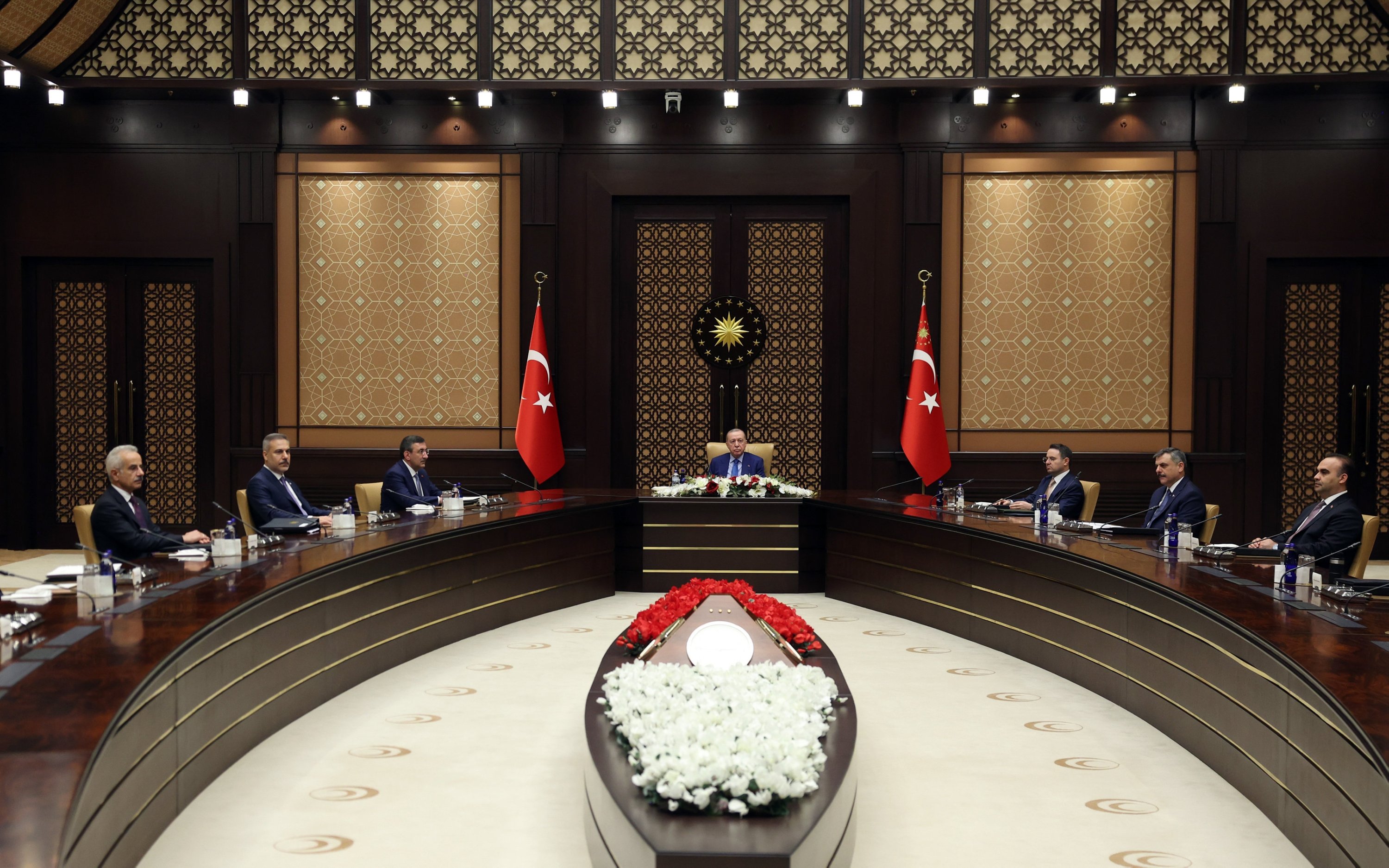
Details of the inaugural meeting of the Cyber Security Board held on Tuesday in Ankara revealed that Türkiye has a vision of keeping its own data within its borders and developing a security system with locally made components.
President Recep Tayyip Erdoğan chaired the meeting of the board in the capital. Ministers, the intelligence chief, the head of the Presidency’s Directorate of Communications and the chief of the cybersecurity directorate, as well as the secretary-general of the National Security Council and head of the Presidency of Defense Industries, attended the meeting.
A report by the Sabah newspaper delved into discussions at the meeting, including talks on global cyberattack risks, data sovereignty, AI-supported disinformation and risks the critical infrastructure faces.
Topics of the meeting included the KamuNet end-to-end public sector network, an artificial intelligence shield, steps needed to end dependence abroad on chips and software, protection plans for vital sectors like energy, finance and health care, and boosting the rapid response capacity in times of crises. The report says that the country aims to continue development of national software, hardware and engineering capacity against cyberattacks and defend the cyber infrastructure.
Participants emphasized that cybersecurity was not merely a technical issue but a basic element of national security. They also highlighted that Türkiye should remain committed to elevating the defense of the “digital homeland” to the highest level in the face of globally expanding cyberattacks, data leaks and the risk of digital manipulation.
Data sovereignty was extensively discussed at the meeting with participants, highlighting the importance of storing and processing Türkiye’s strategic data within the country and decreasing dependence on foreign systems. They underlined that end-to-end networks like KamuNet, the national software inventory and national artificial intelligence solutions would speed up the “digital independence” process.
The “Artificial Intelligence Shield” strategy developed by the Directorate of Communications was also discussed at the meeting. This system aims to boost the data security of public agencies, prevent disinformation and set up a strong line of defense against digital manipulation. Participants also stressed that locally made AI chips, software and encrypted networks would further reinforce digital independence.
Participants also talked about risks posed by dependence on foreign software and hardware and assessed that foreign-sourced systems used in critical infrastructure may pose a serious security challenge in times of a crisis, and Türkiye should boost locally made solutions against “technological domination” from abroad. They discussed cyber threats, which have evolved into tools to engineer public opinion, and how psychological warfare elements and disinformation have been more prevalent. They stressed steps taken to ensure special protection against cyberattacks for critical sectors from energy, health care, finance, defense industry, transportation and media. The board agreed to maximize the coordination between public agencies and enhance the rapid response capacity against cyber threats.
The meeting was a confirmation of Türkiye’s ambitions to be an actor in cybersecurity with deterrent power, instead of remaining merely a defender in cyberspace. It also confirmed that Türkiye would position itself as a country determining its own fate in the digital world and a country where any digital infiltration and attack would be costly for its perpetrators.