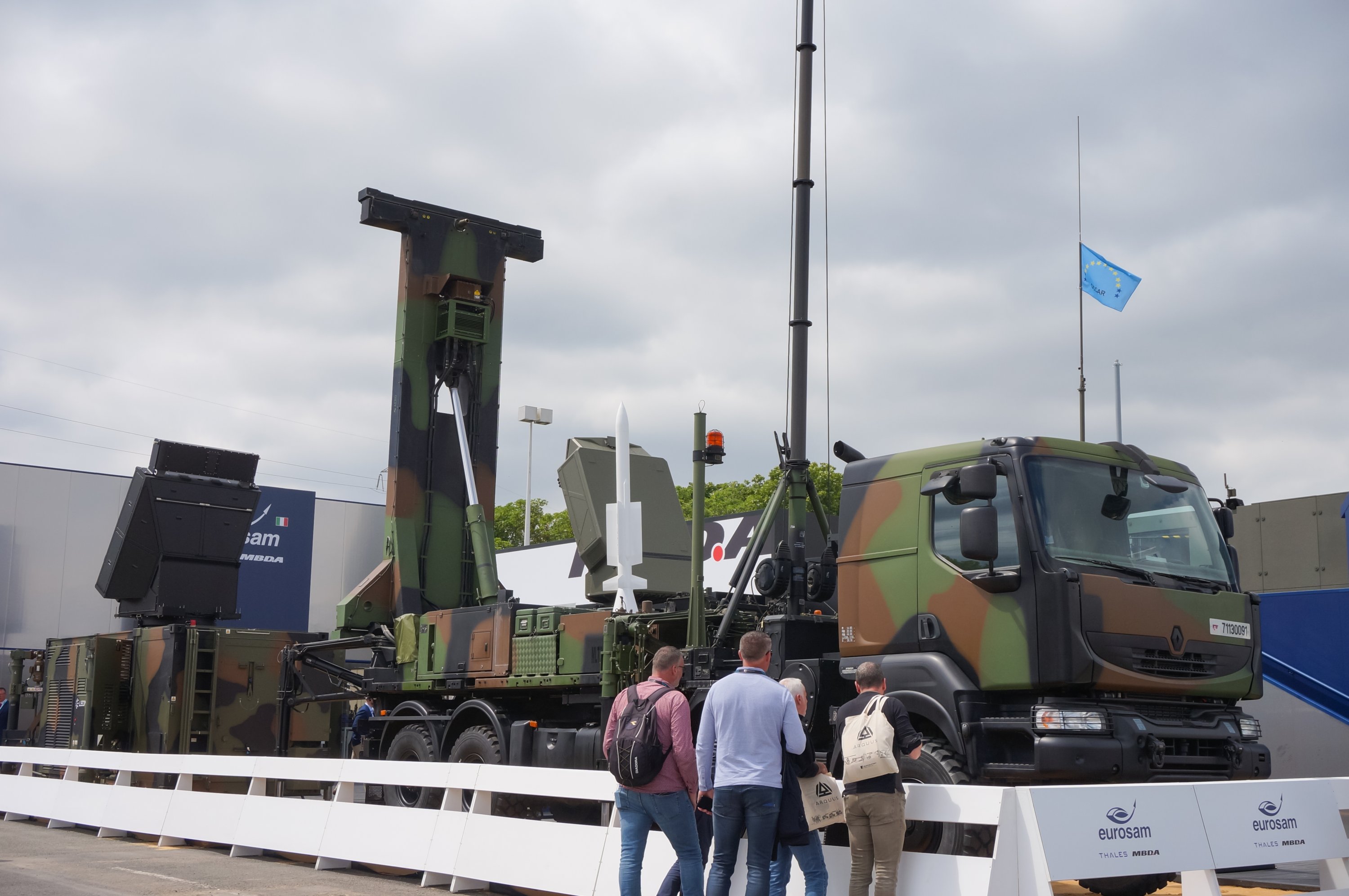
The deployment of SAMP/T air defense system by Italy in central Türkiye’s Konya was completed on Thursday, the Ministry of National Defense announced. The ministry said it was part of NATO’s permanent defense plan for reinforcing the alliance’s air defense.
The SAMP-T (Sol-Air Moyenne Portée/Terrestre) is a next-generation medium- and long-range air and missile defense system jointly developed by Italy and France. It is designed to counter a broad range of aerial threats, including aircraft, helicopters, unmanned aerial vehicles (UAVs) and tactical ballistic missiles.
The system employs advanced Aster 15 and Aster 30 interceptor missiles and provides 360-degree air defense coverage. Considered as a cornerstone of Italy's air defense network, the SAMP-T is mounted on highly mobile wheeled platforms, allowing for rapid deployment and operational readiness.
Equipped with multifunction radar systems such as the Arabel radar or the newer Kronos radar, the system can simultaneously track and engage multiple targets. It is also designed to maintain high effectiveness in electronic warfare environments while protecting military units and critical infrastructure from air and missile threats.
NATO stepped up security on its southwestern flank in light of the U.S.-Israel-Iran war and the alliance’s defense systems intercepted several missiles during the conflict which began in February. In March, an additional Patriot missile battery was deployed in a military base in southern Türkiye’s Adana by NATO.
SAMP/T is deployed at Third Main Jet Base in Konya, a major base of the Turkish Air Forces at the heartland of Türkiye.
The ministry said that at the same time, the country was working on development of local air defense systems “given the changing threat environment.”
The statement said Siper air defense system of the Turkish Air Forces launched a test on June 12 in the northern province of Sinop and successfully destroyed Super Lightning drone, a locally-made unmanned vehicle with high speed and maneuvering ability. The ministry pointed out that it was part of the work to further enhance the Steel Dome project, “to boost our country’s multi-layered air and missile defense capacity, deterrence and ensure that our national security measures are at their highest level.”
The ministry’s weekly news briefing was held in the Ankara headquarters of the Turkish Aerospace Industries (TUSAŞ) on Thursday, on the occasion of the 53rd anniversary of the defense giant. Speaking there, the ministry’s spokesman Brigadier Admiral Zeki Aktürk said authentic platforms and high-tech products developed by TUSAŞ made significant contributions to the Turkish Armed Forces, to development of defense power. Aktürk stated that TUSAŞ’ engineering capabilities, production capacity and innovative approach reinforced Türkiye’s standing in global defense industry.
TUSAŞ’ compound in Ankara’s Kahramankazan district is home to several strategic projects, from the fifth-generation fighter jet KAAN, first locally-made training jet Hürjet, first next-generation training plane Hürkuş, unmanned aerial vehicles ANKA, Aksungur and Super Lightning to Gökbey and Atak helicopters.
Aktürk said Hürkuş and Gökbey were expected to be commissioned by the Turkish Air Forces later this year.