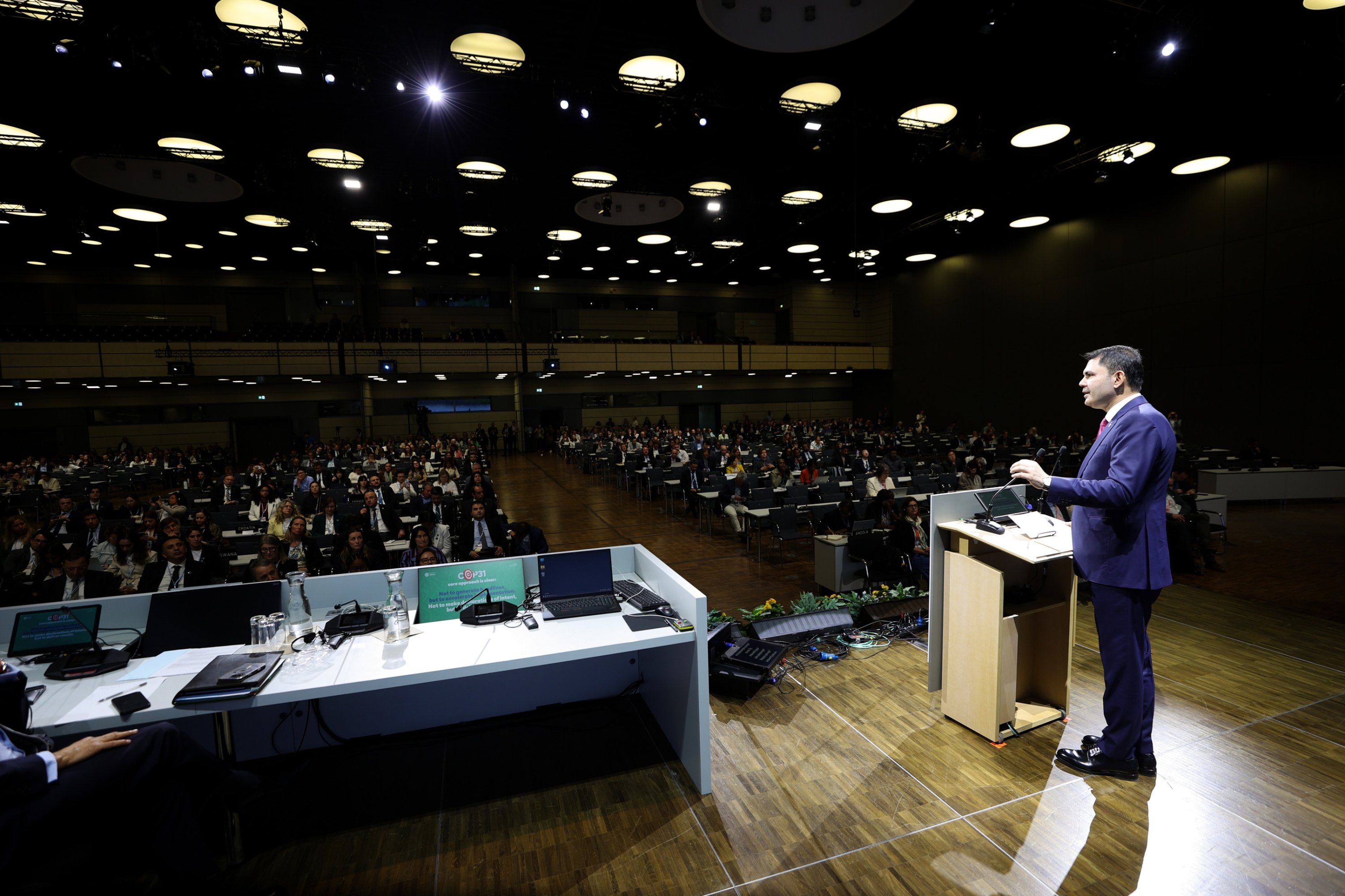
“Climate, Water, Food and Security” was the theme of the first edition of Erciyes Summit held in the central Turkish province of Kayseri this week. As experts and policymakers highlighted that climate change, water scarcity and food insecurity evolved into national security challenges, Türkiye’s role was also under the spotlight to counter these risks.
Türkiye’s growing geopolitical influence provides leverage to the country in environmental diplomacy and food security, especially in its region, beset with multiple crises and conflicts.
In an interview with Daily Sabah, Nabil Gangi, the Food and Agriculture Organization (FAO) Sub-Regional Coordinator for Central Asia and Representative in Türkiye ad interim, highlighted the nation's unique strategic advantages as it prepares to host the U.N. Climate Change Conference (COP31).
Gangi expressed strong confidence in Türkiye’s capacity to lead the upcoming summit, pointing to the country's domestic milestones and regional depth. He said Türkiye was “the right place” to host the summit.
“With its strategic vision, with its Central Asian depth, and the capacity that it has through Mr. Murat Kurum (Minister of Environment, Urban Planning and Climate Change) and basically the entire ministry around it, we have a very strong capacity that would enable Türkiye to shine globally. Türkiye has been addressing issues that are at the core of the COP31 and climate change, whether it is land degradation, water scarcity, agriculture, resilience, sustainability. All these things basically have been at the core of the strategic plan of Türkiye. So what Türkiye has been learning and applying over the past few years is an excellent example to share globally,” he said. He noted that Türkiye was both learning and teaching and thus would be an excellent host for COP31.
In November, Türkiye will host COP31 for the first time, with participation expected to exceed 100,000 attendees. The summit in the southern province of Antalya is set to position the country as an active implementation partner in global climate governance, supported by both on-the-ground operations and integrated digital coordination systems. It is expected to focus heavily on climate adaptation, financing and implementation of commitments made under the Paris Agreement.
A COP31 Trust Fund initiative led by Murat Kurum is expected to mobilize financial resources for innovative climate solutions and accelerate implementation pipelines across sectors.
Speaking at the opening session of the Erciyes Summit, Minister Kurum said climate change is no longer solely an environmental issue but a challenge affecting economies, societies and national stability. “Drought has become a global issue,” Kurum said, noting that declining water resources are affecting agricultural productivity, drinking water security and industrial output. He warned that pressure on water resources directly affects food production and could ultimately create broader security concerns. “When water weakens, production weakens. When production weakens, pressure on food supplies increases. As food pressure rises, social stability and public security are affected at their roots,” Kurum said.
Türkiye also emerged as a critical actor, providing a diplomatic and logistical lifeline in a region embroiled in turmoil and associated humanitarian crises. Most notably, Ankara was behind Black Sea Grain Initiative for safe shipping of grain at the height of the Russia-Ukraine conflict. Reflecting on Türkiye’s role, Gangi suggested that Türkiye could serve as a permanent food security hub, especially for the eastern Mediterranean.
“The Black Sea corridor was instrumental in breaking a big obstacle that was faced around the world, basically causing immense damage, hunger, even civil unrest that reached up to even Sri Lanka even, among other several other countries, the Middle East and so forth. Türkiye has played a very strong role in allowing this grain to pass through its initiative. I believe Türkiye has got a very strong clout regionally, and indeed, globally, because its strategic vision doesn't only (focus on) Europe but also (on Central Asia),” Gangi said.
Gangi stated that Türkiye had “excellent relations with Central Asian countries” as well as advancing ties with key Arab countries in the region. “All this could be used for breaking some impasses that are leading to a food crisis, whether in Gaza or in Lebanon.”
He highlighted that political might and renewed strategic alliances with key countries in the region gave Türkiye a very strong position to break the obstacles and help overcome food insecurity.
Gangi said that FAO looked to Türkiye as it did to other global and regional players, to set the ground politically for the organization to carry out technical work on the ground. Responding to a question regarding the situation in Gaza, where attacks on agricultural systems and water by Israel, despite the cease-fire and how FAO and Türkiye can work together to rebuild the food systems on the ground, Gangi said FAO would continue to work with farmers and producers in Gaza as much as it can, and it basically needed a political environment to do so.
FAO and similar organizations are among those affected by funding cuts in recent years, especially by the United States, which has been a major contributor to organizations like the World Food Programme (WFP). Answering a question on the matter, Gangi said funding overseas developments have seen changes recently and they had to adapt to this change. “In the past, the main funding partners were countries, overseas development agencies of those countries. Today, at least for FAO, one of the biggest donations are through the Green Climate Fund and other multilateral funds,” he said.
“We have to adapt to this. They come with particular requirements and we need to sort of understand more and more the requirements. New administrations, particularly across the Atlantic, come with particular needs and demands of how they see their contribution to the overseas, whether on a humanitarian or in development. We engaged with different administrations, the EU, with the United States, with different administrations to see how we can adapt to the funding mechanisms and the priorities that they deem for themselves as donor partners in the different parts of the world. I think we need, we all need to do that,” he said.
Gangi underlined that climate change was no longer a “scientific phenomenon” and was something “felt and seen,” adding that it was much more than rise of the temperatures or water scarcity.
“Water could be scarce tomorrow and could be in abundance after tomorrow. So the issue is the predictability. And the predictability is what we try to help farmers face,” he said. He acknowledged that uncertainty was nothing new for farmers who have been challenged by weather changes, but they were focusing on helping them by changing the way they think.
“We see patterns of cultivation, of irrigation changing. So we are doing the same, but it is (more) based on adapting to what our scientific evidence is showing us today.
On a question about his thoughts on the international community’s increasing investment in high-end technology like artificial intelligence and chips instead of investment in seeds, Gangi said the world needed seeds like it needed land to sow them upon.
“When the land is degraded, when the seeds are no longer resilient, then we need scientific innovation in order for us to make a resilient seed and a fertile land that would grow the food. And how this food basically, how we manufacture this food, not only to respond to food security, but nutrition as well,” he said.