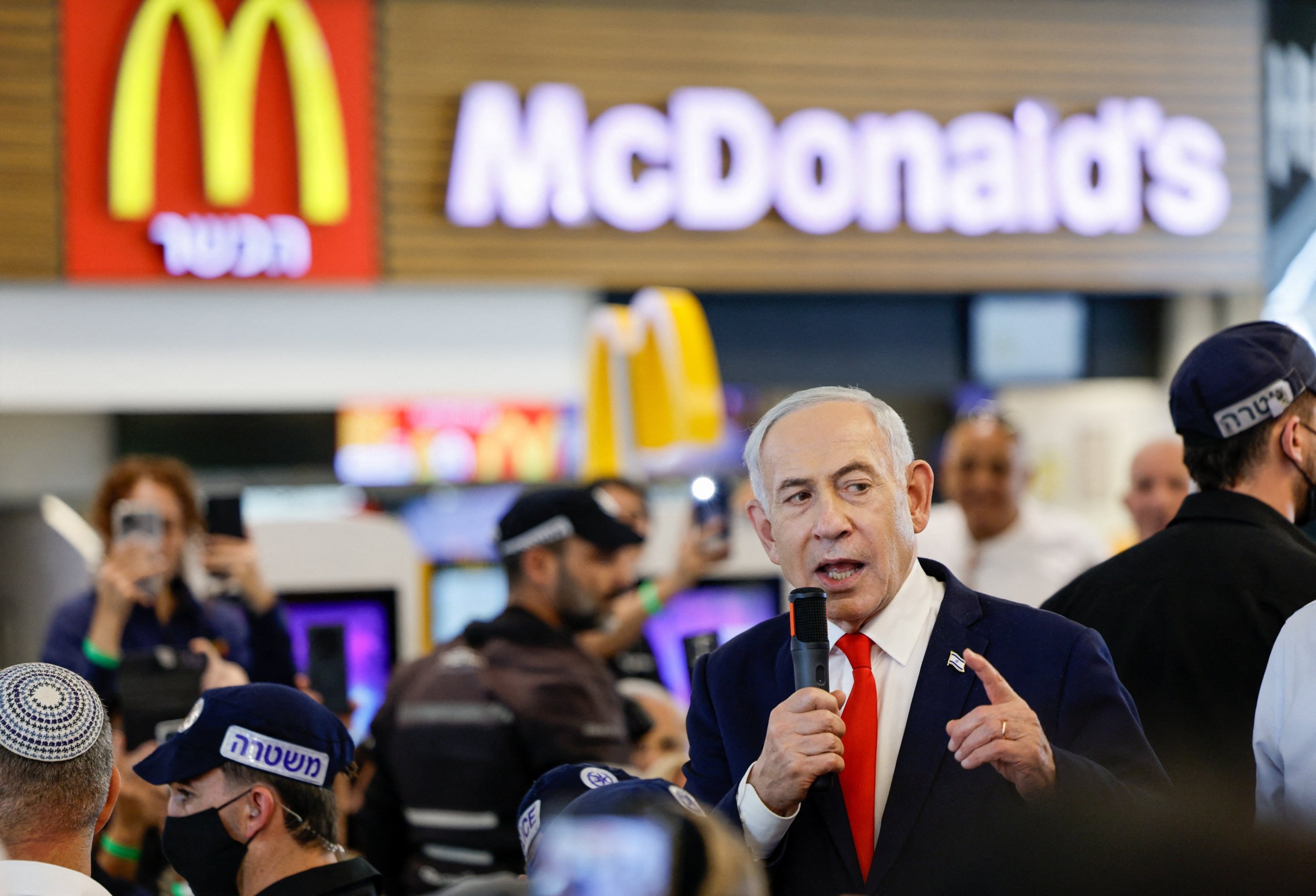
As he unveiled his new “security concept” over the weekend, Israeli Prime Minister Benjamin Netanyahu expectedly touched upon Türkiye, the main adversary of his government’s genocidal policies targeting Palestinians and growing Israeli expansion in the region. As he listed alliances in the region, he put Türkiye squarely into the "Sunni Diamond Alliance" with Saudi Arabia, Egypt and Pakistan, in front of a map apparently drawn by a German think tank.
Netanyahu’s press conference, where he was flanked by maps, is part of his campaign for upcoming elections and, unsurprisingly, was followed on Monday by a visit to an unspecified military base where he warned that they would “strike enemies at a moment’s notice.” He said that they were preparing various contingencies in case of a confrontation with Türkiye, noting that they were working to “stop” Ankara from expanding its military presence in Syria. Netanyahu also acknowledged that they had different views of Türkiye than U.S. President Donald Trump, who announced his endorsement for Netanyahu on Sunday.
Türkiye, which long championed the Palestinian cause, stepped up anti-Netanyahu rhetoric as the Tel Aviv government escalated attacks on Gaza since 2023. The two countries drastically cut off once-budding relations and President Recep Tayyip Erdoğan remains the harshest critic of Israel, describing Netanyahu as “Hitler” at times and slamming genocide committed by the Zionist administration.
Hazar Vural, an academic at the Political Science and International Relations Department at Istanbul Aydın University, says Netanyahu and his ministers stepped up their smear campaign against Türkiye, the government, Erdoğan, the Turkish army and officials. She singles out Türkiye as a different opponent for Israel. “With American support, Israel pursues policies that exploit certain regional actors’ dependencies, seek normalization agreements with them, bring them under control through territorial occupation, fuel separatist conflicts and manufacture artificial crises, all while continuing its genocide and occupation. But when it comes to Türkiye, Israel lacks the ability to shape and control Türkiye’s actions or its growing material power. No other actor has that ability, either,” Vural told Daily Sabah.
“We are therefore witnessing Israel confront a reality that differs from what it is accustomed to. This has been unfolding for nearly two years. What happened in Syria was a key example. As the government changed in Syria, Türkiye sought to help the country recover, build win-win policies and ensure that Syrian territory would no longer provide fertile ground for terrorism. Meanwhile, Israel bombed Syria thousands of times and tried to reshape the country. This makes it clear that Türkiye’s and Israel’s spheres of influence intersect in Syria. Over the past 22 months, the possibility of a confrontation between the two countries playing out in Syria was therefore very real, and we have already seen some preliminary moves in that direction,” she added.
“But there is an important reality here: Syria lies within Türkiye’s strategic hinterland, and Türkiye is directly affected by its security environment. Israel, meanwhile, is trying to reshape the region in line with its grand strategy. Its actions have obstructed Syria’s recovery, expanded its occupation of Syrian territory and demonstrated that it does not want Syria to grow stronger or recover. Indeed, Israel does not even want Syria to remain unified,” she also said.
Israel was quick to exploit the transitional process in Syria in the wake of the December 2024 revolution. It declared a 1974 disengagement agreement void and captured a buffer zone between Israel and Syria.
Assistant professor Sinan Demirtürk of Gazi University, who serves as chair of the Türkiye Policy and Strategic Research Foundation (TURPAV), says that it was clear that Israel was taking steps in Syria, Lebanon and the Mediterranean to counter Türkiye’s future military potential and its national defense industry. “It is also clear that Israel views Türkiye as a major threat and sees its emergence as a significant, peaceful and rational regional power as a source of concern,” he stated.
“Nevertheless, in the short term, a direct military engagement or armed confrontation with Türkiye, whether in Syria or the Mediterranean, would not be reasonable or justifiable for Israel in terms of its own survival, military capabilities or diplomatic relationships,” Demirtürk added.
He underlined that Netanyahu’s remarks were solely part of the election campaign narrative and sought to reinforce a political message.
Still, Türkiye has been cautious about Israel’s next moves in the region, after its attacks expanded to Lebanon first and then Syria. As a matter of fact, the launch of the terror-free Türkiye initiative to eliminate the threat of the terrorist group PKK was partly justified by the need to “establish a united homefront,” as its proponents, President Recep Tayyip Erdoğan and government ally Nationalist Movement Party (MHP), stressed while touting it. For decades, the PKK has been the utmost security threat for Türkiye both within the country and beyond its borders, as the group was based in northern Iraq and has wings in Syria and Iran.
“In recent years, Türkiye’s security and Syria’s security have increasingly converged on several fronts, including efforts to eliminate the PKK terrorist group, a consideration that also extends to Iraq,” Vural says.
“Türkiye is seeking to prevent Syria and Iraq from becoming casualties of instability and other terrorist groups. We can also understand the concepts of a “Terror-Free Türkiye” and a “Terror-Free Region” from this perspective,” she said. Ankara believes dissolution of PKK will also be a relief for the broader region.
As for the “Sunni Diamond Alliance” Netanyahu mentioned, Vural says Türkiye was “an actor with the strategic judgment to understand that it cannot entrust its security entirely to any defense or security pact of which it is a member, nor reduce its security policy to such arrangements.”
Türkiye joined Saudi Arabia and Pakistan in August for the Joint Makkah Defense Agreement, which later evolved into the “Mecca Defense Alliance.” The alliance primarily focuses on security cooperation and faced its first test when Houthis in Yemen stepped up attacks on Saudi Arabia this month. Türkiye has signaled that Egypt may also join the alliance in the future and offered substantial military assistance to the Kingdom.
“Netanyahu’s statements are intended to create a new perception of threat and lay the groundwork for new alliances and defense cooperation agreements against the Republic of Türkiye, particularly concerning Mediterranean policy and North Africa. In this regard, we know that Israel is seriously concerned about the Mecca Alliance, or a defense agreement based on the Mecca initiative, which Egypt could also join or participate in over the longer term. Israel is not assessing the current situation solely in terms of the immediate consequences the Mecca agreement might produce. Rather, it is looking at the issue in the context of the implications it could have for Middle Eastern and Mediterranean policy three, five or 10 years from now,” Demirtürk says.
“Over the long term, Israel is also deeply concerned that this military cooperation and common defense framework could develop into a new military formation capable of preventing its occupations, threats and massacres in the region. That is why Israel is already expressing concern about the potential alliance, which could take shape and expand over the coming year, bringing together Türkiye, Pakistan, Saudi Arabia and Egypt, and possibly Qatar, by referring to it as a 'Sunni axis alliance.'" “Israel fears the implications of such a grouping for its plans in the Middle East,” he added.
"These countries also oppose Israel’s occupation of southern Lebanon and its military control in Syria, including in the Golan Heights and the Quneitra region. They have also pursued diplomatic efforts on international platforms against Israel’s occupation of the region. Over the long term, these countries are likely to seek to become a counterbalancing force against Israel’s occupation and expansionist policies. Even if they are unwilling to risk a direct military confrontation with Israel in the short term, their institutional cooperation will inevitably create a new framework and geopolitical landscape to counter Israel’s expansion. Against this backdrop, Netanyahu is already seeking to rally Israel’s radical right-wing electorate against Türkiye and, through the emerging Mecca Alliance, against Pakistan, Saudi Arabia and Egypt. By creating a new perception of threat and emphasizing Israel’s security challenges, he aims to shore up voter confidence in his leadership,” Demirtürk also said.
Netanyahu’s election campaign crudely tapped into right-wing fears with the face of Erdoğan, next to Iranian and Palestinian leaders, New York Mayor Zohran Mamdani and the Hezbollah leader, all “wanting Netanyahu to lose,” as the prominent billboards across Tel Aviv and Jerusalem claim.
“While Netanyahu benefits domestically from problems and new conflicts by invoking Iran, the cost of this war for the United States is far higher, and its consequences are increasingly negative. It is true that Israel’s security is intertwined with American interests when viewed in the broader context of West Asia. It is also true that the United States is Israel’s greatest supporter in its grand strategy,” Vural says.
Vural noted that the Mecca Defense Alliance was the outcome of an approach Türkiye has advocated for years.
“The broader the alliance becomes, the more quickly the region’s problems can be resolved within the region itself. External actors would then be less able to reshape the region according to their own interests. In this sense, a new defense pact is being established to build something constructive, resolve problems swiftly and deliver win-win outcomes as part of this vision. Ankara has consistently emphasized that the aim is deterrence. Yet less than three months after the initiative emerged, Israel is already trying to attach a sectarian label to it, effectively restricting its scope along sectarian lines. It is attempting to create divisions by exploiting the sectarian card, which has long been used in the region and is all too easy to inflame. Israel also seeks to profit from these tensions by selling weapons. This fits its grand strategy,” Vural stated.
“As in the Flydubai incident, (Netanyahu) seeks to bring regional wars and new formations opposed to Israel to the forefront of public debate, thereby counterbalancing the opposition and rival political parties, which are ahead of him, in a sense. His aim is to consolidate the parliamentary majority once again alongside his coalition partners and the right-wing bloc,” Demirtürk said.
According to Vural, Israel would not risk a confrontation with Türkiye anyway.
Türkiye is the second-largest army of NATO and skilfully pursued relations with different blocs, countries otherwise countering each other. This is most evident in its relations with Russia and Ukraine at the time of the conflict. Israel’s major ally, the United States, also revived its somewhat dormant ties with Türkiye during the second tenure of President Donald Trump.
Implications, consequence
“Such a confrontation would also become a matter for NATO because Türkiye is a member of the alliance, whose collective-defense clause is relevant to security threats involving its members. The United States, too, would be directly implicated. This is something Washington would absolutely not want. Managing the balance therefore becomes, in part, a challenge for the United States, given its influence over Israel and the support and direction it provides,” Vural said.
“Israel, without American support cannot stand up to Türkiye or match its material capabilities, provided we set aside Israel’s nuclear warheads. Israel is a small state without a strategic hinterland, and its military cannot match Türkiye’s in a direct confrontation. However, Israel is an actor that behaves like a terrorist state, sustained by lawlessness and violence and operating without accountability before the international community. It possesses dozens of nuclear warheads for which no one holds it accountable, and it has become so reckless that it might even contemplate using them in Gaza. This would not merely be a matter for Türkiye, nor would it be just another regional war. It would be an act of madness capable of affecting the entire international system and leading to extremely dangerous consequences. No international system or actor would accept or endorse such a scenario,” she added.
“Given the founding principles of the State of Israel and the century-long trajectory of Turkish foreign policy, entering into a direct military confrontation with Türkiye on the ground, or triggering a war or conflict dynamic in the Middle East in which Türkiye could play a central role, would not be an easy prospect for Israel. This is also related to the fact that, despite broad segments of Israeli society supporting wars in the Middle East, including the massacres and occupation in Palestine, as well as the presence of Israeli settlers in Gaza and the West Bank, Israeli citizens may not necessarily hold the same views when it comes to Türkiye. In particular, the large community of Israeli citizens of Turkish origin, whose members migrated from Türkiye to Israel after 1948 and settled there as citizens, would be unlikely to support such a scenario,” Demirtürk pointed out.