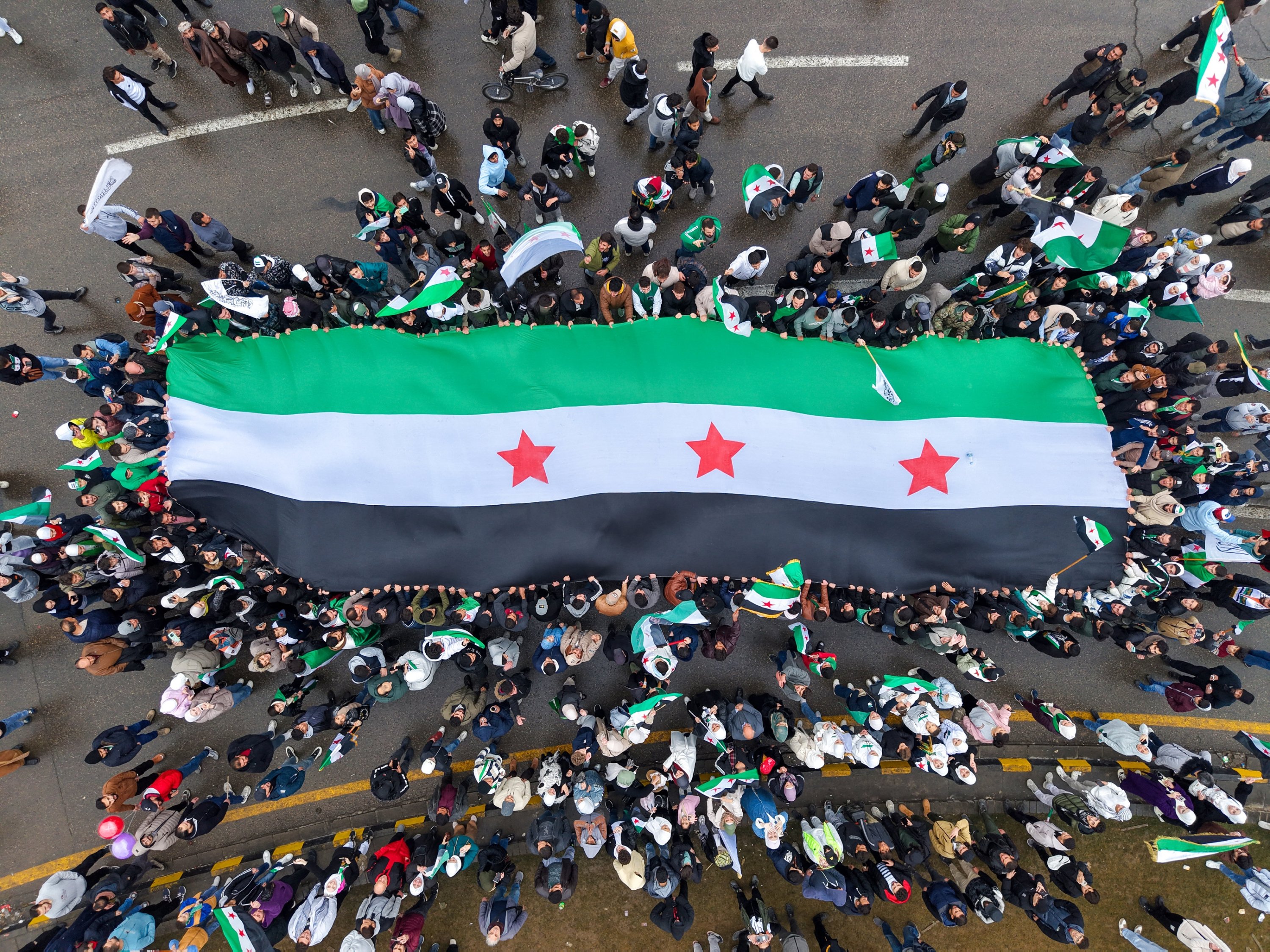
President Recep Tayyip Erdoğan on Monday congratulated Syrians on the first anniversary of what he called the “December 8 Revolution,” praising the country’s post-Assad trajectory and vowing continued Turkish support for stability and territorial unity.
Following 13 years of civil war, Syrian regime dictator Bashar Assad was ousted last year in a lightning offensive by opposition forces. Damascus observes Dec. 8 as its national Liberation Day following the political transition and end of the 13-year conflict that killed hundreds of thousands of people and displaced millions more.
In a message posted on X, Erdoğan said the day marked the liberation of the Syrian people “after years of an oppressive regime, heavy costs, great suffering and numerous hardships.” He offered prayers for those killed in attacks by “the fallen regime and terrorist organizations.”
Erdoğan conveyed Türkiye’s “heartfelt greetings” to Syrians on what he referred to as Syrian Freedom Day, saying Ankara is pleased with the progress made over the past year “despite all kinds of difficulties, sabotage attempts and provocations.”
The president said Türkiye would maintain its support for safeguarding Syria’s territorial integrity and fostering internal reconciliation among all segments of society. He added that Ankara backs efforts to ensure Syria emerges as a “center of peace and stability” in its region.
Earlier in the day, the Foreign Ministry sent Türkiye’s congratulations to the Syrian people for the occasion.
In a written statement, it said the new Syrian government has followed a “prudent and peaceful” foreign policy and taken “lasting steps toward securing the respected position Syria deserves in the international arena, despite facing numerous internal and regional challenges.”
It emphasized that stability, security and prosperity in Syria remain essential for the wider Middle East and reaffirmed its commitment to supporting efforts toward reconstruction and political normalization.
“Türkiye will continue to strongly support initiatives aimed at establishing stability, security and well-being in Syria,” the it added.
Syria’s new administration, led by President Ahmad al-Sharaa, has been working to rebuild and bring Syria back to the international arena since last year.
The anniversary comes as the country seeks to rebuild devastated infrastructure, reestablish state institutions and reintegrate millions displaced by the long-running conflict. Regional actors have expressed hope that the new political climate will accelerate reconciliation processes and contribute to long-term peace.
Türkiye has spearheaded efforts for a path to recovery for Syria since last year and backed the new administration in efforts to restore stability, training Syrian military personnel to help bolster security and launching a support program to increase Syria’s institutional capacity. Turkish companies also view the lifting of sanctions on Syria as creating “big opportunities” for investment in reconstruction.
Earlier this year, Türkiye started training Syrian army personnel as part of the agreements aimed at rebuilding Syria’s defense and security institutions. Ankara has been providing training, advisory and technical support at the request of Damascus since the deal was signed in August. Within the framework of close cooperation to strengthen Syria's defense capacity, 49 Syrian cadets (10 army, 18 navy and 21 air force) began training at Turkish military academies, the Defense Ministry said.
Turkish authorities also say the new administration in Damascus must ensure that all ethnic and religious groups are represented fairly to safeguard internal stability.
Speaking on the sidelines of the Doha Forum over the weekend, Foreign Minister Hakan Fidan said “things are going well in Syria,” but warned that “risks stemming from Israeli expansionism persist.”
He stressed that Türkiye remains engaged, alongside regional partners and the broader international community, in efforts to address Syria’s chronic structural problems. “Our support will continue,” he said, noting that the political transition still faces substantial challenges.
Recently, the foreign ministers of the United States, Syria and Türkiye held a rare trilateral meeting in Washington, where they agreed to move forward with an agreement to integrate the YPG, which is the PKK terrorist group’s Syria wing, into the Syrian army.
Under the March deal between the YPG and Damascus, the YPG forces would merge with the new Syrian national army. The agreement, which is supposed to be implemented by the end of the year, would also bring all border crossings with Iraq and Türkiye, as well as airports and oil fields in the northeast, under the central government’s control. Detention centers housing thousands of Daesh members, now guarded by the YPG terrorist group, would also come under government control.
On the other hand, Türkiye has been a staunch ally of the new administration in Syria and pledged to support Damascus’ efforts to maintain security and stability in the postwar country.
When Damascus moved to integrate the YPG into the new army, Türkiye voiced support as Ankara itself sought to disarm the PKK in a separate initiative.
Turkish officials reiterated multiple times that the integration of the YPG terrorist group must comply with the integration process into the Syrian army and refrain from any actions or statements that could harm Syria's political unity and territorial integrity, emphasizing that the process is being monitored closely.
Tensions between Türkiye and Israel have intensified in Syria over the past year, as Ankara increases both its political influence and military presence in the country, prompting growing concern in Tel Aviv, regional officials say.
Israel's relations with Türkiye sharply deteriorated after the outbreak of the Gaza war on Oct. 7, 2023.
During the same period, Israel carried out several operations in and around Damascus as tensions rose between Druze and Sunni groups in Syria’s Sweida province. Israel, which occupied the Golan Heights in 1967 and unilaterally annexed the territory in 1981, a move not recognized internationally, has in the past year expanded the “buffer zone” deeper into Syrian territory.