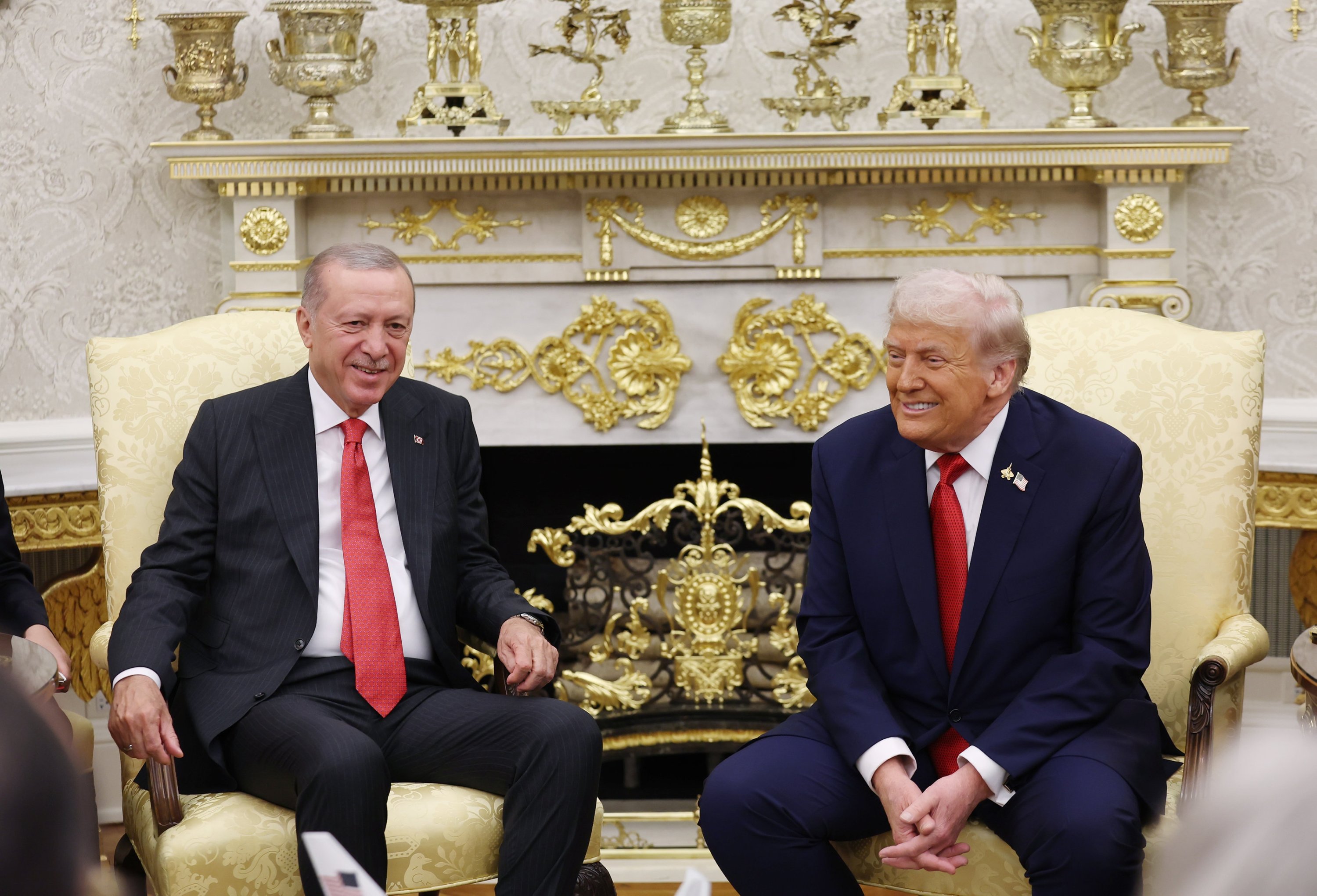
President Recep Tayyip Erdoğan said on Friday that Türkiye and the U.S. agreed to proceed on several bilateral cooperation areas while discussing the necessity for regional peace in the Middle East.
Speaking to journalists on his return from Washington following his participation in the 80th U.N. General Assembly in New York, Erdoğan said: “Our meeting with (U.S. President Donald) Trump enabled us to proceed on several vital issues. Our meeting passed in an honest and constructive atmosphere. I believe that our friendly relations will also reflect on Türkiye-U.S. ties.”
"As you know, my relationship with Mr. Trump has been very good since the past," he added.
Erdoğan also praised the White House hospitality. "At the White House, we were received very well by Mr. Trump and his delegation, and we are leaving satisfied. It was a beautiful visit that cannot be tarnished by any slander."
Erdoğan said that although it is not possible to solve all issues in a single meeting, the meeting paved the way in several fields. “The trade volume potential between the two countries is obvious. We have a target of $100 billion. As the leaders, we have the political will to realize this.”
The two leaders met at the White House to discuss a wide range of issues, from regional crises to defense cooperation. Trump said he would consider lifting U.S. sanctions on Türkiye’s defense sector, imposed over Ankara’s purchase of Russian missiles. The two countries also signed a deal on nuclear cooperation.
The two leaders met at the White House for the first time after six years.
While points of friction remain, both leaders have signaled they want to frame the meeting as an opportunity to rebuild trust and advance mutual interests.
For Washington, the overriding priority is to secure NATO ally Türkiye’s cooperation while limiting Russian influence. Trump has repeatedly underlined the value of Ankara as a partner rather than a rival. For Ankara, one of the most pressing issues is the future of its air force. Türkiye was removed from the F-35 fighter jet program after its 2019 purchase of Russian S-400 missile systems, triggering U.S. sanctions under the Countering America's Adversaries Through Sanctions Act (CAATSA).
Ankara’s harsh criticism of Israeli military operations in Gaza since October 2023 has unsettled policymakers in Washington, many of whom remain committed to Trump’s earlier policies, including recognition of Jerusalem as Israel’s capital.
But Erdoğan has made Gaza central to his international agenda. At the U.N., he called for a permanent cease-fire, humanitarian corridors and recognition of a Palestinian state.
On regional issues, the president said: “Besides trade and investment in our meeting, we also discussed the humanitarian tragedy in Gaza and Syria."
“I support Mr. Trump’s global vision for peace,” Erdoğan highlighted. “There is an agreement between the two sides to stop the bloodshed.”
At the White House, we underlined that a cease-fire must come first, followed by a path toward lasting peace. No one can justify the deaths of innocent children and women in Gaza,” he said. Trump, he added, also expressed the necessity of ending the violence and establishing stability.
Erdoğan reiterated that Gaza dominated this year’s U.N. General Assembly, with 10 more countries – including Security Council members the U.K. and France – recognizing Palestine.
“This is a historic step. The number of countries recognizing Palestine has now exceeded 150, thanks in part to the diplomatic efforts of Türkiye and like-minded nations,” he said. Erdoğan underscored that while international support is growing, decisive action is still needed to stop Israel’s aggressive policies.
"Erdoğan emphasized that a two-state solution remains "the formula for lasting peace" in the Middle East, warning that the current situation is unsustainable. "Mr. Trump is also aware that things cannot continue this way," he said.
The Turkish public and government are major supporters of the Palestinian cause. Türkiye has been a traditional ally to Palestine, but as the Israeli attacks became more brutal, Ankara has become harsher in its criticism in the past year. It has condemned what it calls genocide, halted all trade with Israel and applied to join the genocide case against Israel at the World Court, which Israel rejects.
On Syria, Erdoğan said terrorist organizations "have no place in the future of Syria and never will," calling on the international community to take steps for peace and stability in the war-torn country.
Erdoğan said: "Their participation in the United Nations General Assembly this year was very important for the international legitimacy of the Syrian government," emphasizing the need to restore the Syrian economy and infrastructure.
"We are working on cooperation projects with Syria across all fields, always emphasizing Syria's sovereignty and territorial integrity. Our goal is a country where Syrians of all backgrounds – Arabs, Turkmens, Kurds, Sunnis, Alawites, Druze, Christians – live together peacefully. The Syrian government shares our feelings. We will not accept any attempt to weaken this," he added.
Erdogan also addressed Türkiye's approach to the Mediterranean, saying: "Our stance on resources in the Mediterranean is clear. We will take our fair share of these resources and work together with our neighbors based on the principle of win-win."
He once again asserted Türkiye's firm position on the island of Cyprus. "The chapter on a federation is closed for us. No one can drag us back into federation debates with word games."
Erdoğan continued to say that the Turkish Cypriots will never agree to be a minority on the island. "The only practical solution is to recognize the existence of two separate states on the island,” he said, reminding that he mentioned this fact at his U.N. speech.
The island has been mired in a decadeslong dispute between Greek and Turkish Cypriots, despite a series of diplomatic efforts by the U.N. to achieve a comprehensive settlement.
Ethnic attacks starting in the early 1960s forced Turkish Cypriots to withdraw into enclaves for their safety. In 1974, a Greek Cypriot coup aimed at Greece's annexation led to Türkiye’s military intervention as a guarantor power to protect Turkish Cypriots from persecution and violence.
As a result, the Turkish Republic of Northern Cyprus (TRNC) was founded in 1983. The country is fully recognized only by Türkiye, which does not recognize the Greek Cypriot administration in the south.
The island has seen an on-and-off peace process in recent years, but negotiations have been stalled since 2017.