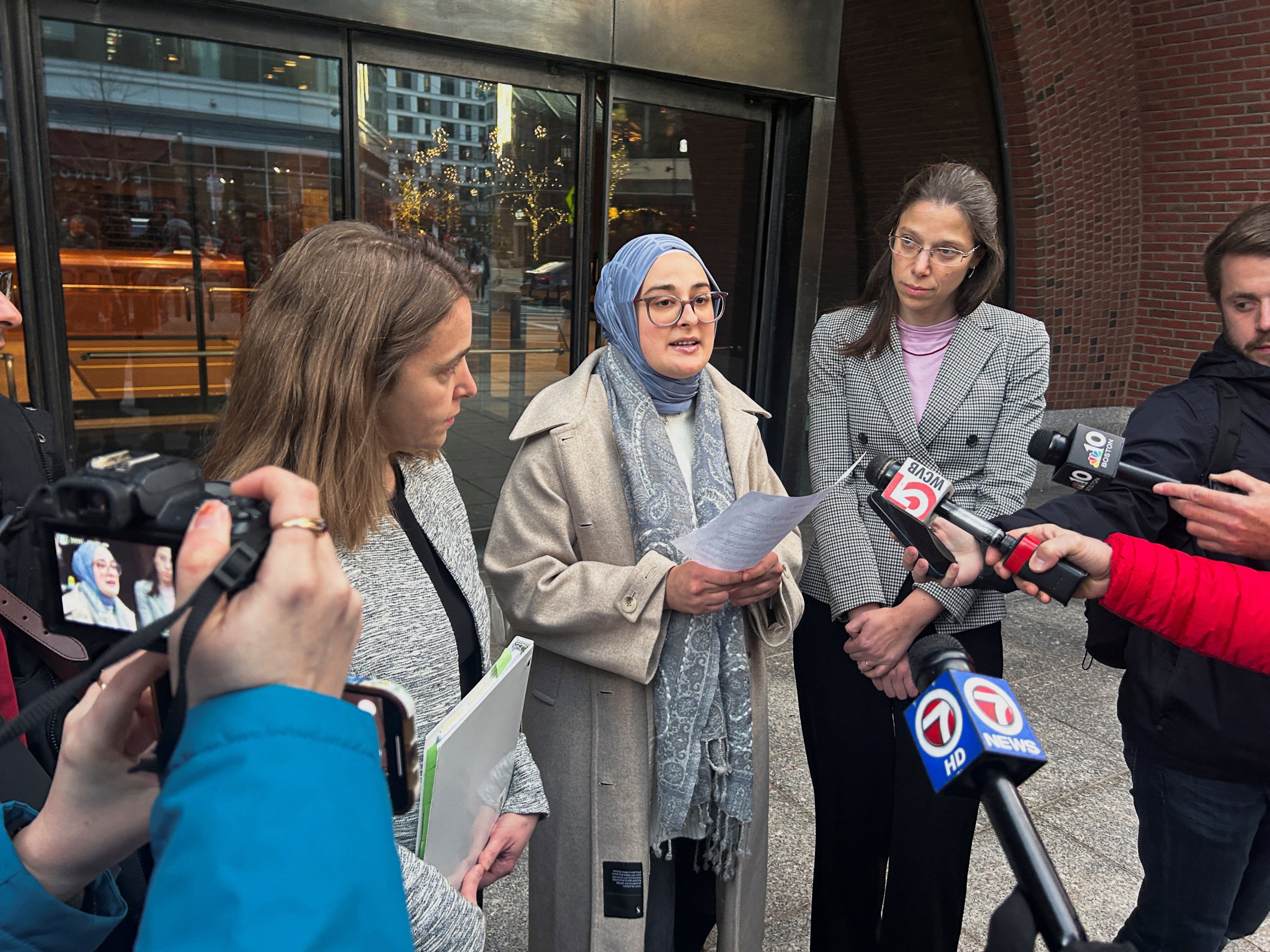
A U.S. federal judge on Thursday said she was “struggling” to understand why President Donald Trump’s administration continues to block a Turkish Tufts University Ph.D. student who engaged in pro-Palestinian activism from working on campus, months after her release from immigration detention.
Chief U.S. District Judge Denise Casper, during a hearing in Boston, questioned whether U.S. Immigration and Customs Enforcement (ICE) acted arbitrarily when it terminated Rümeysa Öztürk's status in a key database used to track foreign students after she co-wrote an opinion piece in the Tufts student newspaper criticizing her school's response to Israel's genocidal war on Gaza.
"What's the rationale for allowing the agency to have the discretion to terminate the record?" Casper asked.
Öztürk's record in the ICE-maintained Student and Exchange Visitor Information System database was terminated on March 25, the same day that she was arrested by masked, plainclothes agents on a street in the Boston suburb of Somerville, Massachusetts, near her home, after the U.S. Department of State revoked her student visa.
The sole basis authorities provided for revoking her visa was the opinion piece, which criticized Tufts' response to calls by students to divest from companies with ties to Israel and to "acknowledge the Palestinian genocide."
The former Fulbright scholar was held for 45 days in a detention facility in Louisiana until a federal judge in Vermont, where she had briefly been held, ordered her immediately released after finding she raised a substantial claim that her detention constituted unlawful retaliation for views she shared in the op-ed in violation of her free speech rights under the U.S. Constitution's First Amendment.
Following her release, Öztürk resumed her studies at Tufts. But the administration's refusal to restore her SEVIS record has prevented her from teaching or working as a research assistant, jeopardizing her academic and career development in the final months before her graduation, said Adriana Lafaille, an attorney for Öztürk at the American Civil Liberties Union of Massachusetts.
She urged the judge to order ICE to reinstate Öztürk's SEVIS record. While the child development researcher's visa remains revoked, Lafaille said that it simply governed her entry into the United States and that its termination did not render her student status unlawful.
Assistant U.S. Attorney Mark Sauter argued that ICE has the discretion to update the SEVIS database to reflect if a student's visa is terminated and the person is facing removal proceedings, as Öztürk has been. But Lafaille said the administration had put forward shifting rationales for its actions, which stood in contrast to how it rescinded its decision to terminate SEVIS records for thousands of other foreign students in April.
"This was one of several retaliatory actions the government took against Ms. Öztürk for her protected speech," Lafaille said.