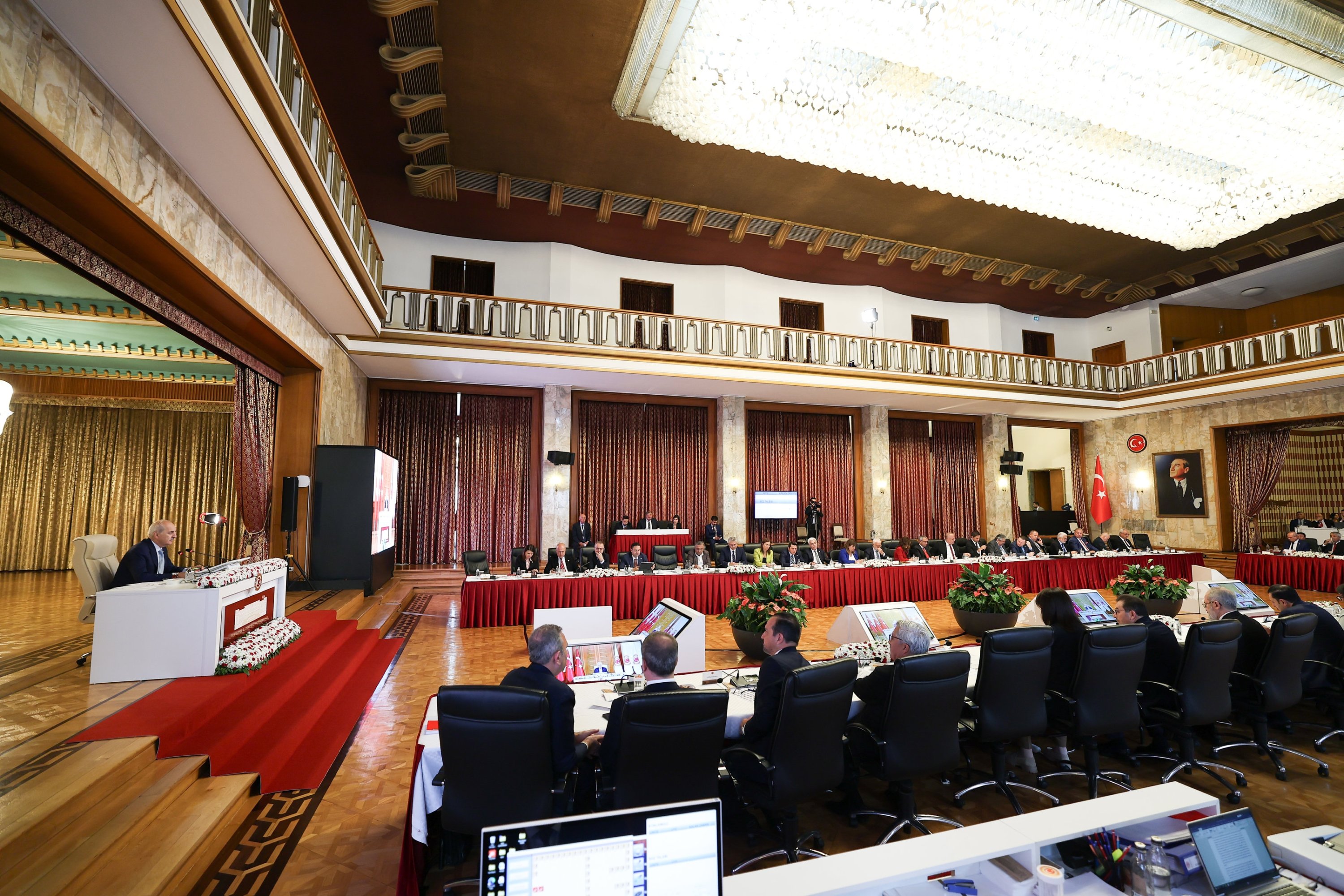
Parliament on Thursday moved forward with the landmark “terror-free Türkiye” initiative as the National Solidarity, Brotherhood and Democracy Committee convened to hear from civil society leaders from the country’s eastern and southeastern regions.
The terror-free initiative aims to end more than 40 years of violence committed by the PKK terrorist group. The PKK consented to lay down arms after its jailed leader, Abdullah Öcalan, urged them to do so. The initiative was originally launched by the leader of the government ally Nationalist Movement Party (MHP), Devlet Bahçeli, in 2024. Bahçeli called on Öcalan to convince the group to abandon its arms and dissolve. Months later, the PKK announced its dissolution and started “burning weapons” in July.
The committee, created to oversee the process, hosted its 11th session in Ankara’s ceremonial hall. Business leaders, women’s associations, security representatives and tribal confederations from southeastern and eastern regions shared their vision for building a future free of terror while strengthening democracy and economic development.
Their participation is notable for southeastern regions of Türkiye, which suffered the brunt of PKK violence, with many Kurdish citizens losing children and loved ones to the PKK’s forced recruitment, their homes to bombing strikes and regional peace to the terrorists’ brutality and harsh state measures to contain it.
Şahismail Bedirhanoğlu, head of the Southeastern Industrialists and Businesspeople Association (GÜNSİAD), told the committee this moment marks a critical turning point after decades of failed attempts.
“Unlike previous efforts, this process is stronger, more supported and has already yielded historic steps with the PKK declaring it will disarm and dissolve,” he said. “The belief that conflict and violence are ending is spreading across society.”
Bedirhanoğlu emphasized the need for legislative reforms enabling broader use of Kurdish in public life and called for Parliament to shoulder its “historic responsibility” in drafting a new civilian constitution. He also urged the government to introduce fresh, region-specific investment incentives to reverse years of capital flight and attract both domestic and international investors.
Özlem Külahci Tanaman, president of the Eastern and Southeastern Women Entrepreneurs Association (DOGÜNKAD), described the initiative as the beginning of a new chapter.
“The commission represents the transformation of conflict into peace,” she said. “Peace must go beyond the silence of arms, bringing stronger democracy, justice and economic renewal. Women’s visibility in decision-making and production will be the guarantee of peace.”
Business leaders echoed the call for economic revitalization. Devrim Türk, head of the Eastern and Southeastern Business Federations (DOGÜNSİFED), underlined the toll of more than 40 years of PKK violence.
“This process is precious for us as the business community,” Türk said, pointing to lost opportunities in agriculture, tourism and industry. He urged measures to boost cross-border trade and provide attractive incentives to spur growth, framing the initiative as a model for conflict resolution worldwide.
Security concerns were also highlighted. Orhan Kandemir, president of the Anatolian Village Guards and Martyrs’ Families Confederation, stressed that nearly 50,000 guards continue serving alongside Turkish forces.
“This process must not exclude village guards,” he said. “We are ready to fulfill our responsibilities to protect the nation’s unity. Guards deserve improved rights and recognition, as their role remains vital for security and stability.”
Rasim Aslan, chair of the Ancient Tribes Federation, emphasized brotherhood and equality as the foundation for lasting peace. He also linked national unity to regional security, arguing that restoring Turkish-Kurdish solidarity is “the greatest safeguard against Israeli aggression and expansionism.”