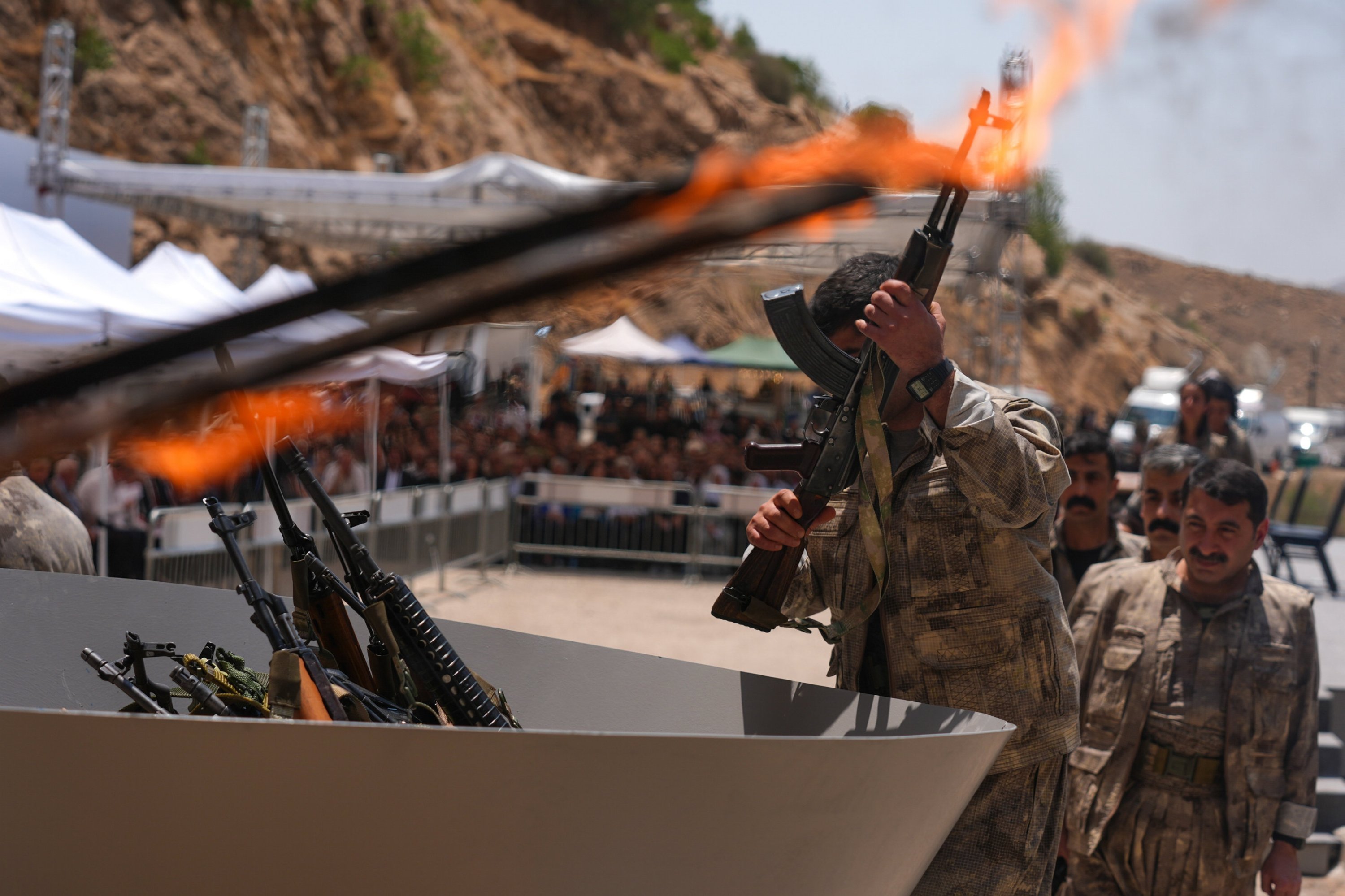
Dozens of PKK terrorists began laying down their arms as a first step toward dissolution in northern Iraq on Friday, two months after the group decided to end its decadeslong terror campaign as part of Türkiye’s terror-free initiative.
A group of around 30 PKK terrorists who took part in fighting Turkish security forces in recent years destroyed their weapons in Sulaymaniyah, a city the PKK has maintained a military and political foothold for years now.
“Thirty PKK terrorists, four of whom were commanders, burned their weapons,” said an Agence France-Presse (AFP) correspondent who was present at the brief ceremony in a cave near the city.
Helicopters hovered above the mountain where the disarmament process got underway, with dozens of Iraqi Kurdish security forces surrounding the area, a Reuters witness said.
The event drew in large crowds from around northern Iraq, as well as southeastern Türkiye. Among those who attended were a Turkish delegation, including lawmakers from the PKK-affiliated Peoples' Equality and Democracy Party (DEM Party) and a handful of journalists.
The disarmament was held inside the Jasana cave in the town of Dukan, 60 kilometers (37 miles) northwest of Sulaymaniyah.
The PKK’s move to begin destroying its weapons was a “historic” act that it hoped would bring peace, the terrorists said in a statement read out in the cave.
After a series of failed efforts, the terror-free Türkiye initiative could pave the way for Ankara to end a campaign that has killed over 40,000 people, burdened the economy, and wrought deep social and political divisions in Türkiye and the wider region.
The PKK has been based in northern Iraq’s mountainous regions, chiefly Qandil, after being pushed well beyond Türkiye’s southeastern frontier in recent years. Türkiye’s military has regularly carried out operations and strikes on PKK bases in the region and established several military outposts there.
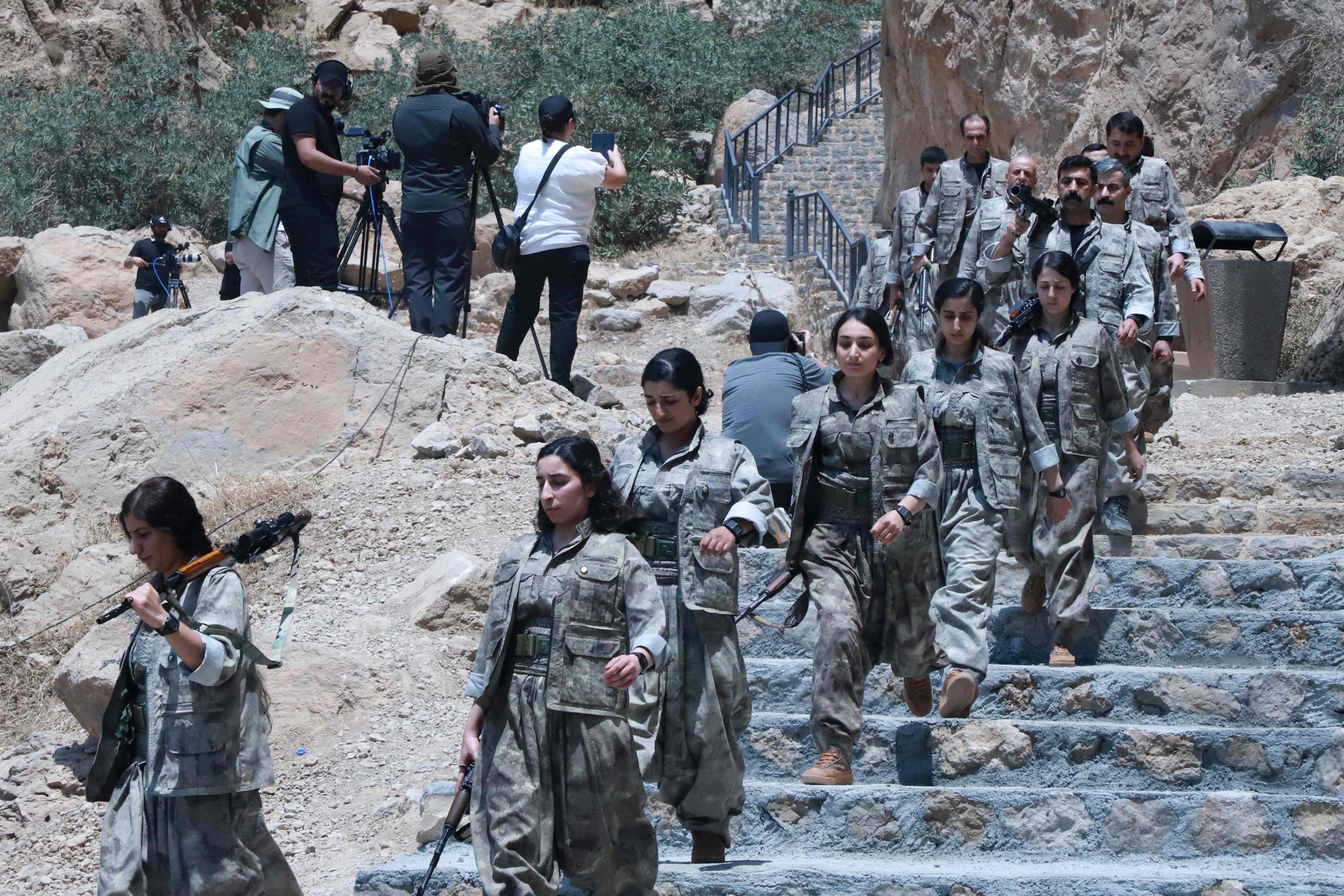
Türkiye expects the total handover of weapons should be completed within a few months.
Speaking to broadcaster NTV, ruling Justice and Development Party (AK Party) spokesperson Ömer Çelik said late Wednesday that a confirmation mechanism, including officials from Turkish intelligence and the armed forces, will oversee the handover process.
“The disarmament process (in Iraq) needs to be completed within three to five months ... If it exceeds this period, it will become vulnerable to provocations,” Çelik said.
The move is a key step in the monthslong terror-free push that began last year in October when Devlet Bahçeli, head of government ally Nationalist Movement Party (MHP), called on PKK jailed leader Abdullah Öcalan to order the group to lay down arms.
After talks back and forth with a delegation of DEM Party lawmakers, Öcalan agreed and made his historic call to the terrorist group in February.
The PKK finally announced in May it would disband and end its operations that have claimed thousands of lives since the 1980s.
President Recep Tayyip Erdoğan said the initiative would gain momentum after the PKK began laying down its weapons.
"The process will gain a little more speed when the terrorist organization starts to implement its decision to lay down arms," he said over the weekend.
"We hope this auspicious process will end successfully as soon as possible, without mishaps or sabotage attempts," he added on Wednesday.
The president is expected to address the nation early on Saturday to make a “historic” announcement on the matter.
Bahçeli on Friday hailed the disarmament, saying its completion would “leave bad memories behind and see the Turkish nation build a new century.”
“The initiative has made progress with solid, healthy moves,” Bahçeli said in a written statement. “Political or ideological circles who were in a race of exploitation and denial to keep up their provocations, have been let down by the blossoming hope for peace.”
Turkish officials said they are preparing to let senior leaders of the group stay in Iraq or leave for third countries, while PKK members not involved in any offenses may benefit from lenient sentences if they surrender to Turkish authorities.
Türkiye’s National Intelligence Organization (MIT) will create a database of all weapons in use by the PKK and those delivered to the authorities.
In the next stage, the proposed parliamentary committee to oversee the initiative will prepare a report on suggestions about the initiative in October. Media outlets report that the committee would specifically tackle how to ensure integration of PKK members into society, although security sources have repeatedly said there would not be a general amnesty nor impunity for terrorists.
The PKK’s dissolution also coincides with the issue of its Syrian offshoot, the YPG, integration into Syria’s new army, which Türkiye supports, following the ouster of Bashar Assad.
The YPG has not openly supported the terror-free Türkiye initiative and appears reluctant to join the PKK in disarming.
The YPG and the new Damascus administration, led by Ahmad al-Sharaa, struck an accord in March with U.S. backing for the YPG’s integration into the new Syrian military but its implementation has been held up by differences between the two sides.
Shortly after the accord, the YPG voiced demands for a decentralized system of governance, to the chagrin of Damascus. The YPG controls vast swathes of territory in the oil-rich northeast and enjoys military backing by the United States, which views it as a partner in the fight against another terrorist group, Daesh.
Türkiye, whose relations with Washington are strained over the latter’s support for the YPG, hopes the group will bow down to the demand of the new government.