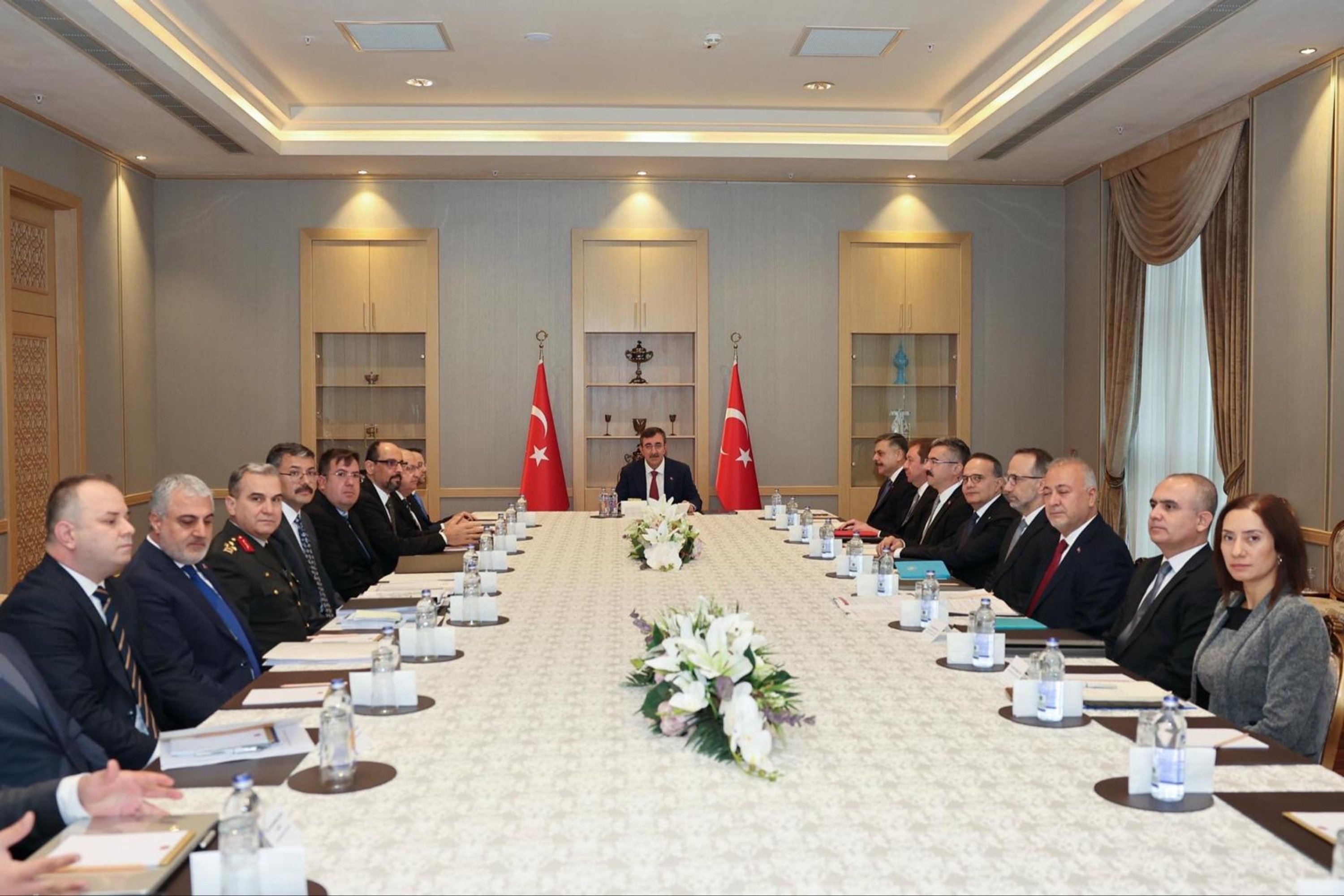
Vice President Cevdet Yılmaz chaired the second meeting of National Solidarity and Social Integration Board established exclusively for terror-free Türkiye initiative. A written statement was issued after Monday’s meeting that aims coordination of the initiative at the highest level for full dissolution of the terrorist group PKK.
The statement said that officials decided upon several matters regarding the process. “The establishment, duties and areas of authority of the subcommittees formed within the Board and tasked with ensuring that the process is carried out effectively, swiftly and in a coordinated manner, as well as inter-institutional coordination issues, were discussed and decided upon,” the statement said.
Among participants of the meeting were Justice Minister Akın Gürlek, Interior Minister Mustafa Çiftçi, National Defense Minister Yaşar Güler, secretary-general of the Turkish Presidency Hakkı Susmaz, National Intelligence Organization (MIT) chair Ibrahim Kalın and secretary-general of the National Security Board Okay Memiş.
The terror-Free Türkiye initiative unofficially began in 2024 upon a call by veteran politician Devlet Bahçeli, leader of government ally Nationalist Movement Party (MHP). Bahçeli has suggested that PKK’s jailed ringleader Abdullah Öcalan order its group to lay down arms, “at Parliament.” Öcalan consented, though he remained in jail, and within months, and after a historic call by Öcalan, the PKK agreed on disarmament. In return, the Turkish Parliament passed a law in August for deferral of sentencing and prosecution for terrorist group’s members not involved in acts of violence. Through security forces and MIT, Türkiye currently monitors the course of disarmament that began in a symbolic way last year after several PKK members burned down their weapons at a ceremony in northern Iraq, where senior cadres of the PKK are based.
“At the Board meeting, the historic responsibility assumed by the Board as part of the ongoing process, as well as its importance in ensuring peace among our people and strengthening social cohesion, was once again emphasized. The current situation was reviewed while ongoing activities related to the implementation of the law and activities planned for the coming period were discussed from multiple perspectives, followed by a general assessment of the situation,” the statement on Monday said.
Speaking at an event in Istanbul on Sunday, Yılmaz stated that terrorism had been a major obstacle to Türkiye’s economic and social development for many years.
Noting that it was not merely a security issue but also had economic and social consequences, Yılmaz said: “We have the Presidency of Strategy and Budget under the Presidency, and together with them, we tried to calculate the economic losses we have suffered due to this issue of terrorism for more than 40 years. Do you know what the figure was? At least $2.3 trillion. This country has suffered a loss of $2.3 trillion. We believe Türkiye would be in a very different position today if we had been able to spend these resources on development, education, health care, production and investment.” Yılmaz said terrorism had negatively affected not only public resources but also human resources and private-sector investments, explaining that security problems had caused people and capital to move to different regions. Yılmaz said the economic potential of these regions could be better utilized once terrorism came to an end, adding that new opportunities would emerge in many areas, from tourism and agriculture to trade and investment, as peace and security became permanent.
Regarding the work of the board he chaired, Yılmaz said subcommittees had been established to work on different areas, adding that the first stage of the process was the laying down of arms and dissolution of organizational structures, while the second stage would involve determining that these developments had taken place concretely on the ground and carrying out the related legal process. “The first stage is to determine on the ground that this process of dissolution and disarmament has taken place, to report on it and to have it confirmed by a decision of the National Security Council. The second stage will not begin until this is completed. This process of verification and confirmation is currently ongoing. We are meticulously and coordinately carrying out our work on this process with all relevant institutions on the ground, and we will continue to do so. We believe we will successfully complete this process. In the second stage, there will be certain legal procedures, and those procedures will come into effect. A board will also be established in our Parliament to monitor this process. Our board will periodically provide information to the parliamentary board. We will also keep our Parliament informed about the work being carried out.”