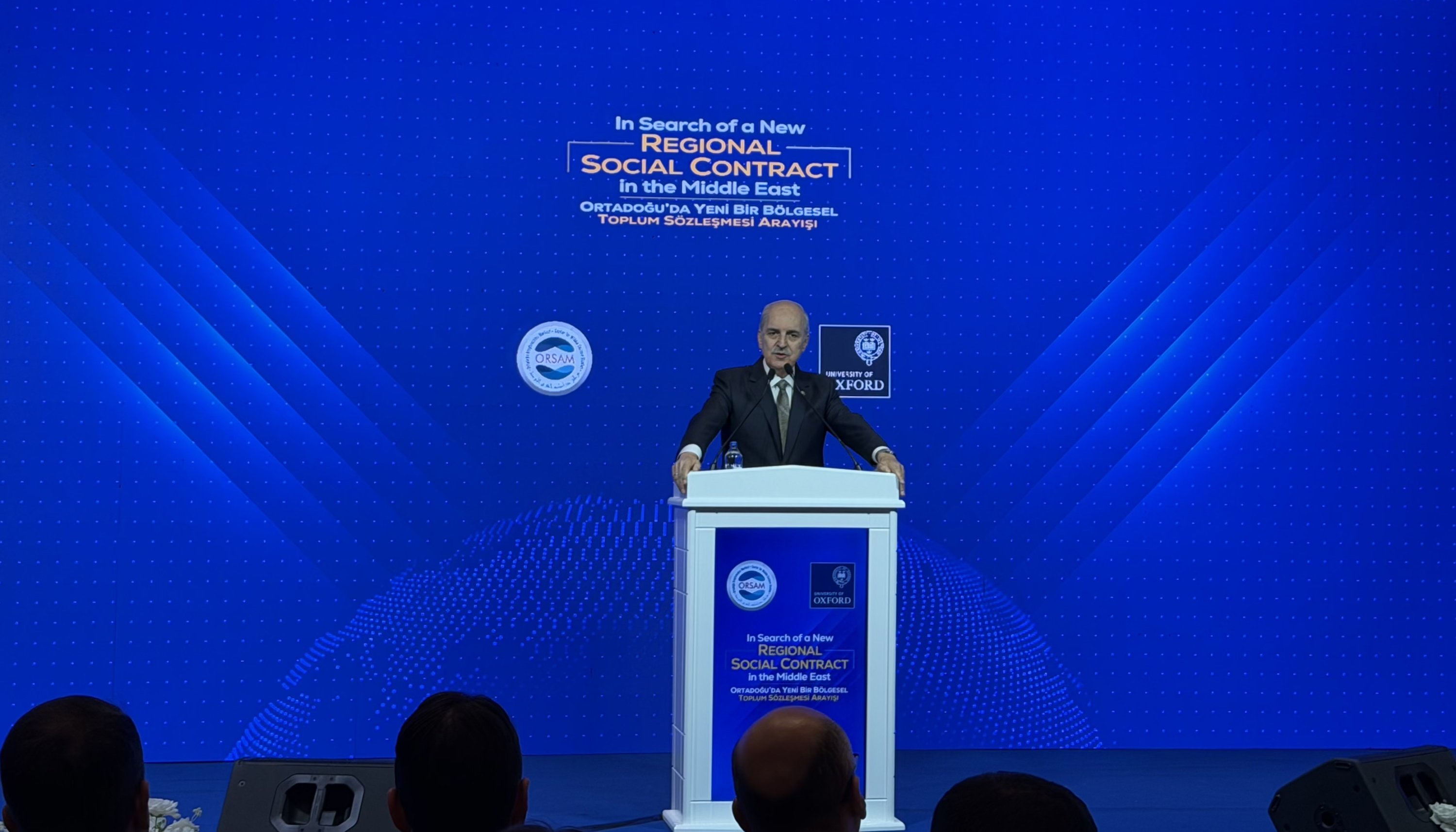
Parliament Speaker Numan Kurtulmuş spoke at the “In Search of a New Social Contract in the Middle East” conference organized by the Center for Middle Eastern Studies (ORSAM) and the University of Oxford in Ankara on Monday and called for a new regional order built on justice, cooperation and shared prosperity, arguing that Middle Eastern countries must move beyond rivalries and external intervention to establish lasting peace. The veteran politician also touched upon the terror-free Türkiye initiative he was heavily involved in.
He described Türkiye's ongoing initiative to end terrorism as a model that could offer lessons for other conflict-resolution efforts, stressing that its objectives extended beyond the disarmament of the terrorist group PKK. “The issue is not simply laying down arms or the disarmament and dissolution of a group,” he said, framing the process as an effort to rebuild social cohesion and enable communities divided by decades of conflict to live together in unity.
He said the initiative had advanced more quickly than some international examples, with progress achieved within approximately two years in areas where other processes had taken eight or nine years. However, Kurtulmuş cautioned against presenting the Turkish experience as a universal formula for resolving every conflict. Instead, he said, it should be considered a potential source of inspiration for international efforts to establish peace and social reconciliation.
He outlined several defining characteristics of the process, including its domestic origins, its grounding in national interests rather than party politics, parliamentary oversight, transparency and its connection to regional stability. Kurtulmuş emphasized that the initiative had emerged from Türkiye's own political dynamics, historical experience and social needs rather than being designed in foreign capitals. He also rejected the idea that any major social issue could be entirely removed from politics, saying the distinction was that the process had not been confined to the agendas of individual political parties. The involvement of Parliament was particularly important, he said, as it provided a platform for different political views to be discussed and helped establish broader ownership of the process.
Kurtulmuş said the parliamentary commission had consulted academics, legal experts, civil society representatives and other segments of society, with their views recorded and considered as part of its work. He cited the commission's report, which received 47 votes from its 50 members, and subsequent legislation that he said was supported by 467 lawmakers as significant milestones. The broad parliamentary backing, he argued, reflected a shared desire for peace, coexistence, economic development and social integration. He described the process as one of the most significant undertakings of the Republic of Türkiye's second century, saying its success depended on ensuring that political disagreements were resolved through dialogue rather than coercion.
For decades, the PKK remained the main security threat for Türkiye, and its violent campaign is blamed for the deaths of thousands of people and immense economic losses, especially in southeastern Türkiye. The PKK claimed to be fighting for the rights of the Kurdish community and exploited the youth from the community for so-called Kurdish self-rule. Apart from small nationalist parties, almost all political parties openly supported the initiative, something rare in polarized Turkish politics. At Parliament, Kurtulmuş chaired the inaugural committee that sought input into the initiative, which eventually led to the inception of the bill on terror-free Türkiye.
Kurtulmuş stressed that lasting peace required recognition of the shared future of Turkish and Kurdish communities, rejecting approaches that treated their destinies as separate. “No proposal that fails to protect the honor of Turks and the pride of Kurds can establish lasting peace in this country,” he said, recalling the principle that had guided the initiative from its outset. He argued that the peoples of the region, including Turks, Kurds, Arabs, Sunnis, Shiites, Muslims and non-Muslims, shared interconnected interests and faced common challenges. “No people in this region can achieve prosperity on their own by following the dictates of imperialist powers,” he said, calling for a common social compact grounded in the recognition that the region's communities shared both a history and a future.
Kurtulmuş also linked Türkiye's domestic peace efforts to developments in neighboring countries, arguing that regional stability could not be secured through isolated national initiatives. He pointed to efforts to integrate the Syrian Democratic Forces (SDF) into Syria's state structures and developments concerning armed groups in Iraq as important elements of the wider regional security environment. He said no country in the region could eliminate terrorism on its own, given the cross-border consequences of armed groups operating in neighboring states. Regardless of whether such groups were driven by ethnic, ideological or religious motivations, he argued, weapons should remain outside the control of nonstate armed actors. The objective of a terror-free Türkiye and a terror-free region, he said, should therefore be understood as a shared regional necessity rather than solely a national security goal.
The parliamentary speaker also said the international system was undergoing profound changes, requiring countries to reconsider the principles governing global power and international relations. “The issue is not who replaces whom at the center of power, but how power can be limited and how it can be transformed into a humane force within the framework of international law,” he said. Kurtulmuş said the emergence of a multipolar world would not, by itself, guarantee a fairer international order. He stressed the need for a system grounded in justice, fairness, the sovereign equality of nations and the fundamental rights and freedoms of all people.
Türkiye, situated at the crossroads of the Middle East, Eastern Mediterranean, Black Sea, Balkans and Caucasus, could not remain a passive observer of these transformations, he said, adding that Ankara sought to contribute proactively to regional and global solutions.
Turning to the Middle East, Kurtulmuş argued that outdated political approaches and externally imposed projects could no longer provide answers to the region’s challenges. “The old Middle East is over,” he said, calling on regional nations to develop common responses to global developments and work toward a new regional framework for peace. He said competition among countries could strengthen the region if it did not turn into hostility, emphasizing that each country's prosperity and development should be regarded as contributing to the wider region. Peace and security, he added, must extend beyond silencing weapons to include stronger legal protections and the advancement of human rights.
Kurtulmuş called for a shift away from what he described as the region's war and terrorism economies toward a peace economy capable of generating new opportunities for development. He said stronger regional cooperation could unlock economic potential through cross-border trade, infrastructure and shared projects, including the Development Road project linking Iraq with wider regional markets. Opening borders to trade and establishing economic corridors connecting Türkiye, Syria, Jordan, Iraq and other neighboring countries could create significant benefits for the region, he said. Kurtulmuş concluded that a new Middle East order would require countries to strengthen the rule of law, democracy and political pluralism at home while expanding cooperation across borders. He said Türkiye was prepared to contribute its experience and resources to this effort, expressing hope that the region's peoples could move beyond divisions imposed over generations and build a future founded on unity, fraternity and peace.