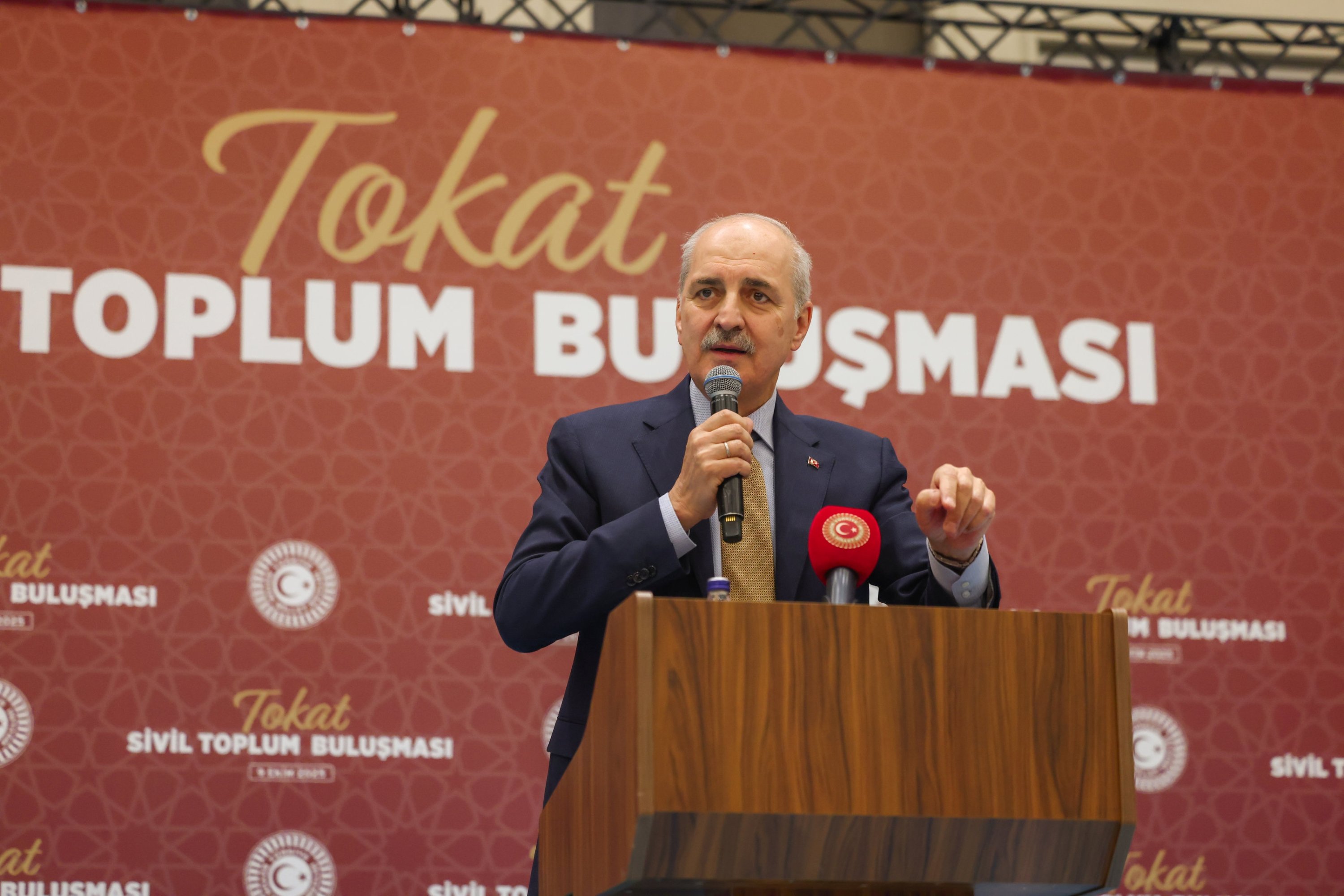
Parliament Speaker Numan Kurtulmuş on Thursday insisted the National Solidarity, Brotherhood and Democracy Committee will not issue any decisions that could harm national unity or dishonor martyrs, emphasizing that the aim is to end terrorism, not mediate ethnic divides.
The committee, established in August, aims to set guidelines for Parliament for the future of the terror-free Türkiye initiative. The initiative, proposed by Nationalist Movement Party (MHP) leader Devlet Bahçeli last year, went through several stages, starting with the PKK terrorist group’s jailed leader Abdullah Öcalan urging the group to dissolve itself in a historic call in February and a ceremony in July where PKK members burned their weapons.
The next stage in the initiative will likely be the enactment of new laws or regulations for the status of the PKK and its members after it fully dissolves itself.
Speaking at a “Civil Society Meeting” in northern Tokat province with local opinion leaders, relatives of fallen soldiers and veterans, Kurtulmuş outlined the committee’s purpose in stark terms: “No decision will be made that will disrupt the unity and solidarity of our nation and homeland in this committee. No decision will be made ... that will grieve the souls of our martyrs or disturb our veterans.”
He said the committee is part of a broader goal to build a terror-free Türkiye. “Our goal is to save Türkiye from the scourge of terrorism that has plagued this country for 50 years,” he declared. “Over these 50 years, we have paid a very heavy price, losing tens of thousands of our people.”
Kurtulmuş rejected characterizing the committee as a peace or reconciliation process between Turks and Kurds. “The issue is not to reconcile Turks and Kurds, but to strengthen our eternal brotherhood by removing weapons, by completely eliminating them,” he said.
For decades, the PKK exploited the disillusioned Kurdish community concentrated in the southeast, claiming to fight for Kurdish self-rule in the region. Kurds opposing the group faced massacres and attacks, while Kurdish youth in economically deprived southeast were brainwashed to join the group.
More than a decade ago, the government tried to win back the community, to root out the issues the PKK exploited to gain support. This “reconciliation process,” as it was called, collapsed when the PKK resumed its attacks after a brief lull, despite the government’s efforts to grant more rights to the Kurdish community.
Kurtulmuş reiterated that the committee will avoid any proposals that might “disrupt the unity, peace, and solidarity of our nation and homeland” or cause anguish to veterans or the relatives of the fallen. The goal, he clarified, is to eliminate crimes committed against the state by terrorist organizations and in doing so, transform ethnic bonds into a more durable brotherhood.
He acknowledged that forces benefiting from ongoing conflict, foreign backers of terrorist groups or those using terrorism as a political tool, may resist the process. “Don’t we know which countries are using terrorism as a scenario for division and fragmentation?” he asked. “We will no longer remove weapons and insert discordants into the mix.”
Despite warnings and uncertainty, he asserted that public support is solid. “I know there are some hesitations, some concerns are being raised, but I assure you that no outcome will emerge in Türkiye that will disturb the conscience of the people. We will build a process that is solely in the nation’s overall interest and strengthens unity, solidarity and brotherhood,” he stressed.
Kurtulmuş also linked regional stability with national security. “When we establish peace and security in the region, neither Israel nor anyone else can have any designs on this region just as Türkiye is building a terror-free Türkiye, a terror-free region will also open the door to a terror-free region,” he said, urging unity as the foundation for peace and resilience.