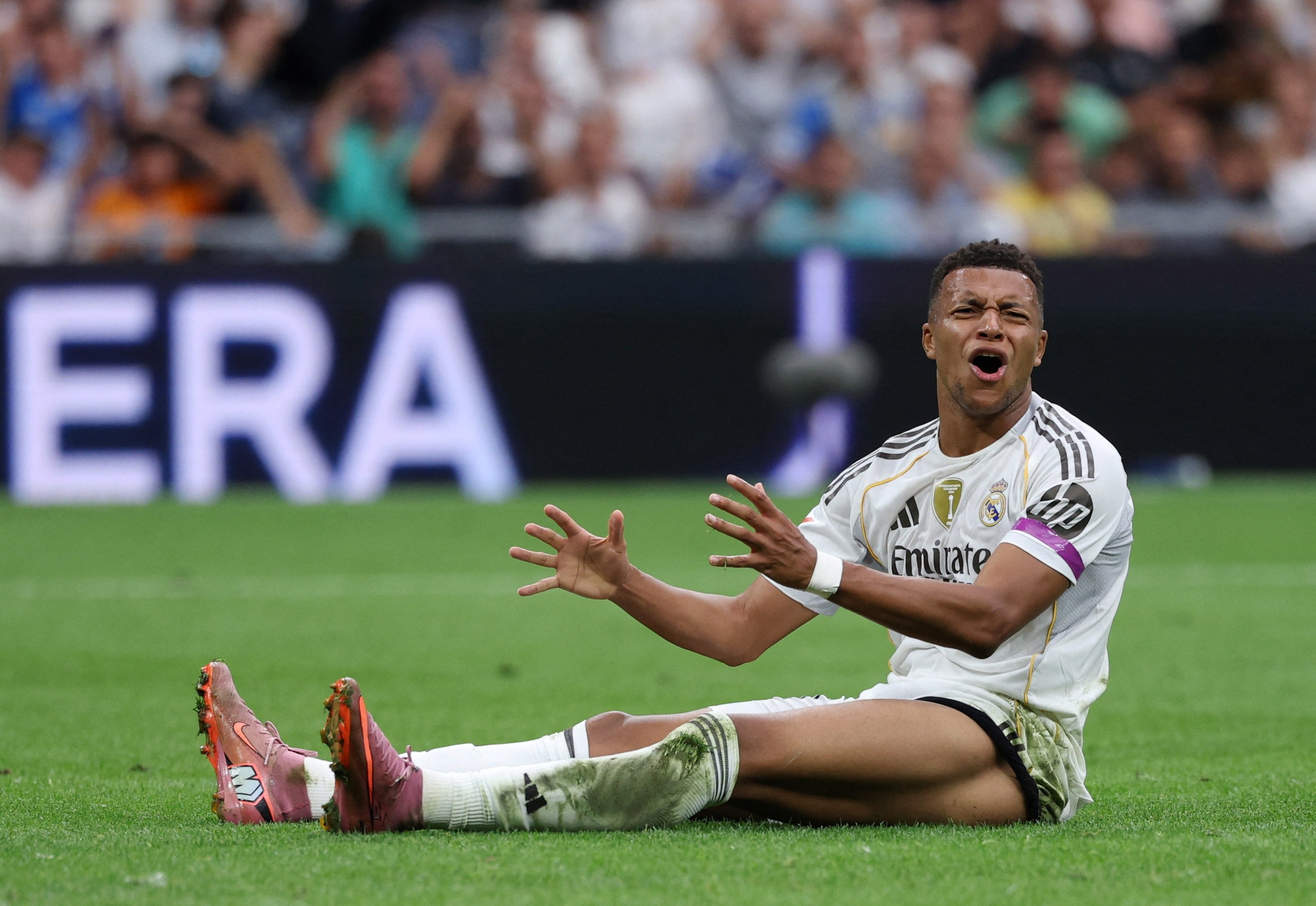
By the time he turned 19, Kylian Mbappe had scaled the kind of heights most players never touch.
He had carried France to a World Cup title, joined the rarefied ranks of the most expensive players in history, and been hailed as the natural heir to Lionel Messi and Cristiano Ronaldo.
The future seemed preordained – Mbappe would be the next king of world football.
Seven years on, the throne remains vacant.
Messi and Ronaldo have faded from their imperial primes, yet Mbappe has not seized the crown that was supposed to be his.
Instead, he finds himself watching from the edge of the spotlight as a new prodigy, Barcelona’s Lamine Yamal, threatens to leapfrog him before his reign even begins.
Last week’s Ballon d’Or ceremony underlined the shift. Mbappe, who just captured the European Golden Shoe as the continent’s top scorer, finished seventh in the vote.
The winner: Ousmane Dembele, his French teammate, whose renaissance season at Paris Saint-Germain was crowned by 32 goals and a historic treble.
In second place stood Yamal, just 18 years old, already a European champion with Spain and the heartbeat of Barcelona’s resurgence.
For Mbappe, once the sport’s boy king, it was another reminder that promise alone does not guarantee permanence.
“Now it could be very complicated because of the fascination of this young player of 18 who broke all the records for his age,” author Luca Caioli, who co-wrote a book on Mbappe’s rise, told the AP. “Mbappe is no longer 19 like when he won the World Cup. It’s changed.”
That change is stark.
In 2018, Mbappe became the first teenager since Pele to score in a World Cup final.
Four years later, he became only the second player in history to score a hat trick in the final, nearly dragging France past Argentina in one of the most dramatic games the sport has seen.
He left PSG as their all-time leading scorer.
Last month, he passed Thierry Henry on France’s charts, closing in on Olivier Giroud’s national record.
The statistics are not those of decline.
At 26, he should be entering his peak, and his start at Real Madrid – 12 goals in 10 matches this season – suggests his scoring instincts are sharper than ever. But football is not mathematics. The Ballon d’Or, for better or worse, rewards timing, perception, and narrative as much as numbers.
Mbappe’s timing has been cursed.
His long-awaited move to Madrid came just as PSG finally won the Champions League without him, and just as Madrid ceded their dominance both in Spain and Europe. “He waited too long to go,” Caioli said. “And then chose the wrong moment.”
Contrast that with Dembele, who found redemption in the same year Mbappe was treading water. Once derided as Barcelona’s great misfire, he reinvented himself at PSG and was rewarded with the game’s top individual honor. The optics mattered: a player reborn leading his team to glory versus a superstar whose brilliance could not change his club’s trajectory.
And then there is Yamal. Too young, some said, to win the Ballon d’Or. But too good to ignore. His back-to-back Kopa Trophies confirmed his supremacy among under-21 players, yet many – including La Liga president Javier Tebas – argued he should have taken the top prize outright. His father went further, declaring his son “the best player in the world by far.”
For Mbappe, there was no such chorus of outrage. Real Madrid, which once boycotted the Ballon d’Or when Vinícius Júnior was overlooked, barely blinked this year. The silence was as telling as the vote.
It is not that Mbappe lacks a case.
His Golden Shoe marked a career first.
He remains the most reliable scorer in world football and the face of his national team.
But he is judged against the legacy of Messi and Ronaldo – a standard no other player has faced in such stark terms.
Together, they collected 13 Ballon d’Ors and turned dominance into routine.
The assumption was that Mbappe would follow. Instead, a teenager from Barcelona is stealing the narrative before he has secured his first.
“He is the present and, without a doubt, has a great future,” Messi said of Yamal. Spain coach Luis de la Fuente was even more direct: “We have seen a genius, the product of a genius.”
For the sport, the symmetry is irresistible. Madrid’s Mbappe versus Barcelona’s Yamal – echoes of Ronaldo versus Messi, a rivalry that defined a generation. But for Mbappe, it sharpens the stakes. No longer is he the future; he is the present under pressure, with his legacy yet to be written.
Time is not his enemy yet.
At 26, he has room to grow, and at Madrid, he has joined the one club virtually guaranteed to give him a platform for Champions League glory.
It feels inevitable he will win Europe’s top prize at least once with the Spanish giants.
But inevitability is not the same as achievement – and the longer Yamal dazzles, the more Mbappe’s delay in claiming football’s crown risks defining his career.