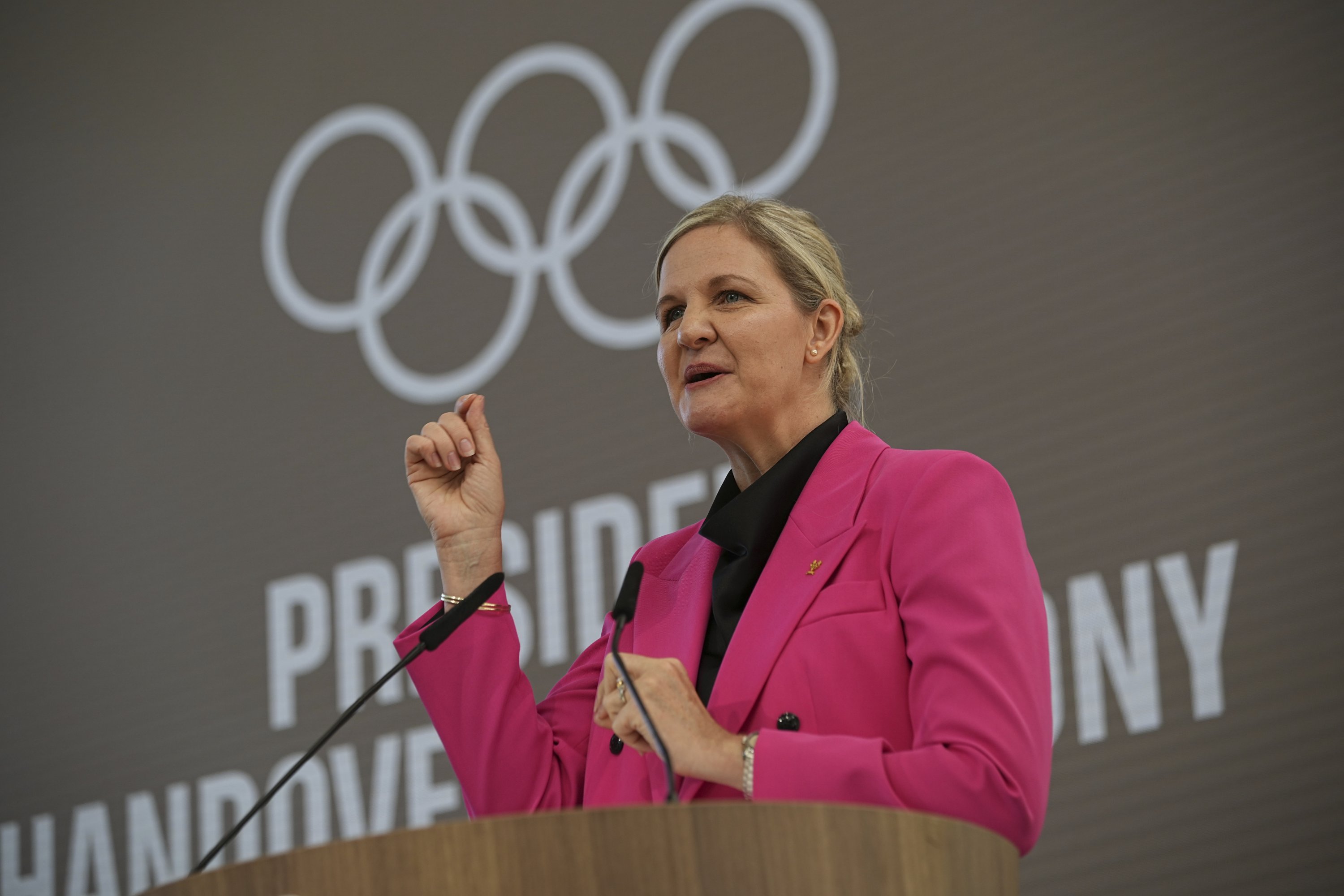
International Olympic Committee President Kirsty Coventry says she hopes sports can reach a consensus on protecting the female category, with fair competition as the top priority.
Following her election as head of the Olympic movement in June, Coventry pledged that the IOC would lead discussions on gender eligibility criteria in sport, four years after the organization had encouraged federations to address the matter independently.
Earlier this month, the IOC established a “Protection of the Female Category Working Group,” bringing together experts and representatives from international sports federations to deliberate on the issue.
“What I would like for the IOC to do is to bring everyone together to try and find a consensus among all of us that we can all get behind and that we can implement,” Coventry told reporters in Tokyo on Saturday.
“And above anything and everything else, it's fair and protects the female category. So they met last week, and I'm looking forward to debriefing with them in the next few weeks.”
The IOC’s 2021 guidelines on fairness, inclusion and non-discrimination suggested that federations prioritize the inclusion of gender-nonconforming athletes in the category of their choice, while making no presumptions of unfair advantage.
Despite this, several Olympic sports over the past few years have barred athletes who have undergone male puberty from competing in the female category at an elite level.
Boxing and athletics introduced mandatory tests this year for athletes in the female class to detect the SRY gene, which is on the Y chromosome and triggers the development of male characteristics in mammals.
These measures target athletes with differences of sexual development (DSD), who were raised female but sometimes carry some of the physical advantages of males.
Coventry, who said the working group met for the first time last week, suggested there might still not be a one-size-fits-all solution to the issue.
“The idea behind the working group is for us as the IOC to try and bring together the sporting world and to find some consensus in how we are going to protect the female category and what that means,” she added.
“It’s different for each sport because in some sports, like equestrian, men and women already compete against each other. So maybe it’s not as big of a topic.
“But in a lot of the other sports, it’s been a very big topic for a long time.”