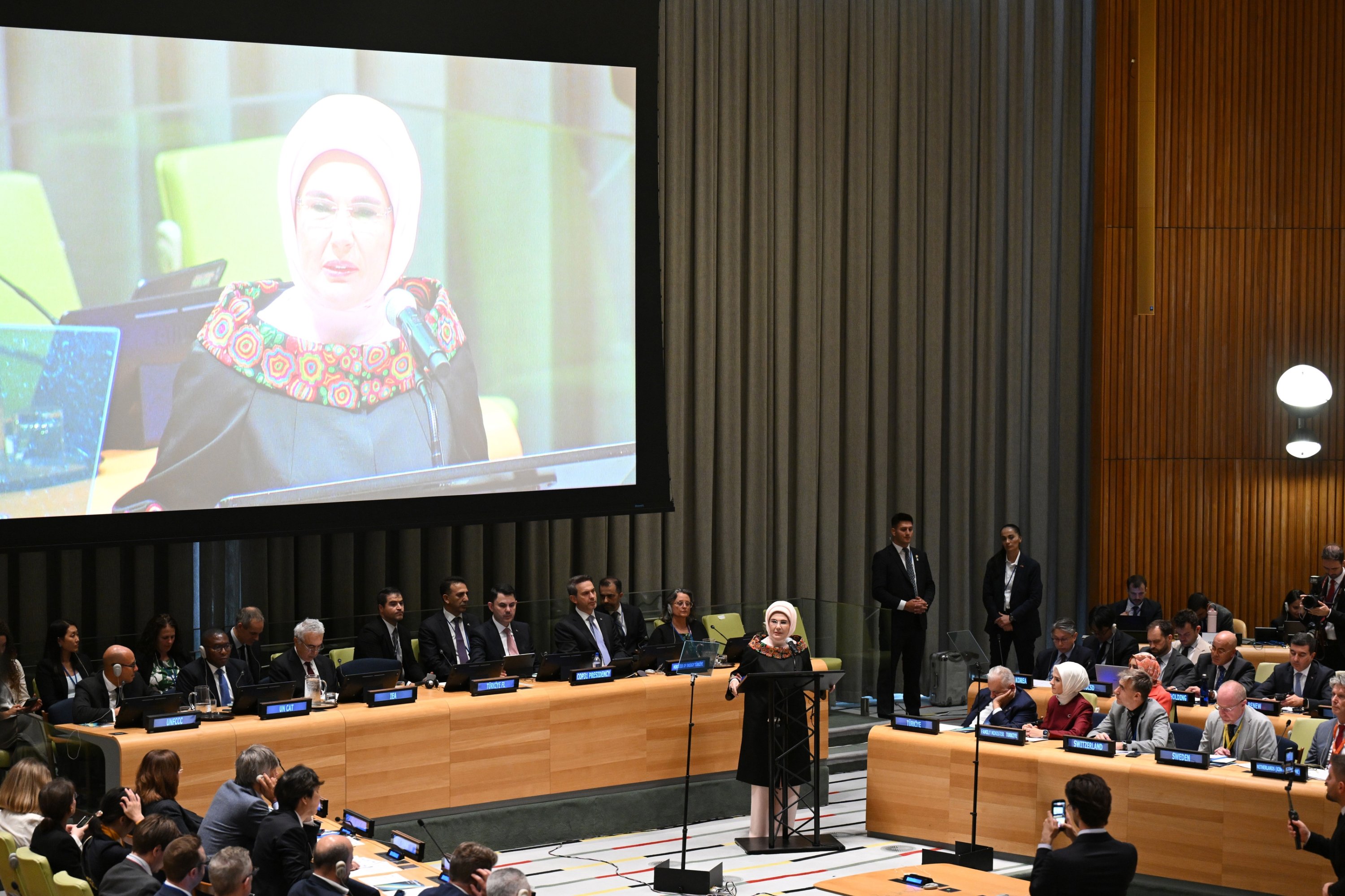
Turkish first lady Emine Erdoğan, and chairperson of the U.N. High-Level Advisory Board of Eminent Persons on Zero Waste, urges a global shift away from the throwaway culture built around single-use products, calling for a sustainability model centered on durable products, circular production and responsible consumption.
Speaking at the International Energy Agency’s (IEA) High-Level Energy Transition Dialogue Meeting at the U.N. headquarters in New York on Tuesday, Erdoğan said the world needed to look beyond simply producing more clean energy and address the growing consumption patterns driving energy demand and greenhouse gas emissions.
Erdoğan said increasingly common headlines about record temperatures, severe heat waves and the hottest summers on record were accompanied by forest fires, floods and powerful storms.
“These events are the result of the energy demand created by ever-increasing consumption and rising greenhouse gas emissions,” Erdoğan said, describing the developments as “nature’s way of speaking to us.”
She argued that the energy transition should not be limited to asking how more clean energy could be produced, but should first address why more energy was needed.
“We need to stop and think about how we use our resources and the consequences of our unlimited consumption habits,” she said.
Erdoğan said lasting solutions required addressing the root causes of environmental problems rather than simply managing their symptoms.
Humanity extracts, processes and consumes resources before turning products into waste, she said, noting that waste contained energy, natural resources and human labor that had already been invested in production.
She also highlighted the connection between food waste and energy consumption, saying an amount of food equivalent to 5.8 trillion plates was wasted each year globally without being consumed.
The energy used to produce, package, prepare, preserve and distribute that food was consequently wasted as well, Erdoğan said, arguing that waste needed to be considered beyond its purely technical dimension.
Citing research showing that 85% of people tended to purchase more than they needed, Erdoğan called for a change in consumption habits.
“Our primary concern should be to move away from the throwaway culture built around single-use products,” she said, calling for a sustainability culture centered on long-lasting and durable products for the well-being of people and intergenerational justice.
Erdoğan said production processes could be redesigned to prevent waste, while discarded materials could be transformed back into raw materials and returned to the production system.
She pointed to nature as a model for circularity, noting that nothing in nature ultimately became waste and that the output of one organism became the input of another.
“We can only solve the problems accumulated within our linear production and consumption system by learning to think circularly,” she said.
Erdoğan also highlighted Türkiye’s Zero Waste Project, launched in 2017 and developed into a global movement, as an important roadmap for energy and resource security.
She said IEA studies demonstrated the strong relationship between zero waste and the energy transition, noting that stronger circular waste management could contribute to significant emissions reductions in the energy sector.
Türkiye was preparing for the transition by accelerating its zero waste practices and clean energy investments, Erdoğan said.
Türkiye ranked fifth in Europe and 11th globally in terms of installed renewable energy capacity, she said, adding that the country aimed to increase its solar and wind installed capacity to 120,000 megawatts by 2035.
Erdoğan said Türkiye also planned to further advance its zero waste approach through the action agenda of COP31, which it will host in November.
“Zero waste is one of the strongest ways to open the door to real transformation across every stage from production to consumption,” she said.
She also highlighted the second International Zero Waste Forum, held in Istanbul in June, which brought together 120 ministers and more than 7,000 participants from 183 countries.
Erdoğan said strong policies and international cooperation were needed to ensure sustainability commitments moved beyond paper and translated into concrete action.