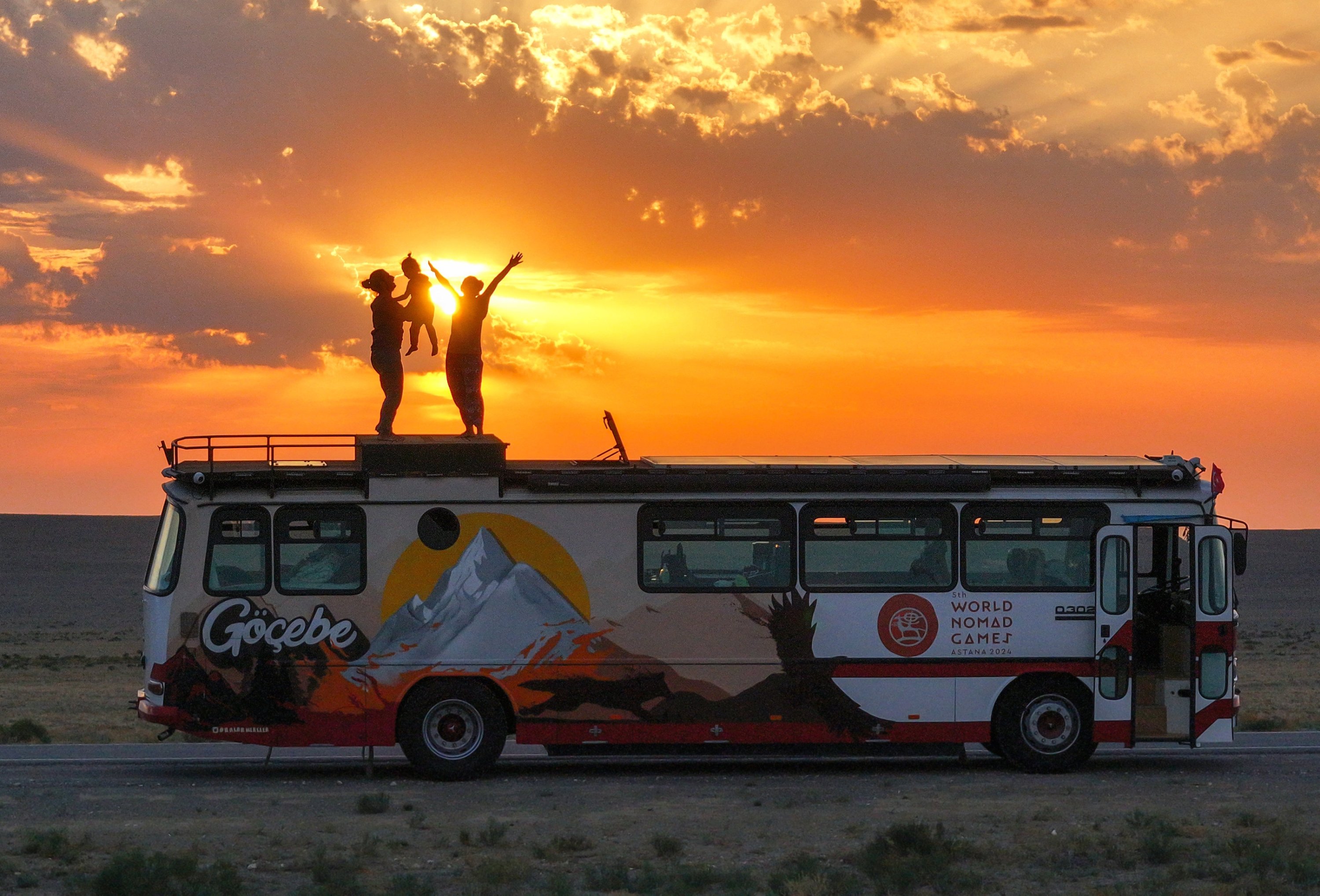
Leaving behind their settled life in Istanbul, Turkish psychologist Idil Saliha Duran and her husband, carpenter Burak Duran, set out on a monthslong journey across Central Asia with their 3-year-old son, Güneş Kutluhan, in a caravan they named "Göçebe" – meaning “Nomad.”
Motivated by Idil Duran’s desire to visit her maternal ancestors’ homeland of Kyrgyzstan, the family traveled more than 16,000 kilometers in two and a half months, passing through Türkiye, Georgia, Azerbaijan, Kazakhstan and Kyrgyzstan.
Driving a self-renovated 1982 Mercedes O302 bus that they converted into a mobile home over three years, the Durans participated last year in the Fifth World Nomad Games held in Astana, Kazakhstan. Their journey was documented by Anadolu Agency (AA) photojournalist Muhammed Enes Yıldırım.
The couple shares updates from their nomadic lifestyle on their social media accounts under the name "Oralarnereler" – loosely translated as “Where Are Those Places.” One of their major milestones was crossing the Azerbaijan border, which had been closed to civilian vehicles for five years but was opened for them with support from Türkiye’s Foreign Ministry and the World Ethnosport Confederation.
“This trip was a dream of ours for the past 10 years,” said Burak Duran. “When the Kazakh government invited us to the Nomad Games, we knew it was time.”
Duran described the expansive steppes of Kazakhstan as a landscape that brought reflection and perspective. “People there call it a desert, but we call it the steppe. We listened to Neşet Ertaş songs while driving and often found ourselves lost in thought. Life and death cross your mind in that vast silence. Every few miles, you see another tomb – not like ours, but domed, unique,” he said.
Despite the long and sometimes harsh road conditions, the family says they never felt fear.
“Our ancestors traveled these lands on horseback. We’re doing it on four wheels. How hard could it be?” Duran said. “The real fear is internal. We had already faced our fears when we chose this life in a caravan.”
A significant moment for the family was visiting the mausoleum of Hoca Ahmet Yesevi in Turkistan for the first time. “Seeing the small, soot-darkened cell where he retreated from the world was deeply moving,” Duran said.
Their route took them along Issyk-Kul Lake and up the foothills of the Tien Shan mountains. “Everyone should see these ancestral lands,” he added.
For Idil Saliha Duran, the journey had profound personal meaning. Her maternal ancestors fled Kyrgyzstan after conflicts and migrated to Türkiye in 1954, while her father’s side is originally from Tatarstan.
“This wasn’t a touristic trip,” she said. “It was emotional and spiritual. No matter how far apart we are or in which country we live, we Turks are one people. We must remember that.”
In Kazakhstan, the family was welcomed with traditional hospitality – sweets, horse meat, fermented mare’s milk and dombra music, even at gas stations and roadside stops.
“Our caravan broke down in Kazakhstan, and people we had never met helped us just because we were Turkish,” she recalled. “They didn’t know us or our journey. But to them, we were one of their own. This journey wasn’t just about us. It was about all those watching from Türkiye and across Turkic communities.”
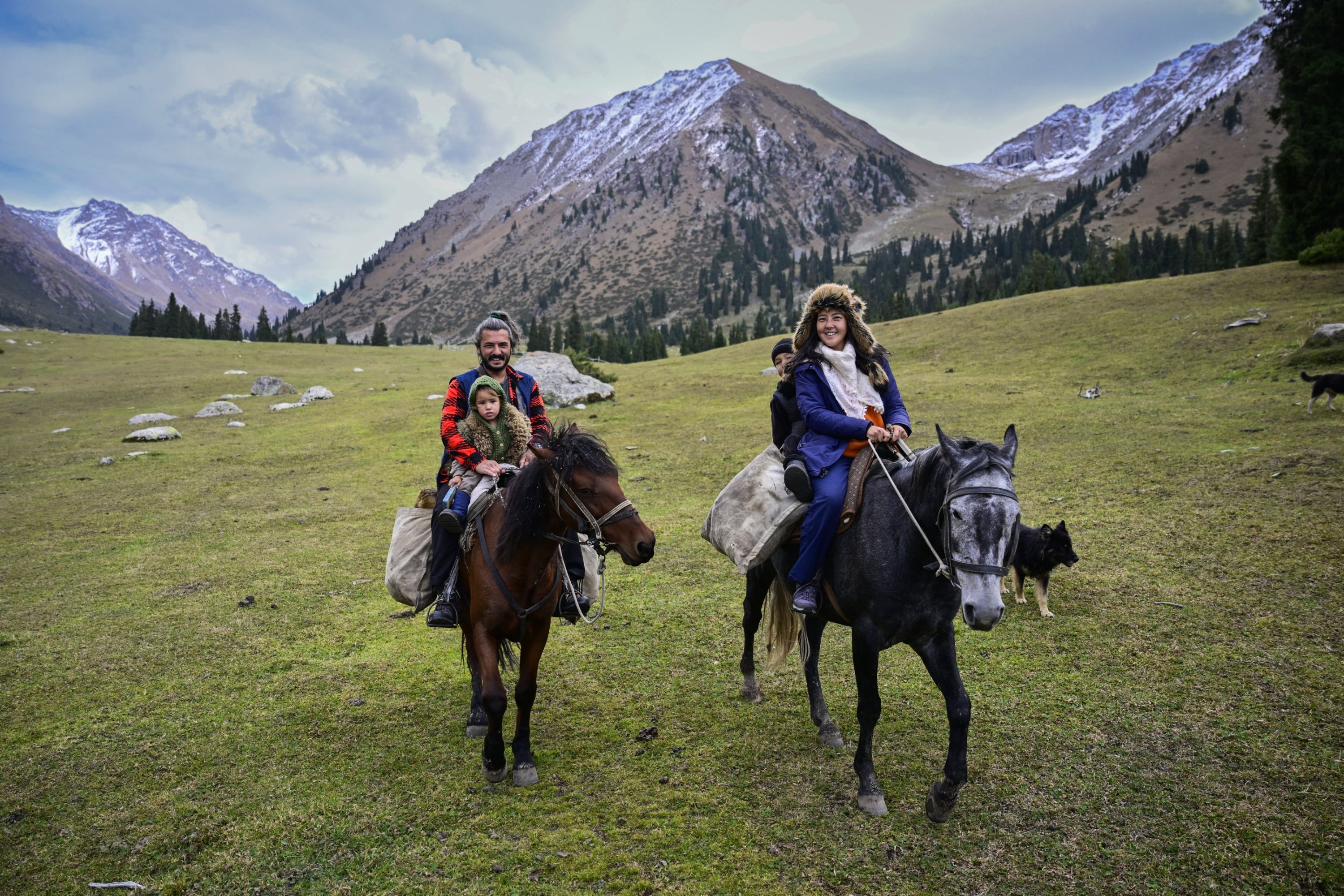
The Durans reached 4,000 meters (13125 feet) altitude in the Tien Shan mountains by horseback and cooked traditional meals in a felt yurt, called a “boz üý.” Idil Duran hoped to visit her great-grandfather’s village, a known local hero in Kyrgyzstan, but authorities didn’t permit the caravan on narrow mountain roads.
Still determined, the family traveled 860 kilometers (534.38 miles) by taxi to reach the village.
“The road was winding and dangerous, but we made it,” she said. “We embraced long-lost relatives, cried with them, and felt deeply connected. Thousands wrote to us saying, ‘You went for us. Thanks to you, we saw our homeland.’”