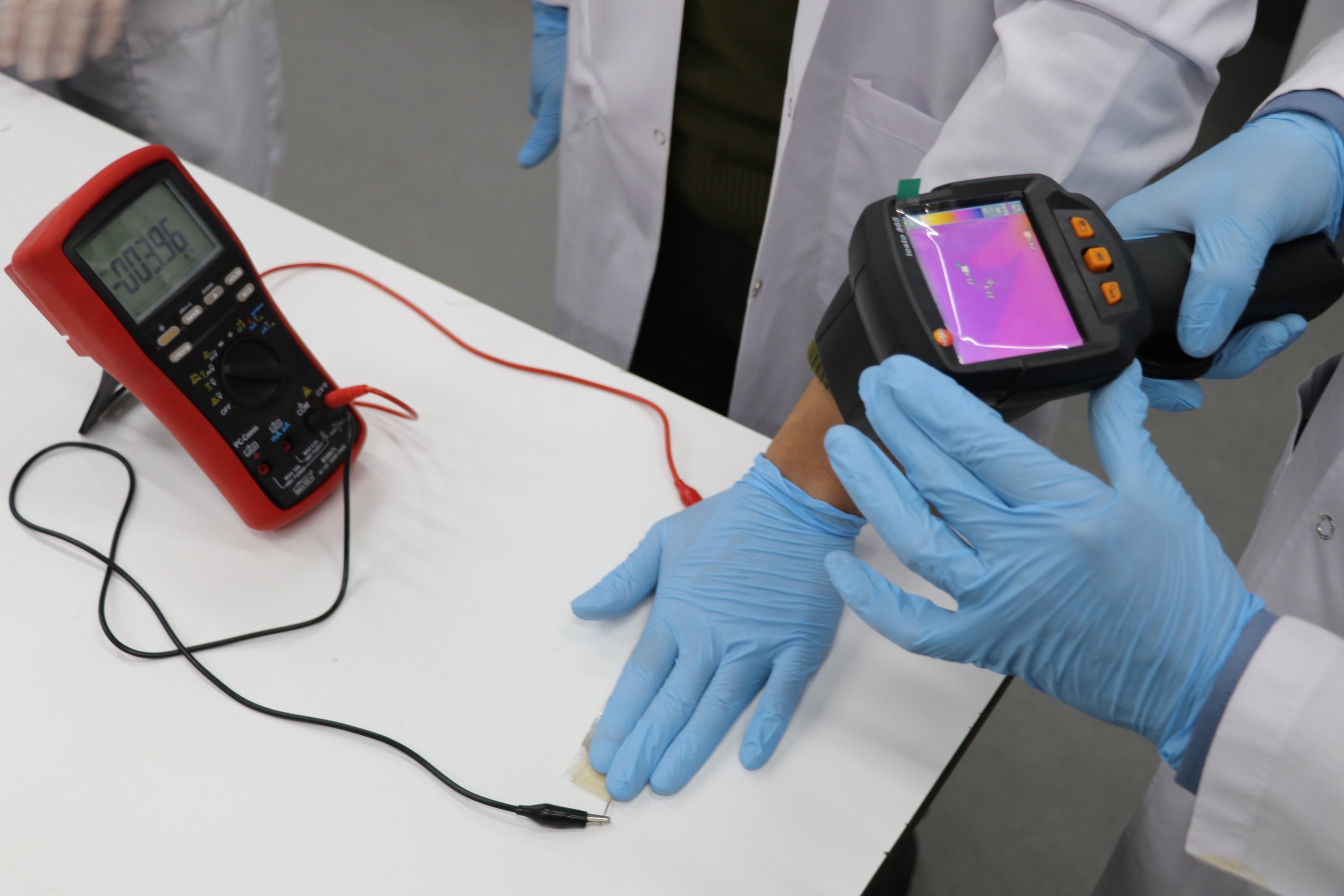
Researchers at Sivas University of Science and Technology in Türkiye's eastern city of Sivas are developing a homegrown project that converts waste heat – including heat generated by the human body – into electrical energy, drawing inspiration from science fiction films such as The Matrix while focusing on practical, real-world applications.
The project aims to harness temperature differences between the human body and the surrounding environment, as well as heat losses from vehicles and industrial systems, to generate electricity using thermoelectric principles. The researchers say the technology could provide an alternative or supplementary energy source for wearable electronics.
A significant portion of the world’s energy is lost as waste heat during conversion processes in industry, transportation and everyday life. Recovering even a fraction of that energy has become an important focus in renewable and sustainable energy research.
At Sivas University of Science and Technology, researchers are studying how electricity can be produced from temperature differences using thermoelectric materials. The work examines high-heat areas such as aircraft exhaust systems, vehicle exhaust manifolds, brake components and engine blocks, as well as the temperature difference between the human body – typically around 36.5 degrees Celsius (97.7 degrees Fahrenheit) – and the surrounding environment.
The system under development aims to convert heat that would otherwise be wasted into usable electrical energy. Researchers say electricity generated from body heat could be used in low-power devices such as hearing aids, smartwatches and sensor-based wearable technologies, reducing reliance on batteries or extending the time between charges.
Ilhan Danacı, a research assistant in the university’s Department of Aeronautical Engineering, said the project was inspired in part by ideas commonly seen in science fiction.
“Science fiction films often explore the concept of humans as an energy source,” Danacı said. “We took inspiration from those ideas and approached them from a scientific and engineering perspective, focusing on the temperature difference between the human body and the environment to produce renewable energy.”
Danacı emphasized that waste heat recovery has become a key research area worldwide.
“In global energy systems, nearly two-thirds of energy is lost at various stages,” he said. “Converting waste heat into electrical energy is therefore extremely important. Whether it comes from aircraft systems, vehicles or the human body, temperature differences can be evaluated to generate electricity. For devices that are in constant contact with the human body, such as hearing aids or smartwatches, this can help extend battery life or reduce charging frequency.”
The project’s long-term goal is not to power high-energy devices, but to support low-power electronics used in wearable technologies. Danacı said similar studies are being conducted internationally, but his team developed a different materials approach by combining conductive and insulating polymers.
The project was submitted to Türkiye’s Scientific and Technological Research Council (TÜBITAK) and has been successfully completed, he said.
While the idea of humans being used as an energy source is best known from The Matrix film series – in which machines harvest bioelectric and thermal energy from captive humans to power artificial intelligence (AI) – scientists note that the films exaggerated the concept for dramatic effect. In reality, the amount of energy produced by the human body is limited, but researchers say capturing small amounts of body heat can still be valuable for low-power electronics.
Experts in renewable energy note that thermoelectric technology is already used in specialized applications, including space exploration and industrial monitoring. Advances in materials science have made it increasingly feasible to apply the same principles to everyday devices, turning science fiction inspiration into practical engineering solutions rather than cinematic fantasy.