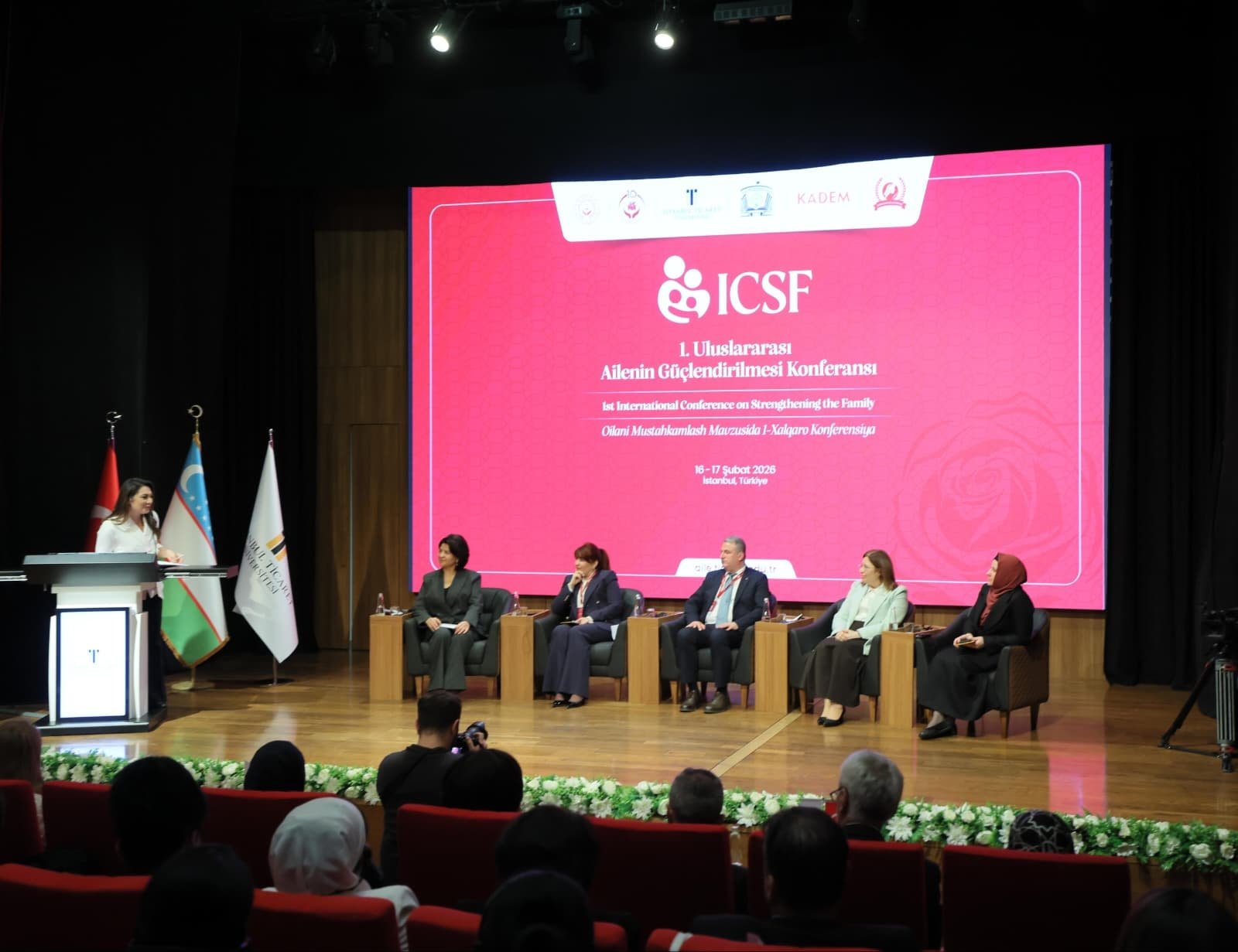
The First International Conference on Strengthening the Family started on Monday in Istanbul, bringing together policymakers, academics and civil society representatives for high-level discussions on family-centered social policies. The conference is jointly organized by the Ministry of Family and Social Services and the Women and Democracy Foundation (KADEM), and is hosted by Istanbul Commerce University.
Focused on the theme “State Policies Based on Strengthening the Family in Türkiye and Uzbekistan,” the two-day event will examine how families are affected by challenges such as digitalization, migration and economic uncertainty, while offering a comparative look at policy approaches in both countries.
Speaking during the opening ceremony, professor Necip Şimşek, rector of Istanbul Commerce University, emphasized that strengthening the family is a strategic investment in society and requires scientific, holistic and sustainable approaches.
Şimşek mentioned that “The family is the most fundamental social institution where individuals first encounter the world, internalize values, and build psychological resilience and social cohesion,” he said, adding that rapid social change, digitalization, and socio-cultural transformations are placing increasing pressure on family structures.
Referring to the scientific scope of the conference, Şimşek explained that nearly 180 paper submissions were received, with 85 accepted following a rigorous peer-review process. He noted that the strong participation from multiple countries, particularly from Uzbekistan and Türkiye, demonstrates the conference’s international academic relevance. “This level of interest clearly shows that family studies remain a critical and growing field within global academic circles,” he said.
Speaking at the conference, KADEM Chair Canan Sarı underlined that strengthening the family is a strategic policy priority that requires international cooperation, evidence-based approaches, and strong civil society engagement.
Drawing attention to the deep-rooted historical and cultural ties between Türkiye and Uzbekistan, Sarı noted that these brotherly relations are now evolving into concrete and meaningful areas of cooperation. “This closeness, shaped by our shared past, also calls on us to think together about our responsibilities for the future,” she said, stressing that the two countries are aligned not only diplomatically and economically, but also around the core values that sustain social structures.
At the heart of this shared agenda, Sarı said, lies the family. “Strengthening the family is not a short-term intervention; it is a long-term investment in society as a whole,” she stated. She warned that families today are under pressure from multidimensional global challenges, including economic uncertainty, wars, forced migration, social crises, rapid digitalization, shifting value systems, weakened intergenerational ties, and declining fertility rates. According to Sarı, these trends “clearly demonstrate that strengthening the family is a strategic policy area that requires regional cooperation, shared reasoning and international solidarity.”
Highlighting Türkiye’s recent efforts, Sarı said the country has shown strong political will in developing family-centered policies, strengthening social support mechanisms, and enhancing social resilience. She stressed that these policies reflect an understanding of the family not merely as a structure in need of protection, but as a fundamental value that shapes the future of society.
Sarı explained that KADEM addresses family issues through a broad and integrated framework, spanning education, employment, legal safeguards and the fight against violence. She added that making women’s labor visible, protecting their rights, and increasing their participation in social life directly contribute to “healthier, more resilient, and stronger families,” grounded in justice and human dignity.
She also underlined the importance of academic knowledge in ensuring that these efforts produce sustainable and lasting outcomes. “Experience gained in the field must be supported by scientific analysis in order to strengthen the impact and permanence of policy recommendations,” Sarı said, noting that KADEM supports academic production through journals, congresses, workshops, and conferences.
Referring to the preparatory process of the conference, Sarı said the workshops held in both Uzbekistan and Istanbul created a shared platform for collective thinking on family policies. These meetings, she noted, enabled a comparative examination of the two countries’ historical experience, legal frameworks, institutional capacities, and implementation models, while also shedding light on the risks currently facing the family institution.
Ayşenur Çoban, director general of the Family Institute at the Ministry of Family and Social Services, said the family plays a central role in society, stating: “The family is not only a moral and emotional anchor; it is also an irreplaceable social structure that provides economic support, social protection and the transmission of ethical values.”
She added, “Stable family environments are directly linked to higher academic achievement, stronger emotional resilience, and lower risks of poverty and criminal involvement among children.”
Çoban drew attention to pressures affecting family structures worldwide, citing delayed marriages, rising divorce rates, and the increase in single-person households. “In Türkiye, households without children now constitute the majority,” she said, warning that declining fertility rates pose “serious demographic and strategic risks.” She added, “The gradual disappearance of children from household life signals not only population aging, but also a weakening of social dynamism, productivity and long-term national resilience.”
Addressing global trends, Çoban said that while international human rights frameworks recognize the family as “the natural and fundamental unit of society,” commitment to its protection has weakened. “Certain ideological approaches, often presented as universally accepted human rights norms, risk undermining the family structure and, indirectly, harming women and children,” she said, stressing “the need for conceptual clarity and a careful distinction between genuine human rights protections and ideological impositions.”
Outlining recent policy steps, Çoban highlighted the 2024 Presidential Circular on the Protection and Strengthening of the Family, along with the accompanying Vision Document and Action Plan. “These instruments are supported by national and provincial coordination mechanisms to ensure a coherent and whole-of-government approach,” she said, also pointing to the establishment of the Directorate of Family and Population Policies and high-level governance structures for population policy.
Speaking on the role of the Family Institute, Çoban noted, “Our primary responsibility is to produce evidence-based research, support the Population Policies Council, and ensure that policy decisions are grounded in reliable data and long-term projections.” She added that declaring 2025 as the “Year of the Family” and 2026–2035 as the “Decade of Family and Population” reflects “a clear understanding that demographic challenges cannot be solved through short-term measures.”
Highlighting Türkiye’s international engagement, Çoban said the country is actively promoting family-centered policies within platforms such as the U.N., the Organization of Islamic Cooperation (ICYF), and the Organization of Turkic States. “The family is increasingly being recognized as a legitimate and strategic policy domain,” she noted, adding that Türkiye’s initiatives are “beginning to set an example internationally.”