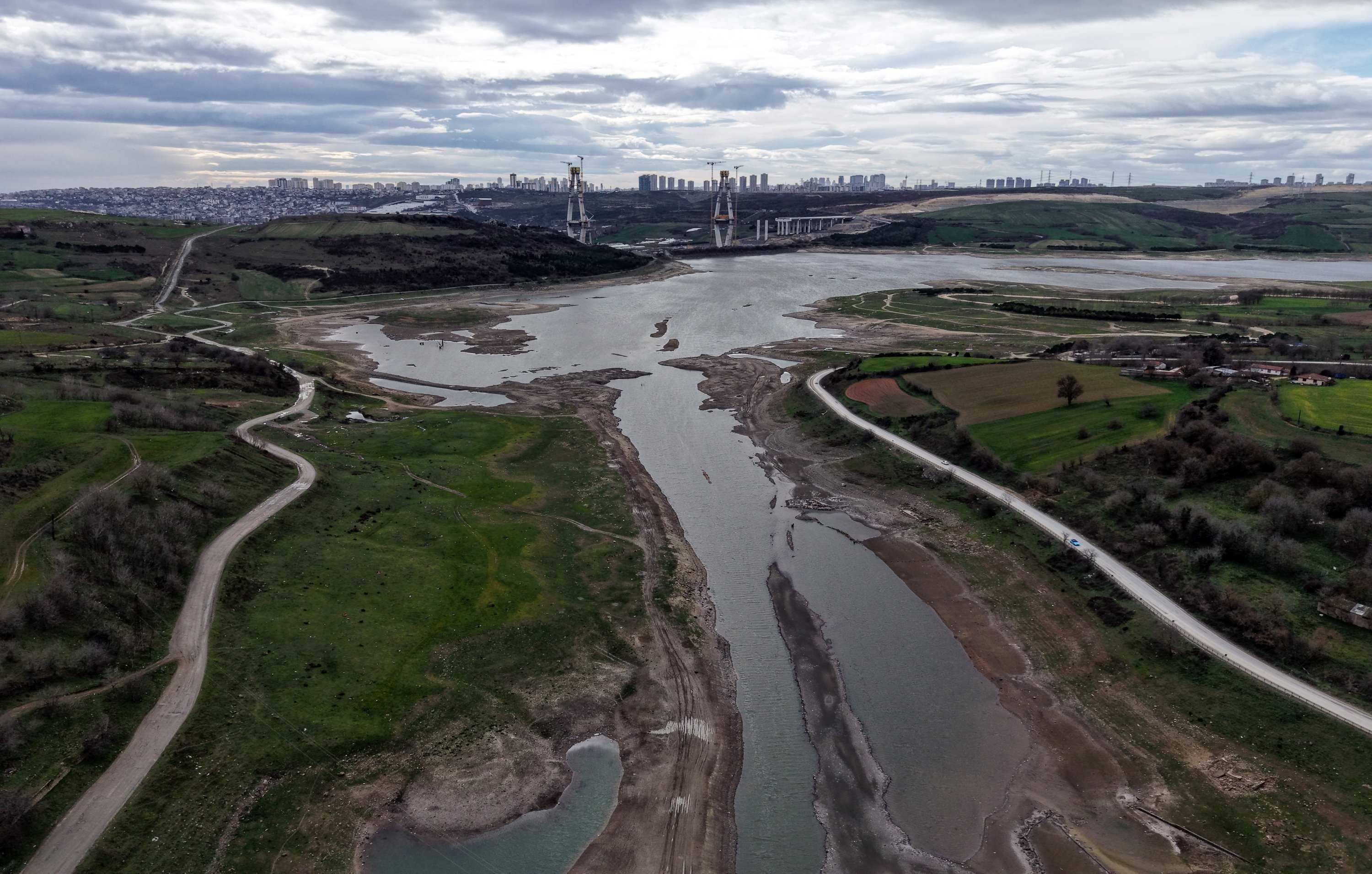
Reservoirs supplying water to Istanbul have seen a modest recovery following recent rainfall, with average water levels rising to 30.25%, according to data released by the city’s water authority on Monday, though officials and experts warn that supplies remain under significant pressure.
Figures from the Istanbul Water and Sewage Administration (ISKI) show that reservoir occupancy had dropped to 17.12% on Dec. 7 before increasing over the past month due to rainfall. Since the start of the year, reservoirs have received 145.1 millimeters of precipitation, pushing storage levels up by 11.48% points.
Despite the increase, current levels remain the second-lowest for the same period in the past 10 years, underscoring ongoing concerns over water security in Türkiye’s largest city of more than 16 million people.
As of Sunday, water levels stood at 44.28% in the Ömerli reservoir, 49.19% in Darlık and 84.93% in Elmalı, while several key reservoirs remained critically low, including Terkos at 18.24%, Sazlıdere at 17.78%, Kazandere at 7.13% and Pabuçdere at 9.23%, according to ISKI.
The reservoirs and ponds supplying Istanbul have a total storage capacity of about 869 million cubic meters, with current water volumes measured at roughly 263 million cubic meters.
Additional water has been transferred to the city from outside sources, including 63.42 million cubic meters from the Melen system and 26.71 million cubic meters from the Yeşilçay project so far this year, bringing the total to 90.13 million cubic meters.
Daily water consumption in Istanbul remains high. On Saturday, the city used about 3.12 million cubic meters of water, most of it supplied through regulators rather than reservoirs, ISKI data showed.
Climate experts say rainfall alone will not resolve Istanbul’s long-term water challenges.
“The main problem is not how much rain falls into the reservoirs, but excessive water consumption,” said Levent Kurnaz, director of the Climate Change and Policy Research and Application Center at Boğaziçi University.
Kurnaz said water use in the city must be brought under control year-round, not only during drought periods, adding that temporary water cuts often backfire by encouraging residents to store water.
“The real solution is to create systems that encourage people to use less water,” he said.
He also cautioned against confusing Istanbul’s water supply issues with agricultural irrigation, noting that the water in question is treated drinking water stored in reservoirs for urban use.
As climate change continues to affect weather patterns, Kurnaz warned that Istanbul is likely to face declining water availability over the long term.
“This year has been particularly dry,” he said. “It is difficult to predict next year, but in the long run, the amount of water reaching Istanbul will decrease.”