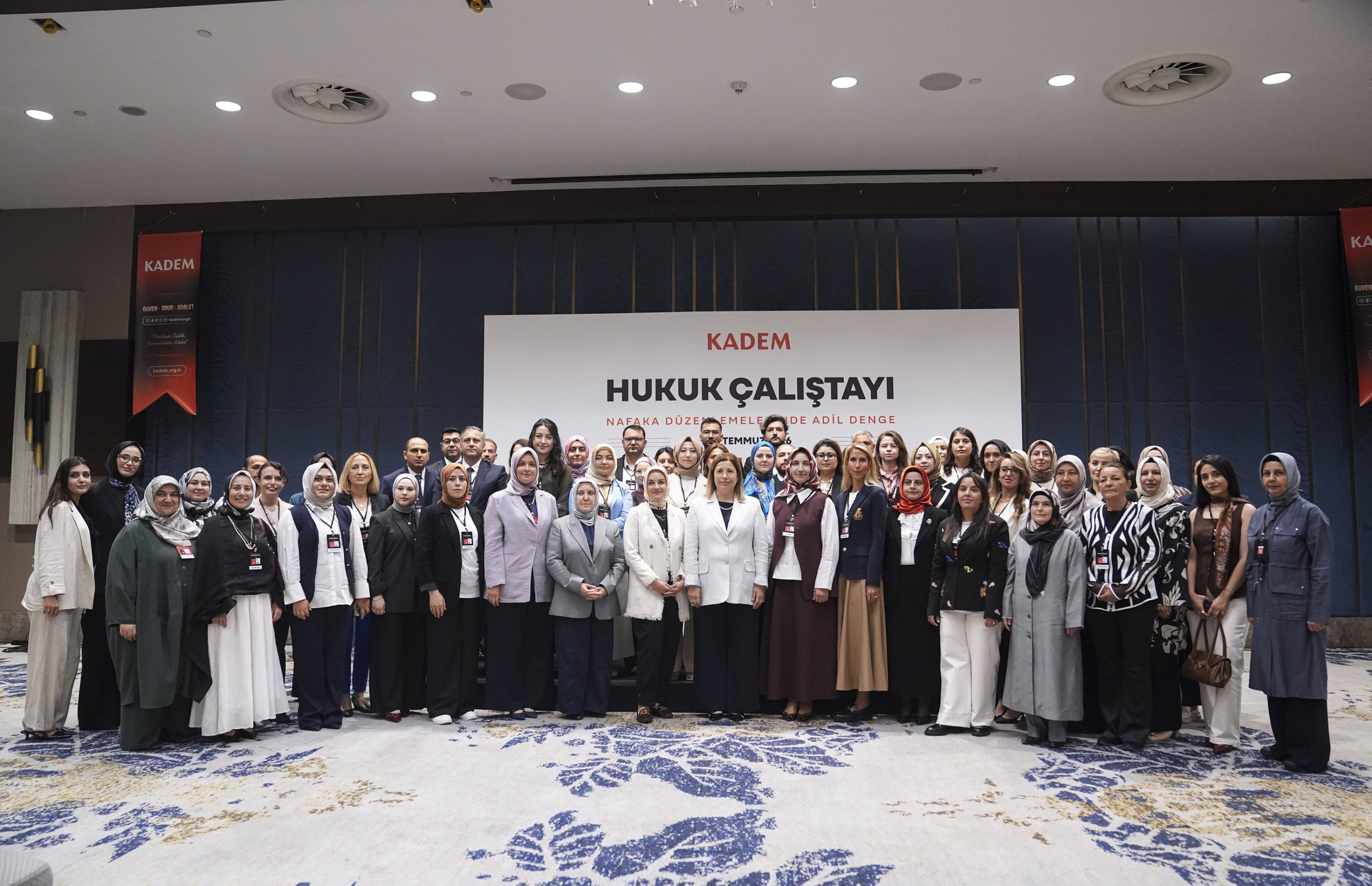
The Women and Democracy Foundation (KADEM) on Saturday convened judges, lawyers, academics, government officials and civil society representatives in Istanbul to discuss alimony reform, one of Türkiye's most contentious legal issues.
Introduced under the Turkish Civil Code that entered into force in 2002, the system has come under increasing scrutiny in recent years as policymakers, legal experts and civil society organizations seek to strike a balance between protecting economically vulnerable spouses after divorce and ensuring fairness for those required to pay alimony.
The debate entered a new phase in June 2026, when Türkiye's Constitutional Court annulled the legal provision allowing indefinite poverty alimony and gave Parliament nine months to establish a new legal framework.
KADEM's workshop, titled "A Fair Balance in Alimony Regulations," focused on finding solutions that protect the rights of financially vulnerable spouses while addressing concerns over the current alimony system.
Opening the event, KADEM Legal Board Chair Elif Şeker said any future reform should be guided by fairness and human dignity rather than one-sided approaches.
"Alimony regulations should neither victimize women nor place a disproportionate burden on the paying party," Şeker said. "A fair, predictable and sustainable system that considers genuine needs is essential."
She added that lasting reforms can only be achieved through cooperation among legal professionals, academics, judges and policymakers.
KADEM Chairperson Canan Sarı described alimony as more than a technical matter of family law, saying it directly affects people's lives, family relations and society's perception of justice.
The workshop came as Parliament prepares new legislation following the Constitutional Court's decision to strike down the provision allowing indefinite poverty alimony.
Sarı said the reform process should balance the concerns of all parties without weakening women's existing legal protections.
"We support reviewing the legal framework in line with changing social realities," she said. "However, protecting women's acquired rights and preventing new forms of victimization must remain a fundamental principle."
She emphasized that women who leave the workforce for years because of caregiving responsibilities or who lack financial independence after divorce continue to require legal protection.
At the same time, Sarı said changing economic conditions, longer life expectancy, different marriage durations and evolving employment opportunities for women make it necessary to reassess how the alimony system operates.
"We need to think about a legal framework that does not create new victims or lead to the loss of rights, while protecting women and children and resolving the problems encountered in practice," she said.
The daylong workshop featured discussions on international practices, Türkiye's current legal framework and recent court decisions. Participants examined the purpose of poverty alimony, the role of the social state and fixed-term alimony models, as well as the criteria for determining alimony amounts and challenges in enforcing court-ordered payments.
Recently, Justice Minister Akın Gürlek welcomed the Constitutional Court's ruling, describing it as an important step toward ensuring greater fairness and equity in family law. He said the government was already preparing a new legislative framework as part of a broader judicial reform package in response to years of public debate and concerns raised by legal professionals.
Gürlek said the planned legislation would protect the rights of both former spouses by maintaining support for those in genuine financial need while preventing what he described as unfair lifelong financial obligations. He added that the proposal would seek to balance social justice, family values and individual rights.
KADEM plans to compile the workshop's recommendations and findings into a report that will be shared with relevant public institutions, policymakers and legal professionals with the aim of contributing to future reforms of Türkiye's alimony legislation.